















































KI-Beratung Beta

Produktbild: Advances in Plant Microbiome and Sustainable Agriculture
Band 19

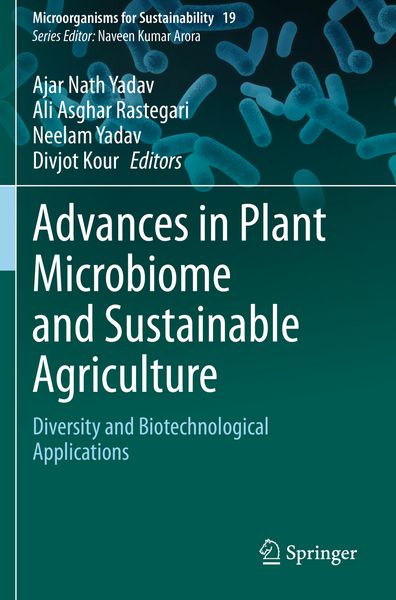
Advances in Plant Microbiome and Sustainable Agriculture Diversity and Biotechnological Applications

197,99 €

inkl. gesetzl. MwSt., Versandkostenfrei


Beschreibung

Microbes are ubiquitous in nature, and plant-microbe interactions are a key strategy for colonizing diverse habitats. The plant microbiome (epiphytic, endophytic and rhizospheric) plays an important role in plant growth and development and soil health. Further, rhizospheric soil is a valuable natural...

Beschreibung

Microbes are ubiquitous in nature, and plant-microbe interactions are a key strategy for colonizing diverse habitats. The plant microbiome (epiphytic, endophytic and rhizospheric) plays an important role in plant growth and development and soil health. Further, rhizospheric soil is a valuable natural resource, hosting hotspots of microbes, and is vital in the maintenance of global nutrient balance and ecosystem function. The term endophytic microbes refers to those microorganisms that colonize the interior the plants. The phyllosphere is a common niche for synergism between microbes and plants and includes the leaf surface. The diverse group of microbes are key components of soil-plant systems, and where they are engaged in an extensive network of interactions in the rhizosphere/endophytic/phyllospheric they have emerged as an important and promising tool for sustainable agriculture. Plant microbiomes help to directly or indirectly promote plant growth using plant growth promotingattributes, and could potentially be used as biofertilizers/bioinoculants in place of chemical fertilizers. This book allows readers to gain an understanding of microbial diversity associated with plant systems and their role in plant growth, and soil health. Offering an overview of the state of the art in plant microbiomes and their potential biotechnological applications in agriculture and allied sectors, it is a valuable resource for scientists, researchers and students in the field of microbiology, biotechnology, agriculture, molecular biology, environmental biology and related subjects.

Portrait


Dr. Ajar Nath Yadav
 is an Assistant Professor at the Department of Biotechnology, Eternal University, Baru Sahib, Himachal Pradesh, India. He has extensive teaching and research experience. He holds a doctorate degree in Microbial Biotechnology from the Indian Agricultural Research Institute, New Delhi and Birla Institute of Technology, Mesra, Ranchi, India,. Dr. Yadav has published 133 highly cited papers and has received 12 best paper presentation awards as well as an outstanding teacher award in 2018. He is a life member of the Association of Microbiologists in India, Indian Science Congress Council and National Academy of Sciences, India.


Dr. Ali Asghar Rastegari
 is currently working as an Assistant Professor at the Faculty of Biological Science, Department of Molecular and Cell Biochemistry, Falavarjan Branch, Islamic Azad University, Isfahan, I.R. Iran. He has extensive teaching and research experience. He holds a Ph.D. in Molecular Biophysics from the University of Science and Research, Tehran Branch, Iran. He has published 18 research papers and 12 abstracts at various conferences. He is a life member of the Iranian Society for Trace Elements Research (ISTER), The Biochemical Society of I.R. IRAN, and a member of the Society for Bioinformatics in Northern Europe (SocBiN).


Dr. Neelam Yadav
 is a Senior Researcher, currently working on microbial diversity from diverse sources and their biotechnological applications in agriculture and allied sectors. She holds a postgraduate degree from Veer Bahadur Singh Purvanchal University, Uttar Pradesh, India. Her research interests include probiotic microbes and beneficial microbiomes from diverse sources. She has published 35 papers in respected international and national journals. She is an editor/ reviewer for various international and national journals. She is a life member of the Microbiologists in India, Indian Science Congress Council, Indiaand National Academy of Sciences, India.


Ms. Divjot Kour
 is Project Fellow in the DEST-Project at the Department of Biotechnology, Akal College of Agriculture, Eternal University, Baru Sahib, Himachal Pradesh, India, and holds a doctorate degree in Biotechnology from the same university. She has published 25 research and review papers in various international and national journals as well as and book chapters. She has published 18 research communications at conferences/symposiums/workshops. She has received 5 best paper presentation awards, and has isolated over 500 microbes (bacteria and fungi) from diverse sources. She is a member of the National Academy of Sciences, India.


Produktdetails

Einband

Taschenbuch

Erscheinungsdatum

02.08.2021

Abbildungen

XXII, 296 p. 36 illus., 33 illus. in color.

Herausgeber Ajar Nath Yadav + weitere

Produktdetails

Einband

Taschenbuch

Erscheinungsdatum

02.08.2021

Abbildungen

XXII, 296 p. 36 illus., 33 illus. in color.

Herausgeber
Verlag Springer Singapore
Seitenzahl

296

Maße (L/B/H)

23,5/15,5/1,7 cm

Gewicht

555 g

Auflage

1. Auflage

Sprache

Englisch

ISBN

978-981-15-3210-8

Herstelleradresse

Springer-Verlag KG
Sachsenplatz 4-6
1201 Wien
AT

Email: ProductSafety@springernature.com

Ein neues Kapitel für Ihre Bücher

Ein neues Kapitel für Ihre Bücher

Schenken Sie Ihren alten Schätzen ein zweites Leben und erhalten Sie dafür eine Thalia Geschenkkarte.

Jetzt verkaufen
Jetzt verkaufen

Noch keine Bewertungen vorhanden

Verfassen Sie die erste Bewertung zu diesem Artikel

Helfen Sie anderen Kundinnen und Kunden durch Ihre Meinung.

Kundinnen und Kunden meinen

Bewertungen (0)

  • Produktbild: Advances in Plant Microbiome and Sustainable Agriculture
  • Chapter 1. Plant-Microbes Interaction: Current Developments and Future Challenges.- Chapter 2. Rhizospheric Microbiomes: Biodiversity, Current Advancement, and Potential Biotechnological Application.- Chapter 3. Endophytic Microbiomes: Biodiversity, Current Status, and Potential Agricultural Applications.- Chapter 4. Culturable Plant-Associated Endophytic Microbial Communities from Leguminous and Non-Leguminous Crops.- Chapter 5. Arbuscular Mycorrhizal Fungi: Abundance, Interaction with Plants and Potential Biological Application.- Chapter 6. Endophytic Microbiomes and their Plant Growth Promoting Attributes for Plant Health.- Chapter 7. Diversity and Biotechnological Potential of Culturable Rhizospheric Actinomicrobiota.- Chapter 8. Bacillus and Endomicrobiome: Biodiversity and potential Applications in Agriculture.- Chapter 9. Role of Microbes in Improving Plant Growth and Soil Health for Sustainable Agriculture.- Chapter 10. Biofertilizers and Biopesticides: Microbes for SustainableAgriculture.