















































KI-Beratung Beta

Gutscheinbedingungen

Gültig bis 30.11.2026 | Gültig für nicht preisgebundene fremdsprachige Bücher | Einzelne Artikel können ausgeschlossen sein | Online auf thalia.de und in der Thalia App einlösbar | Click & Collect nur mit Online-Zahlung (Paypal/Kreditkarte) vorab | Nicht kombinierbar mit anderen Gutscheinen oder Preisaktionen | Nur einmal pro Einkauf einlösbar | Gutschein wird auf max. 500€ Bestellwert angerechnet | Keine Barauszahlung | Nicht gültig für Versandkosten und Services

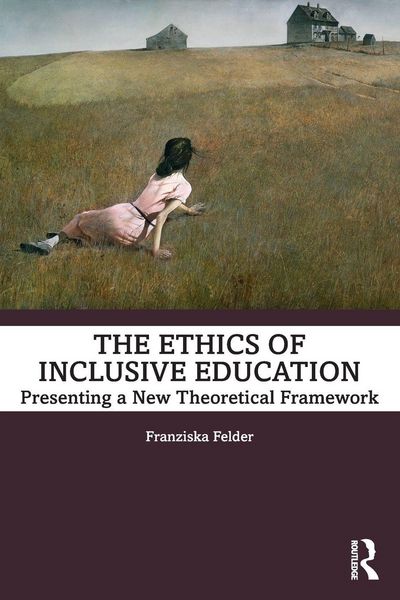
  • Produktbild: The Ethics of Inclusive Education
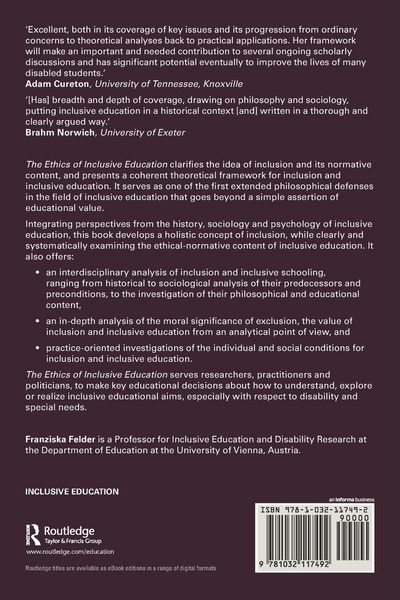
  • Produktbild: The Ethics of Inclusive Education

The Ethics of Inclusive Education Presenting a New Theoretical Framework

64,99 €

inkl. gesetzl. MwSt., Versandkostenfrei


Beschreibung

The Ethics of Inclusive Education clarifies the idea of inclusion and its normative content, and presents a coherent theoretical framework for inclusion and inclusive education. It serves as one of the first extended philosophical defenses in the field of inclusive education that goes beyond a simple...

Beschreibung

The Ethics of Inclusive Education clarifies the idea of inclusion and its normative content, and presents a coherent theoretical framework for inclusion and inclusive education. It serves as one of the first extended philosophical defenses in the field of inclusive education that goes beyond a simple assertion of educational value.

Integrating perspectives from the history, sociology and psychology of inclusive education, this book develops a holistic concept of inclusion, while clearly and systematically examining the ethical-normative content of inclusive education. It also offers:

    • an interdisciplinary analysis of inclusion and inclusive schooling, ranging from historical to sociological analysis of their predecessors and preconditions, to the investigation of their philosophical and educational content,
    • an in-depth analysis of the moral significance of exclusion, the value of inclusion and inclusive education from an analytical point of view, and
    • practice-oriented investigations of the individual and social conditions for inclusion and inclusive education.

The Ethics of Inclusive Education serves researchers, practitioners and politicians, to make key educational decisions about how to understand, explore or realize inclusive educational aims, especially with respect to disability and special needs.

Rezension

'Excellent, both in its coverage of key issues and its progression from ordinary concerns to theoretical analyses back to practical applications. Her framework will make an important and needed contribution to several ongoing scholarly discussions and has significant potential eventually to improve the lives of many disabled students.' - Adam Cureton, University of Tennessee, Knoxville

'[Has] breadth and depth of coverage, drawing on philosophy and sociology, putting inclusive education in a historical context [and] written in a thorough and clearly argued way.'- Brahm Norwich, University of Exeter

Produktdetails

Einband

Taschenbuch

Erscheinungsdatum

31.12.2021

Verlag Taylor & Francis
Seitenzahl

256

Produktdetails

Einband

Taschenbuch

Erscheinungsdatum

31.12.2021

Verlag Taylor & Francis
Seitenzahl

256

Maße (L/B/H)

23,4/15,6/1,5 cm

Gewicht

395 g

Sprache

Englisch

ISBN

978-1-03-211749-2

Herstelleradresse

Libri GmbH
Europaallee 1
36244 Bad Hersfeld
DE

Email: gpsr@libri.de

Ein neues Kapitel für Ihre Bücher

Ein neues Kapitel für Ihre Bücher

Schenken Sie Ihren alten Schätzen ein zweites Leben und erhalten Sie dafür eine Thalia Geschenkkarte.

Jetzt verkaufen
Jetzt verkaufen

Noch keine Bewertungen vorhanden

Verfassen Sie die erste Bewertung zu diesem Artikel

Helfen Sie anderen Kundinnen und Kunden durch Ihre Meinung.

Kundinnen und Kunden meinen

Bewertungen (0)

Die Leseprobe wird geladen.
  • Produktbild: The Ethics of Inclusive Education
  • Produktbild: The Ethics of Inclusive Education
    1. Introduction
    2. The Fenty Story
    3. The missing social dimension in the inclusion debates
    4. The structure of this book
  • The approach, scope and method
      1. The comparison with slavery
      2. The limits of rights-based approaches
      3. The methodological approach: nonideal theorizing

    1. A brief review of the history of (inclusive) education
      1. The status of disabled people before the eighteenth century
      2. The Age of Enlightenment
      3. Shifting backgrounds and the importance of compulsory education
      4. The rupture of the Second World War and the growing importance of human rights
      5. The emergence of the concept of 'inclusion'
      6. The difficult role of special education today

    2. The concept of inclusion
      1. A confusing plethora of definitions
      2. The strong focus on schools and the lack of a debate on exclusion
      3. Inclusion between description and evaluation
      4. Inclusion as a 'thick concept'
      5. Two camps and the problems associated with them
      6. Inclusion: the proposal
      7. The sociological perspective
      8. The elements of inclusion
      9. The ontogenesis of inclusion in evolutionary biology and individual psychology

    3. Disability
      1. Change of emphasis within the inclusion literature
      2. The 'deconstruction' model
      3. The 'barrier' model
      4. The difference made by disability
      5. The social-relational model

    4. Inclusive education
      1. The current inclusion discourse and its shortcomings
      2. The school as an organisation and institution
      3. School versus family
      4. The functions of school

    5. Values that matter
      1. Step 1: Exclusion
      2. Step 2: The ethical-normative significance of inclusion
      3. Step 3: Inclusion and education

    6. Conclusion: the transformation of education
      1. The shift towards inclusion
      2. Closing remarks

    7. References