















































KI-Beratung Beta

Gutscheinbedingungen

Gültig bis 30.11.2026 | Gültig für nicht preisgebundene fremdsprachige Bücher | Einzelne Artikel können ausgeschlossen sein | Online auf thalia.de und in der Thalia App einlösbar | Click & Collect nur mit Online-Zahlung (Paypal/Kreditkarte) vorab | Nicht kombinierbar mit anderen Gutscheinen oder Preisaktionen | Nur einmal pro Einkauf einlösbar | Gutschein wird auf max. 500€ Bestellwert angerechnet | Keine Barauszahlung | Nicht gültig für Versandkosten und Services

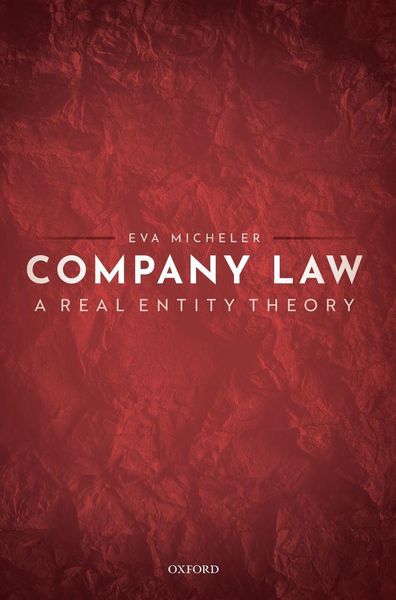
  • Produktbild: Company Law
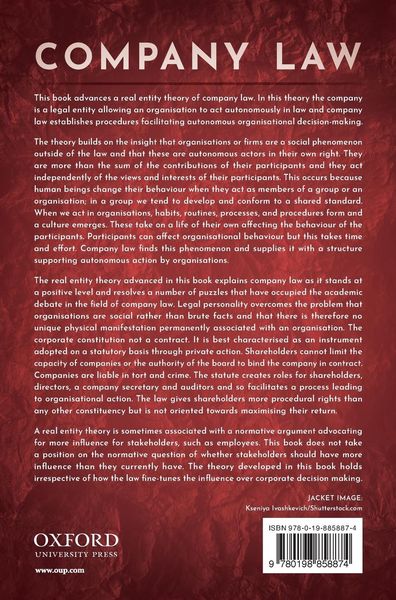
  • Produktbild: Company Law

Company Law A Real Entity Theory

135,99 €

inkl. gesetzl. MwSt., Versandkostenfrei


Beschreibung

This book advances a real entity theory of company law, in which the company is a legal entity which acts autonomously in law, and company law establishes procedures facilitating autonomous organisational decision-making. The theory builds on the insight that organisations or firms are a social phenomenon...

Beschreibung

This book advances a real entity theory of company law, in which the company is a legal entity which acts autonomously in law, and company law establishes procedures facilitating autonomous organisational decision-making. The theory builds on the insight that organisations or firms are a social phenomenon outside of the law and that these are autonomous actors in their own right. They are more than the sum of the contributions of their participants and they act independently of the views and interests of their participants. This occurs because human beings change their behaviour when they act as members of a group or an organisation; in a group we tend to develop and conform to a shared standard, and when we act in organisations habits, routines, processes, and procedures form and a culture emerges. These take on a life of their own affecting the behaviour of the participants. Participants can affect organisational behaviour but this takes time and effort. Company law finds this phenomenon and supplies it with a structure supporting autonomous action by organisations. The real entity theory advanced in this book explains company law as it stands at a positive level. Legal personality overcomes the problems that organisations are social rather than brute facts and that there is no unique physical manifestation permanently associated with an organisation. The corporate constitution is not a contract - it is best characterised as an instrument adopted on a statutory basis through private action. Shareholders cannot limit the capacity of companies or the authority of the board to bind the company in contract and companies are liable in tort and crime. The statute creates roles for shareholders, directors, a company secretary, and auditors and so facilitates a process leading to organisational action. The law also integrates the interests of creditors and stakeholders.

Produktdetails

Einband

Gebundene Ausgabe

Erscheinungsdatum

01.02.2022

Verlag Oxford Academic
Seitenzahl

320

Produktdetails

Einband

Gebundene Ausgabe

Erscheinungsdatum

01.02.2022

Verlag Oxford Academic
Seitenzahl

320

Maße (L/B/H)

25/17,5/2,2 cm

Gewicht

677 g

Sprache

Englisch

ISBN

978-0-19-885887-4

Herstelleradresse

Libri GmbH
Europaallee 1
36244 Bad Hersfeld
DE

Email: gpsr@libri.de

Ein neues Kapitel für Ihre Bücher

Ein neues Kapitel für Ihre Bücher

Schenken Sie Ihren alten Schätzen ein zweites Leben und erhalten Sie dafür eine Thalia Geschenkkarte.

Jetzt verkaufen
Jetzt verkaufen

Noch keine Bewertungen vorhanden

Verfassen Sie die erste Bewertung zu diesem Artikel

Helfen Sie anderen Kundinnen und Kunden durch Ihre Meinung.

Kundinnen und Kunden meinen

Bewertungen (0)

Die Leseprobe wird geladen.
  • Produktbild: Company Law
  • Produktbild: Company Law
    • 1.: Introduction
    • 2.: Theories of the company
    • 3.: Corporate personality
    • 4.: Corporate capacity
    • 5.: Limited liability
    • 6.: Corporate actions
    • 7.: The organizational framework
    • 8.: The role of the directors
    • 9.: The role of the shareholders
    • 10.: Enforcement
    • 11.: Public enforcement
    • 12.: Conclusions