















































KI-Beratung Beta

Gutscheinbedingungen

Gültig bis 11.11.2026 | Gültig für Spielzeug, Filme, Musik, Software, Games, Geschenke & Trends, Schreibwaren, Hörbücher und Hörbuch-Downloads (außer Abo & Shelfies), gebrauchte Bücher, nicht preisgebundene Bücher und Kalender | Einlösbar unter thalia.de und in der Thalia App | Click & Collect nur mit Online-Zahlung (Paypal/Kreditkarte) vorab | Einzelne Artikel können ausgeschlossen sein | Nicht kombinierbar mit anderen Gutscheinen oder Preisaktionen | Nur einmal pro Einkauf einlösbar | Gutschein wird auf max. 500€ Bestellwert angerechnet | Keine Barauszahlung | Digitale Hörbücher nur für Android  | Nicht gültig für preisgebundene Artikel (aufgrund der Buchpreisbindung sind Gutscheine nicht auf Bücher, eBooks, Presse einlösbar), tolino eReader & Zubehör, Abonnements & Flatrates, Geschenkkarten, Versandkosten und Services

  • Produktbild: Introduction to Orbital Perturbations
  • Produktbild: Introduction to Orbital Perturbations
Band 40

Introduction to Orbital Perturbations

Aus der Reihe Space Technology Library

82,99 €

inkl. gesetzl. MwSt., Versandkostenfrei


Beschreibung

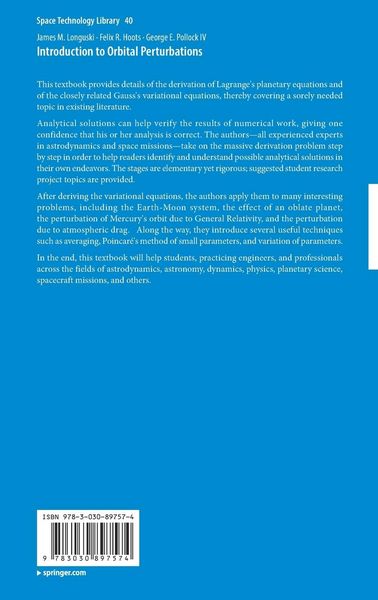
This textbook provides details of the derivation of Lagrange's planetary equations and of the closely related Gauss's variational equations, thereby covering a sorely needed topic in existing literature. 

Analytical solutions can help verify the results of numerical work, giving one confidence that his...

Beschreibung

This textbook provides details of the derivation of Lagrange's planetary equations and of the closely related Gauss's variational equations, thereby covering a sorely needed topic in existing literature. 

Analytical solutions can help verify the results of numerical work, giving one confidence that his or her analysis is correct. The authors—all experienced experts in astrodynamics and space missions—take on the massive derivation problem step by step in order to help readers identify and understand possible analytical solutions in their own endeavors. The stages are elementary yet rigorous; suggested student research project topics are provided.

After deriving the variational equations, the authors apply them to many interesting problems, including the Earth-Moon system, the effect of an oblate planet, the perturbation of Mercury's orbit due to General Relativity, and the perturbation due to atmospheric drag.  Along the way, they introduce several useful techniques such as averaging, Poincaré's method of small parameters, and variation of parameters. 

In the end, this textbook will help students, practicing engineers, and professionals across the fields of astrodynamics, astronomy, dynamics, physics, planetary science, spacecraft missions, and others.

“An extensive, detailed, yet still easy-to-follow presentation of the field of orbital perturbations.”

-        Prof. Hanspeter Schaub, Smead Aerospace Engineering Sciences Department, University of Colorado, Boulder

“This book, based on decades of teaching experience, is an invaluable resource for aerospace engineering students and practitioners alike who need an in-depth understanding of the equations they use.”

-        Dr. Jean Albert Kéchichian, The Aerospace Corporation, Retired

“Today we look at perturbations through the lens of the modern computer. But knowing the why and the how is equally important. In this well organized and thorough compendium of equations and derivations, the authors bring some of the relevant gems from the past back into the contemporary literature.”

-        Dr. David A Vallado, Senior Research Astrodynamicist, COMSPOC

“The book presentation is with the thoroughness that one always sees with these authors. Their theoretical development is followed with a set of Earth orbiting and Solar System examples demonstrating the application of Lagrange’s planetary equations for systems with both conservative and nonconservative forces, some of which are not seen in orbital mechanics books.”

-        Prof. Kyle T. Alfriend, University Distinguished Professor, Texas A&M University

Produktdetails

Einband

Gebundene Ausgabe

Erscheinungsdatum

03.03.2022

Abbildungen

XXII, 339 p. 38 illus., 12 illus. in color.

Verlag Springer

Produktdetails

Einband

Gebundene Ausgabe

Erscheinungsdatum

03.03.2022

Abbildungen

XXII, 339 p. 38 illus., 12 illus. in color.

Verlag Springer
Seitenzahl

339

Maße (L/B/H)

24,1/16/2,6 cm

Gewicht

659 g

Auflage

1st ed. 2022

Sprache

Englisch

ISBN

978-3-030-89757-4

Herstelleradresse

Springer-Verlag GmbH
Europaplatz 3
69115 Heidelberg
DE

Email: ProductSafety@springernature.com

Ein neues Kapitel für Ihre Bücher

Ein neues Kapitel für Ihre Bücher

Schenken Sie Ihren alten Schätzen ein zweites Leben und erhalten Sie dafür eine Thalia Geschenkkarte.

Jetzt verkaufen
Jetzt verkaufen

Noch keine Bewertungen vorhanden

Verfassen Sie die erste Bewertung zu diesem Artikel

Helfen Sie anderen Kundinnen und Kunden durch Ihre Meinung.

Kundinnen und Kunden meinen

Bewertungen (0)

  • Produktbild: Introduction to Orbital Perturbations
  • Produktbild: Introduction to Orbital Perturbations
  • Chapter 1. The n-Body Problem.- Chapter 2. General Perturbations .- Chapter 3. Evaluation of Lagrange’s Brackets .- Chapter 4. Lagrange’s Planetary Equations .- Chapter 5. Expansion of the Perturbation Function.- Chapter 6. The Earth-Moon System .- Chapter 7. Potential of an Oblate Spheroid.- Chapter 8. Effects of General Relativity.- Chapter 9. Perturbations due to Atmospheric Drag .- Chapter 10. Periodic Solutions in Nonlinear Oscillations.