















































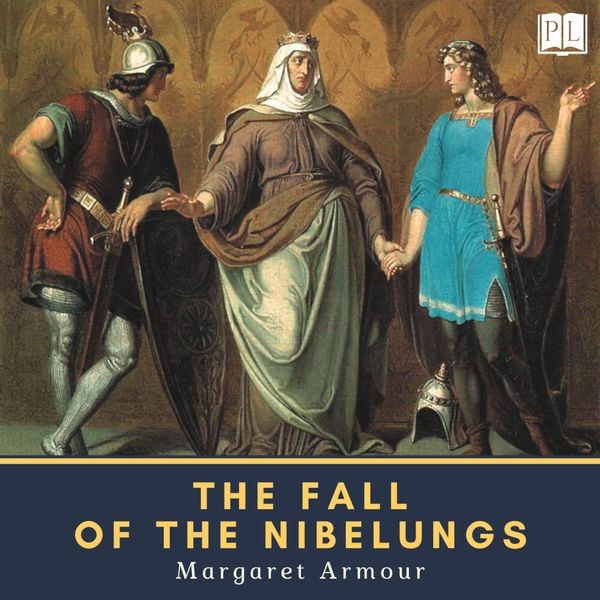

Margaret Armour
1. The Fall of the Nibelungs
The Fall of the Nibelungs
Gesprochen von
-
- Hardcover
- Taschenbuch
- Hörbuch ausgewählt
-
Form:Thalia Hörbuch-Abo
-
Sprache:Englisch
0,00 € *
inkl. gesetzl. MwSt.
* im Probemonat gratis danach 7,95 €/Monat
* im Probemonat gratis danach 7,95 €/Monat
Im Hörbuch-Abo laden
- Monatlich einen Titel wählen & behalten
- Jederzeit pausieren oder kündigen
- Weitere Hörbücher im Abo für max. 7,95 €
Beschreibung
Produktdetails
Family Sharing
Ja
Gesprochen von
Michael Wolf + weitereSpieldauer
7 Stunden und 31 Minuten
Abo-Fähigkeit
Ja
Erscheinungsdatum
01.09.2021
Hörtyp
Lesung
Fassung
ungekürzt
Medium
MP3
Anzahl Dateien
41
Verlag
Parolita LibroSprache
Englisch
EAN
4066338276728
The Nibelungenlied (Middle High German: Der Nibelunge liet or Der Nibelunge nôt), translated as The Fall of the Nibelungs, is an epic poem written around 1200 in Middle High German. Its anonymous poet was likely from the region of Passau. The Nibelungenlied is based on an oral tradition of Germanic heroic legend that has some of its origin in historic events and individuals of the 5th and 6th centuries and that spread throughout almost all of Germanic-speaking Europe. Parallels to the German poem from Scandinavia are found especially in the heroic lays of the Poetic Edda and in the Völsunga saga.
The poem is split into two parts: in the first part, Siegfried comes to Worms to acquire the hand of the Burgundian princess Kriemhild from her brother King Gunther. Gunther agrees to let Siegfried marry Kriemhild if Siegfried helps Gunther acquire the warrior-queen Brünhild as his wife. Siegfried does this and marries Kriemhild; however Brünhild and Kriemhild become rivals, leading eventually to Siegfried's murder by the Burgundian vassal Hagen with Gunther's involvement. In the second part, the widow Kriemhild is married to Etzel, king of the Huns. She later invites her brother and his court to visit Etzel's kingdom intending to kill Hagen. Her revenge results in the death of all the Burgundians who came to Etzel's court as well as the destruction of Etzel's kingdom and the death of Kriemhild herself.
The Nibelungenlied was the first heroic epic put into writing in Germany, helping to found a larger genre of written heroic poetry. The poem's tragedy appears to have bothered its medieval audience, and very early on a sequel was written, the Nibelungenklage, which made the tragedy less final. The poem was forgotten after around 1500, but was rediscovered in 1755. Dubbed the "German Iliad", the Nibelungenlied began a new life as the German national epic. The poem was appropriated for nationalist purposes and was heavily used in anti-democratic, reactionary, and Nazi propaganda before and during the Second World War. Its legacy today is most visible in Richard Wagner's operatic cycle Der Ring des Nibelungen, which, however, is mostly based on Old Norse sources. In 2009, the three main manuscripts of the Nibelungenlied were inscribed in UNESCO's Memory of the World Register in recognition of their historical significance. It has been called "one of the most impressive, and certainly the most powerful, of the German epics of the Middle Ages".
Noch keine Bewertungen vorhanden
Verfassen Sie die erste Bewertung zu diesem Artikel
Helfen Sie anderen Kundinnen und Kunden durch Ihre Meinung.
Kurze Frage zu unserer Seite
Vielen Dank für Ihr Feedback
Wir nutzen Ihr Feedback, um unsere Produktseiten zu verbessern. Bitte haben Sie Verständnis, dass wir Ihnen keine Rückmeldung geben können. Falls Sie Kontakt mit uns aufnehmen möchten, können Sie sich aber gerne an unseren Kund*innenservice wenden.
zum Kundenservice