















































KI-Beratung Beta

Produktbild: Biological Consequences of Plate Tectonics

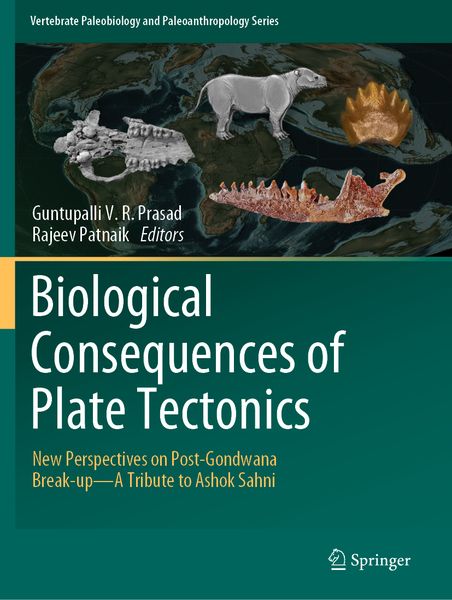
Biological Consequences of Plate Tectonics New Perspectives on Post-Gondwana Break-up–A Tribute to Ashok Sahni

115,99 €

inkl. gesetzl. MwSt., Versandkostenfrei


Beschreibung

Produktdetails

Einband

Taschenbuch

Erscheinungsdatum

24.11.2021

Abbildungen

XLVII, 432 p. 152 illus., 63 illus. in color.

Herausgeber

Guntupalli V.R. Prasad + weitere

Verlag

Springer

Seitenzahl

432

Maße (L/B/H)

27,9/21/2,6 cm

Gewicht

1159 g

Sprache

Englisch

ISBN

978-3-030-49755-2

Beschreibung

Rezension

“This volume is a welcome contribution to a palaeontologist’s library. It provides a good synthesis on the current state of palaeontology in India, offering new insights to old questions. The opus is well illustrated and the text makes for easy reading. The authors are commended for their valuable contributions. … the volume is highly recommended for those wanting to delve into eastern Gondwana during the late Mesozoic and Paleogene.” (Fernando Abdala, Ameghiniana, Vol. 58 (3), 2021)

Portrait


Dr. Guntupalli V.R. Prasad received his Ph.D. from Panjab University, Chandigarh in the year 1986. He is a former Professor at the University of Jammu and Indian Institute of Science Education & Research (Kolkata). He is presently a Professor in the Department of Geology, University of Delhi, India. Prof. Prasad has more than 34 years teaching experience at Graduate and undergraduate level. A vertebrate paleontologist by training, he has been working for the last three and half decades on the evolution of Mesozoic vertebrates of India using form and function of vertebrate fossils.  Prasad’s research has focused primarily on biodiversity changes during the time span of Deccan volcanism

which brought many new species of fishes, amphibians, reptiles and mammals to light and also provided paleontological constraints on the age of initiation and duration of Deccan Volcanism. His research has also thrown light on faunal dispersals and biogeographic linkages between the physically isolated and rapidly northward drifting Indian plate and other landmasses. Dr. Prasad’s findings of diverse mammalian groups from the Jurassic and Cretaceous of India have firmly placed India on Mesozoic mammalian map of the world. Author of more than 100 scientific papers published in leading journals in his field of specialization as well as high impact journals like Nature, Science, Nature Communications, and Proceedings of National Academy of Sciences, Prof. Prasad received Shanti Swarup Bhatnagar Prize, India’s highest science award, for his outstanding contributions in the field Vertebrate Paleontology.  Other recognitions received by Prof. Prasad include J.C.Bose National Fellowship, National Geoscience Award, L. Rama Rao Birth Centenary Award, and National Award in Geosciences & Technology. He has been honored with the Fellowship of the Indian National Science Academy (FNA), Indian Academy of Sciences (FASc.), National Academy of Sciences (FNASc.), and Academy of Sciences for the Developing World (TWAS).

Dr. Rajeev Patnaik did his Ph.D at Panjab University, Chandigarh and Post-Doctoral fellowships at Paläontologische 
Museum
 München, Ludwig-Maximilians-Universität, Germany and Institut des Sciences de l'Evolution de Montpellier, France. By integrating aspects of stable isotopes, microwear, morphometrics, cladistics and enamel microstructure, he has been able to contribute towards the understanding of diet and evolution of some Indian fossil mammals such as murine rodents and primate/hominins. He has also worked on the impact of climate change, palaeoecology, palaeobiogeography and geological context of  Indian Neogene mammals with particular focus on the hominoids. He and his colleagues discovered new hominoids/primates, ostrich-like eggshells, new pelican and darter fossils from the Siwaliks (subhimalaya); Late Cretaceous rice from central India; and Miocene mammals from the Baripada Beds of Odisha. He has published over 100 research papers in reputed journals and has served as Associate Editor for scholarly journals such as Journal of Human Evolution, Current Science and Journal of the Geological Society of India. In 2016 he was awarded the prestigious National Geoscience Award by the Honourable President of India and in 2019 was elected as a Fellow of the Indian Academy of Sciences.


Produktdetails

Einband

Taschenbuch

Erscheinungsdatum

24.11.2021

Abbildungen

XLVII, 432 p. 152 illus., 63 illus. in color.

Herausgeber

Verlag

Springer

Seitenzahl

432

Maße (L/B/H)

27,9/21/2,6 cm

Gewicht

1159 g

Sprache

Englisch

ISBN

978-3-030-49755-2

Herstelleradresse

Springer-Verlag KG
Sachsenplatz 4-6
1201 Wien
AT

Email: ProductSafety@springernature.com

Ein neues Kapitel für Ihre Bücher

Ein neues Kapitel für Ihre Bücher

Schenken Sie Ihren alten Schätzen ein zweites Leben und erhalten Sie dafür eine Thalia Geschenkkarte.

Jetzt verkaufen
Jetzt verkaufen

Noch keine Bewertungen vorhanden

Verfassen Sie die erste Bewertung zu diesem Artikel

Helfen Sie anderen Kundinnen und Kunden durch Ihre Meinung.

Kundinnen und Kunden meinen

Bewertungen (0)

Weitere Artikel finden Sie in

  • Produktbild: Biological Consequences of Plate Tectonics

  • 1 The Age of Dinosaurs in India.- 2 New fossil evidence for the presence of ornithischian and saurischian remains in the Jurassic of India.- 3 A minuscule tribosphenic mammal from an Early Cretaceous palaeopolar location of Australia.- 4 The largest toothed monotreme (new genus new species) from the early Cretaceous of Lightning Ridge, NSW, Australia.- 5 Molluscan fauna from the Upper Cretaceous Deccan intertrappean beds of central India: palaeobiogeographic significance.- 6 Chelonian Pelomedusoides remains from the Late Cretaceous of southwestern India: Systematics and palaeobiogeographical implications.- 7 The global affinities of Cretaceous and Paleogene Indian faunas: complex biogeography of a subcontinental raft.- 8 Anuran lissamphibians and squamate reptiles from Upper Cretaceous (Maastrichtian) Deccan intertrappean sites from central India, with a review of a lissamphibians and squamates diversity in the northward drifting Indian plate.- 9 Plant-derived biomarker signatures during the northward flight of India.- 10 Isolated Africa: Review and a palaeobiological scenario.- 11 Biogeography of Eocene mammals, continental and marine, in relation to the tectonic history of Indo-Pakistan.- 12 New specimens of
    Frugivastodon
     (Mammalia: Apatotheria) from the early Eocene of India confirm its apatemyid status and elucidate dispersal of Apatemyidae.- 13
    Indohyus
    , endemic radiation of raoellid artiodactyls after continental collision in the Eocene of India and Pakistan.- 14 Do the size variation(s) within non-volant mammals and the known evolutionary relationship(s) of the large-sized perissodactyls from the Cambay Shale (western India) point to a short-lived corridor for secular migration(s) between India and Eurasia prior to  ~54.5 Ma?.- 15 Parallel evolution of giant Anseriformes (Aves) in the Cenzoic of Laurasia, South America and Australia.- 16 Depositional biofacies of the Middle Eocene Subathu Formation of the Himalayan foreland basinin the context of India-Asia collision tectonics.- 17 Role of plate tectonics and climate in the geographical distribution of Indian late Cretaceous-early Palaeogene angiosperm flora.- 18 Post-collisional climate of India and implications for Neogene-Quaternary mammalian dispersals.- 19 Murine diversification in the Indian cradle: Coalescence of the
    Erimanthos-Apodus-Mus
     groups before 11 Ma.