















































KI-Beratung Beta

Gutscheinbedingungen

Gültig bis 30.11.2026 | Gültig für nicht preisgebundene fremdsprachige Bücher | Einzelne Artikel können ausgeschlossen sein | Online auf thalia.de und in der Thalia App einlösbar | Click & Collect nur mit Online-Zahlung (Paypal/Kreditkarte) vorab | Nicht kombinierbar mit anderen Gutscheinen oder Preisaktionen | Nur einmal pro Einkauf einlösbar | Gutschein wird auf max. 500€ Bestellwert angerechnet | Keine Barauszahlung | Nicht gültig für Versandkosten und Services

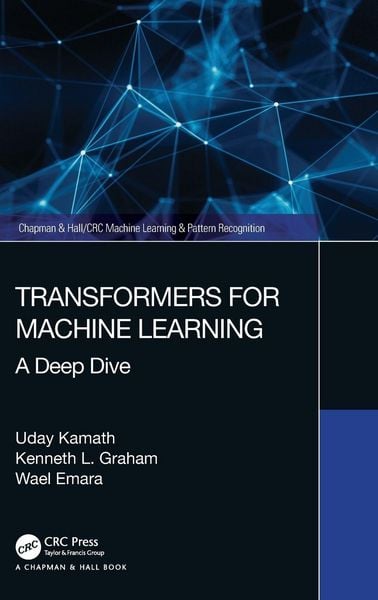
Produktbild: Transformers for Machine Learning

Transformers for Machine Learning A Deep Dive

183,99 €

inkl. gesetzl. MwSt., Versandkostenfrei


Beschreibung

Transformers are becoming a core part of many neural network architectures, employed in a wide range of applications such as NLP, Speech Recognition, Time Series, and Computer Vision. Transformers have gone through many adaptations and alterations, resulting in newer techniques and methods. Transformers...

Beschreibung

Transformers are becoming a core part of many neural network architectures, employed in a wide range of applications such as NLP, Speech Recognition, Time Series, and Computer Vision. Transformers have gone through many adaptations and alterations, resulting in newer techniques and methods. Transformers for Machine Learning: A Deep Dive is the first comprehensive book on transformers.

Key Features:

  • A comprehensive reference book for detailed explanations for every algorithm and techniques related to the transformers.
  • 60+ transformer architectures covered in a comprehensive manner.
  • A book for understanding how to apply the transformer techniques in speech, text, time series, and computer vision.
  • Practical tips and tricks for each architecture and how to use it in the real world.
  • Hands-on case studies and code snippets for theory and practical real-world analysis using the tools and libraries, all ready to run in Google Colab.

The theoretical explanations of the state-of-the-art transformer architectures will appeal to postgraduate students and researchers (academic and industry) as it will provide a single entry point with deep discussions of a quickly moving field. The practical hands-on case studies and code will appeal to undergraduate students, practitioners, and professionals as it allows for quick experimentation and lowers the barrier to entry into the field.

Produktdetails

Einband

Gebundene Ausgabe

Erscheinungsdatum

25.05.2022

Abbildungen

75 SW-Abb., 13 Farbabb., 75 SW-Zeichn., 13 Farbzeichn., 11 Tabellen

Verlag Taylor & Francis

Produktdetails

Einband

Gebundene Ausgabe

Erscheinungsdatum

25.05.2022

Abbildungen

75 SW-Abb., 13 Farbabb., 75 SW-Zeichn., 13 Farbzeichn., 11 Tabellen

Verlag Taylor & Francis
Seitenzahl

284

Maße (L/B/H)

24/16,1/2 cm

Gewicht

543 g

Sprache

Englisch

ISBN

978-0-367-77165-2

Herstelleradresse

Libri GmbH
Europaallee 1
36244 Bad Hersfeld
DE

Email: gpsr@libri.de

Ein neues Kapitel für Ihre Bücher

Ein neues Kapitel für Ihre Bücher

Schenken Sie Ihren alten Schätzen ein zweites Leben und erhalten Sie dafür eine Thalia Geschenkkarte.

Jetzt verkaufen
Jetzt verkaufen

Noch keine Bewertungen vorhanden

Verfassen Sie die erste Bewertung zu diesem Artikel

Helfen Sie anderen Kundinnen und Kunden durch Ihre Meinung.

Kundinnen und Kunden meinen

Bewertungen (0)

Die Leseprobe wird geladen.
  • Produktbild: Transformers for Machine Learning
  • List of Figures
    List of Tables
    Author Bios
    Foreword
    Preface
    Contributors

    Deep Learning and Transformers: An Introduction
    1.1 DEEP LEARNING: A HISTORIC PERSPECTIVE
    1.2 TRANSFORMERS AND TAXONOMY
    1.2.1 Modified Transformer Architecture
    1.2.1.1 Transformer block changes
    1.2.1.2 Transformer sublayer changes
    1.2.2 Pretraining Methods and Applications
    1.3 RESOURCES
    1.3.1 Libraries and Implementations
    1.3.2 Books
    1.3.3 Courses, Tutorials, and Lectures
    1.3.4 Case Studies and Details

    Transformers: Basics and Introduction
    2.1 ENCODER-DECODER ARCHITECTURE
    2.2 SEQUENCE TO SEQUENCE
    2.2.1 Encoder
    2.2.2 Decoder
    2.2.3 Training
    2.2.4 Issues with RNN-based Encoder Decoder
    2.3 ATTENTION MECHANISM
    2.3.1 Background
    2.3.2 Types of Score-Based Attention
    2.3.2.1 Dot Product (multiplicative)
    2.3.2.2 Scaled Dot Product or multiplicative
    2.3.2.3 Linear, MLP, or additive
    2.3.3 Attention-based Sequence to Sequence
    2.4 TRANSFORMER
    2.4.1 Source and Target Representation
    2.4.1.1 Word Embedding
    2.4.1.2 Positional Encoding
    2.4.2 Attention Layers
    2.4.2.1 Self-Attention
    2.4.2.2 Multi-Head Attention
    2.4.2.3 Masked Multi-Head Attention
    2.4.2.4 Encoder-Decoder Multi-Head Attention
    2.4.3 Residuals and Layer Normalization
    2.4.4 Position-wise Feed-Forward Networks
    2.4.5 Encoder
    2.4.6 Decoder
    2.5 CASE STUDY: MACHINE TRANSLATION
    2.5.1 Goal
    2.5.2 Data, Tools and Libraries
    2.5.3 Experiments, Results and Analysis
    2.5.3.1 Exploratory Data Analysis
    2.5.3.2 Attention
    2.5.3.3 Transformer
    2.5.3.4 Results and Analysis
    2.5.3.5 Explainability

    Bidirectional Encoder Representations from Transformers (BERT)
    3.1 BERT
    3.1.1 Architecture
    3.1.2 Pre-training
    3.1.3 Fine-tuning
    3.2 BERT VARIANTS
    3.2.1 RoBERTa
    3.3 APPLICATIONS
    3.3.1 TaBERT
    3.3.2 BERTopic
    3.4 BERT INSIGHTS
    3.4.1 BERT Sentence Representation
    3.4.2 BERTology
    3.5 CASE STUDY: TOPIC MODELING WITH TRANSFORMERS
    3.5.1 Goal
    3.5.2 Data, Tools, and Libraries
    3.5.2.1 Data
    3.5.2.2 Compute embeddings
    3.5.3 Experiments, Results, and Analysis
    3.5.3.1 Building Topics
    3.5.3.2 Topic size distribution
    3.5.3.3 Visualization of topics
    3.5.3.4 Content of topics
    3.6 CASE STUDY: FINE-TUNING BERT
    3.6.1 Goal
    3.6.2 Data, Tools and Libraries
    3.6.3 Experiments, Results and Analysis

    Multilingual Transformer Architectures
    4.1 MULTILINGUAL TRANSFORMER ARCHITECTURES
    4.1.1 Basic Multilingual Transformer
    4.1.2 Single-Encoder Multilingual NLU
    4.1.2.1 mBERT
    4.1.2.2 XLM
    4.1.2.3 XLM-RoBERTa
    4.1.2.4 ALM
    4.1.2.5 Unicoder
    4.1.2.6 INFOXL
    4.1.2.7 AMBER
    4.1.2.8 ERNIE-M
    4.1.2.9 HITCL
    4.1.3 Dual-Encoder Multilingual NLU
    4.1.3.1 LaBSE
    4.1.3.2 mUSE
    4.1.4 Multilingual NLG
    4.2 MULTILINGUAL DATA
    4.2.1 Pre-training Data
    4.2.2 Multilingual Benchmarks
    4.2.2.1 Classification
    4.2.2.2 Structure Prediction
    4.2.2.3 Question Answering
    4.2.2.4 Semantic Retrieval
    4.3 MULTILINGUAL TRANSFER LEARNING INSIGHTS
    4.3.1 Zero-shot Cross-lingua