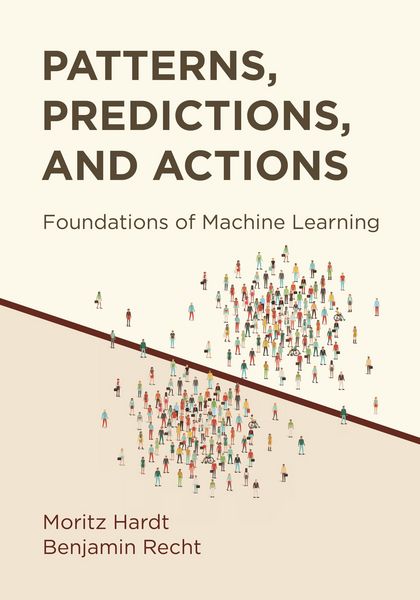
Produktbild: Patterns, Predictions, and Actions - Foundations of Machine Learning

Patterns, Predictions, and Actions - Foundations of Machine Learning Foundations of Machine Learning

72,99 €

inkl. gesetzl. MwSt., Versandkostenfrei


Beschreibung

Produktdetails

Einband

Gebundene Ausgabe

Erscheinungsdatum

18.10.2022

Abbildungen

41 b/w illus. 10 tables.

Verlag

University Presses

Seitenzahl

320

Maße (L/B/H)

25,8/17,9/2,5 cm

Gewicht

730 g

Sprache

Englisch

ISBN

978-0-691-23373-4

Beschreibung

Produktdetails

Einband

Gebundene Ausgabe

Erscheinungsdatum

18.10.2022

Abbildungen

41 b/w illus. 10 tables.

Verlag

University Presses

Seitenzahl

320

Maße (L/B/H)

25,8/17,9/2,5 cm

Gewicht

730 g

Sprache

Englisch

ISBN

978-0-691-23373-4

Herstelleradresse

Libri GmbH
Europaallee 1
36244 Bad Hersfeld
DE

Email: gpsr@libri.de

Ein neues Kapitel für Ihre Bücher

Ein neues Kapitel für Ihre Bücher

Schenken Sie Ihren alten Schätzen ein zweites Leben und erhalten dafür eine Thalia Geschenkkarte.

Jetzt verkaufen
Jetzt verkaufen

Noch keine Bewertungen vorhanden

Verfassen Sie die erste Bewertung zu diesem Artikel

Helfen Sie anderen Kundinnen und Kunden durch Ihre Meinung.

Kundinnen und Kunden meinen

Bewertungen (0)

  • Produktbild: Patterns, Predictions, and Actions - Foundations of Machine Learning
    • List of Figures
    • List of Tables
    • Preface
    • Acknowledgments
    • 1 Introduction
      • Ambitions of the twentieth century
      • Pattern classi¿cation
      • Prediction and action
      • Chapter notes
    • 2 Fundamentals of Prediction
      • Modeling knowledge
      • Prediction via optimization
      • Types of errors and successes
      • The Neyman-Pearson Lemma
      • Decisions that discriminate
      • Chapter notes
    • 3 Supervised Learning
      • Sample versus population
      • Supervised learning
      • A ¿rst learning algorithm: The perceptron
      • Connection to empirical risk minimization
      • Formal guarantees for the perceptron
      • Chapter notes
    • 4 Representations and Features
      • Measurement
      • Quantization
      • Template matching
      • Summarization and histograms
      • Nonlinear predictors
      • Chapter notes
    • 5 Optimization
      • Optimization basics
      • Gradient descent
      • Applications to empirical risk minimization
      • Insights from quadratic functions
      • Stochastic gradient descent
      • Analysis of the stochastic gradient method
      • Implicit convexity
      • Regularization
      • Squared loss methods and other optimization tools
      • Chapter notes
    • 6 Generalization
      • Generalization gap
      • Overparameterization: Empirical phenomena
      • Theories of generalization
      • Algorithmic stability
      • Model complexity and uniform convergence
      • Generalization from algorithms
      • Looking ahead
      • Chapter notes
    • 7 Deep Learning
      • Deep models and feature representation
      • Optimization of deep nets
      • Vanishing gradients
      • Generalization in deep learning
      • Chapter notes
    • 8 Datasets
      • The scienti¿c basis of machine learning benchmarks
      • A tour of datasets in di¿erent domains
      • Longevity of benchmarks
      • Harms associated with data
      • Toward better data practices
      • Limits of data and prediction
      • Chapter notes
    • 9 Causality
      • The limitations of observation
      • Causal models
      • Causal graphs
      • Interventions and causal e¿ects
      • Confounding
      • Experimentation, randomization, potential outcomes
      • Counterfactuals
      • Chapter notes
    • 10 Causal Inference in Practice
      • Design and inference
      • The observational basics: Adjustment and controls
      • Reductions to model ¿tting
      • Quasi-experiments
      • Limitations of causal inference in practice
      • Chapter notes
    • 11 Sequential Decision Making and Dynamic Programming
      • From predictions to actions
      • Dynamical systems
      • Optimal sequential decision making
      • Dynamic programming
      • Computation
      • Partial observation and the separation heuristic
      • Chapter notes
    • 12 Reinforcement Learning
      • Exploration-exploitation trade-ös: Regret and PAC-error
      • Unknown models and approximate dynamic programming
      • Certainty equivalence is often optimal
      • The limits of learning in feedback loops
      • Chapter notes
    • 13 Epilogue
      • Beyond pattern classi¿cation?
    • 14 Mathematical Background
      • Common notation
      • Multivariable calculus and linear algebra
      • Probability
      • Estimation
    • Bibliography
    • Index