















































KI-Beratung Beta

Gutscheinbedingungen

Gültig bis 30.11.2026 | Gültig für nicht preisgebundene fremdsprachige Bücher | Einzelne Artikel können ausgeschlossen sein | Online auf thalia.de und in der Thalia App einlösbar | Click & Collect nur mit Online-Zahlung (Paypal/Kreditkarte) vorab | Nicht kombinierbar mit anderen Gutscheinen oder Preisaktionen | Nur einmal pro Einkauf einlösbar | Gutschein wird auf max. 500€ Bestellwert angerechnet | Keine Barauszahlung | Nicht gültig für Versandkosten und Services

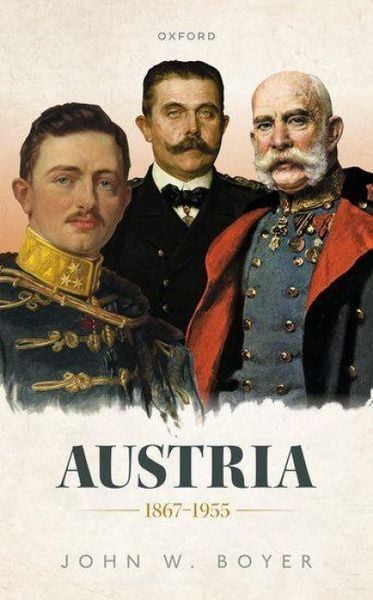
Produktbild: Austria 1867-1955

Austria 1867-1955

56,99 €

inkl. gesetzl. MwSt., Versandkostenfrei


Beschreibung

Austria 1867-1955 connects the political history of German-speaking provinces of the Habsburg Empire before 1914 (Vienna and the Alpine Lands) with the history of the Austrian Republic that emerged in 1918. John W. Boyer presents the case of modern Austria as a fascinating example of democratic nation-building....

Beschreibung

Austria 1867-1955 connects the political history of German-speaking provinces of the Habsburg Empire before 1914 (Vienna and the Alpine Lands) with the history of the Austrian Republic that emerged in 1918. John W. Boyer presents the case of modern Austria as a fascinating example of democratic nation-building. The construction of an Austrian political nation began in 1867 under Habsburg Imperial auspices, with the German-speaking bourgeois Liberals defining the concept of a political people (Volk) and giving that Volk a constitution and a liberal legal and parliamentary order to protect their rights against the Crown. The decades that followed saw the administrative and judicial institutions of the Liberal state solidified, but in the 1880s and 1890s the membership of the Volk exploded to include new social and economic strata from the lower bourgeoisie and the working classes. Ethnic identity was not the final structuring principle of everyday politics, as it was in the Czech lands. Rather social class, occupational culture, and religion became more prominent variables in the sortition of civic interests, exemplified by the emergence of two great ideological parties, Christian Socialism and Social Democracy in Vienna in the 1890s. The war crisis of 1914/1918 exploded the Empire, with the Crown self-destructing in the face of military defeat, chronic domestic unrest, and bitter national partisanship. But this crisis also accelerated the emergence of new structures of democratic self-governance in the German-speaking Austrian lands, enshrined in the republican Constitution of 1920. Initial attempts to make this new project of democratic nation-building work failed in the 1920s and 1930s, culminating in the catastrophe of the 1938 Nazi occupation. After 1945 the surviving legatees of the Revolution of 1918 reassembled under the four-power Allied occupation, which fashioned a shared political culture which proved sufficiently flexible to accommodate intense partisanship, resulting, by the 1970s, in a successful republican system, organized under the aegis of elite democratic and corporatist negotiating structures, in which the Catholics and Socialists learned to embrace the skills of collective but shared self-governance.

Produktdetails

Einband

Gebundene Ausgabe

Erscheinungsdatum

13.10.2022

Verlag Oxford University Press
Seitenzahl

1131

Produktdetails

Einband

Gebundene Ausgabe

Erscheinungsdatum

13.10.2022

Verlag Oxford University Press
Seitenzahl

1131

Maße (L/B/H)

24/16,5/5,8 cm

Gewicht

1416 g

Sprache

Englisch

ISBN

978-0-19-822129-6

Herstelleradresse

Libri GmbH
Europaallee 1
36244 Bad Hersfeld
DE

Email: gpsr@libri.de

Ein neues Kapitel für Ihre Bücher

Ein neues Kapitel für Ihre Bücher

Schenken Sie Ihren alten Schätzen ein zweites Leben und erhalten Sie dafür eine Thalia Geschenkkarte.

Jetzt verkaufen
Jetzt verkaufen

Noch keine Bewertungen vorhanden

Verfassen Sie die erste Bewertung zu diesem Artikel

Helfen Sie anderen Kundinnen und Kunden durch Ihre Meinung.

Kundinnen und Kunden meinen

Bewertungen (0)

Die Leseprobe wird geladen.
  • Produktbild: Austria 1867-1955
    • Introduction: The Terms of Austrian History
    • 1: The Settlement of 1867 and the Creation of a Liberal Constitutional Order
    • 2: Liberalism Ascendant: State Politics and Administration in the Austrian Lands, 1867-1879
    • 3: The Era of the Iron Ring: State Consolidation and the Emergence of Civic Radicalism, 1879-1895
    • 4: Two Decades of Constitutional Upheaval, 1895-1914
    • 5: Late Imperial Society and Culture: The Crucible of Vienna
    • 6: The Monarchy in the First World War
    • 7: The Revolution of 1918-1919
    • 8: The First Austrian Republic, 1920-1932
    • 9: The Catholic Dictatorship and the Nazi Occupation, 1933-1945
    • 10: The Reconstruction of a Republican Political System, 1945-1955
    • Conclusion: The Construction of a New Political Culture, 1955-1983