















































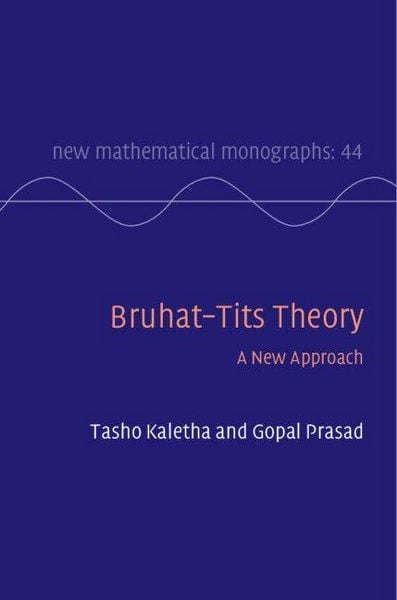
Bruhat-Tits Theory A New Approach
202,99 €
inkl. gesetzl. MwSt.,
Beschreibung
Produktdetails
Einband
Gebundene Ausgabe
Erscheinungsdatum
26.01.2023
Abbildungen
Worked examples or Exercises
Verlag
Cambridge AcademicSeitenzahl
750
Maße (L/B/H)
22,9/15,2/4,6 cm
Gewicht
1261 g
Sprache
Englisch
ISBN
978-1-108-83196-3
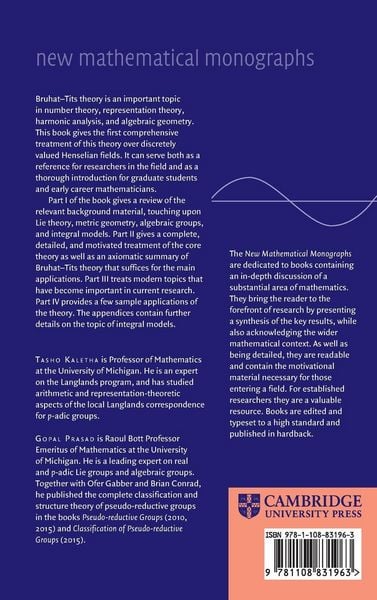
Bruhat-Tits theory is an important topic in number theory, representation theory, harmonic analysis, and algebraic geometry. This book gives the first comprehensive treatment of this theory over discretely valued Henselian fields. It can serve both as a reference for researchers in the field and as a thorough introduction for graduate students and early career mathematicians. Part I of the book gives a review of the relevant background material, touching upon Lie theory, metric geometry, algebraic groups, and integral models. Part II gives a complete, detailed, and motivated treatment of the core theory as well as an axiomatic summary of Bruhat-Tits theory that suffices for the main applications. Part III treats modern topics that have become important in current research. Part IV provides a few sample applications of the theory. The appendices contain further details on the topic of integral models, including a detailed study of integral models.
Ein neues Kapitel für Ihre Bücher
Ein neues Kapitel für Ihre Bücher
Schenken Sie Ihren alten Schätzen ein zweites Leben und erhalten Sie dafür eine Thalia Geschenkkarte.
Noch keine Bewertungen vorhanden
Verfassen Sie die erste Bewertung zu diesem Artikel
Helfen Sie anderen Kundinnen und Kunden durch Ihre Meinung.
Kurze Frage zu unserer Seite
Vielen Dank für Ihr Feedback
Wir nutzen Ihr Feedback, um unsere Produktseiten zu verbessern. Bitte haben Sie Verständnis, dass wir Ihnen keine Rückmeldung geben können. Falls Sie Kontakt mit uns aufnehmen möchten, können Sie sich aber gerne an unseren Kund*innenservice wenden.
zum Kundenservice