KI-Beratung Beta

  • Produktbild: Laser Inter-Satellite Links Technology
  • Produktbild: Laser Inter-Satellite Links Technology

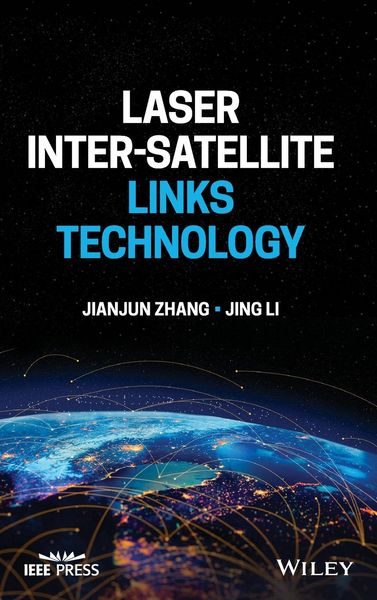
Laser Inter-Satellite Links Technology

149,99 €

inkl. gesetzl. MwSt., Versandkostenfrei


Beschreibung

LASER INTER-SATELLITE LINKS TECHNOLOGY

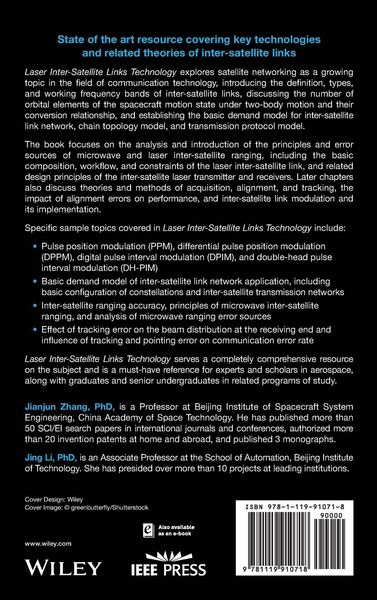
State of the art resource covering key technologies and related theories of inter-satellite links

Laser Inter-Satellite Links Technology explores satellite networking as a growing topic in the field of communication technology, introducing the definition, types,...

Beschreibung

LASER INTER-SATELLITE LINKS TECHNOLOGY

State of the art resource covering key technologies and related theories of inter-satellite links

Laser Inter-Satellite Links Technology explores satellite networking as a growing topic in the field of communication technology, introducing the definition, types, and working frequency bands of inter-satellite links, discussing the number of orbital elements of the spacecraft motion state under two-body motion and their conversion relationship, and establishing the basic demand model for inter-satellite link network, chain topology model, and transmission protocol model.

The book focuses on the analysis and introduction of the principles and error sources of microwave and laser inter-satellite ranging, including the basic composition, workflow, and constraints of the laser inter-satellite link, and related design principles of the inter-satellite laser transmitter and receivers. Later chapters also discuss theories and methods of acquisition, alignment, and tracking, the impact of alignment errors on performance, and inter-satellite link modulation and its implementation.

Specific sample topics covered in Laser Inter-Satellite Links Technology include:

  • Pulse position modulation (PPM), differential pulse position modulation (DPPM), digital pulse interval modulation (DPIM), and double-head pulse interval modulation (DH-PIM)
  • Basic demand model of inter-satellite link network application, including basic configuration of constellations and inter-satellite transmission networks
  • Inter-satellite ranging accuracy, principles of microwave inter-satellite ranging, and analysis of microwave ranging error sources
  • Effect of tracking error on the beam distribution at the receiving end and influence of tracking and pointing error on communication error rate

Laser Inter-Satellite Links Technology serves a completely comprehensive resource on the subject and is a must-have reference for experts and scholars in aerospace, along with graduates and senior undergraduates in related programs of study.

Produktdetails

Einband

Gebundene Ausgabe

Erscheinungsdatum

05.01.2023

Verlag John Wiley & Sons Inc
Seitenzahl

208

Produktdetails

Einband

Gebundene Ausgabe

Erscheinungsdatum

05.01.2023

Verlag John Wiley & Sons Inc
Seitenzahl

208

Maße (L/B/H)

23,5/15,7/1,6 cm

Gewicht

456 g

Auflage

1. Auflage

Sprache

Englisch

ISBN

978-1-119-91071-8

Herstelleradresse

Libri GmbH
Europaallee 1
36244 Bad Hersfeld
DE

Email: gpsr@libri.de

Ein neues Kapitel für Ihre Bücher

Ein neues Kapitel für Ihre Bücher

Schenken Sie Ihren alten Schätzen ein zweites Leben und erhalten Sie dafür eine Thalia Geschenkkarte.

Jetzt verkaufen
Jetzt verkaufen

Noch keine Bewertungen vorhanden

Verfassen Sie die erste Bewertung zu diesem Artikel

Helfen Sie anderen Kundinnen und Kunden durch Ihre Meinung.

Kundinnen und Kunden meinen

Bewertungen (0)

Die Leseprobe wird geladen.
  • Produktbild: Laser Inter-Satellite Links Technology
  • Produktbild: Laser Inter-Satellite Links Technology
  • Author Biography xi

    Preface xiii

    1 Introduction 1

    1.1 Connotation of Inter-Satellite Link 1

    1.2 Types of Inter-Satellite Links 5

    1.3 Band Selection of Inter-Satellite Link 7

    1.3.1 Selection of Link Band 7

    1.3.2 Selection of Working Frequency 8

    1.4 Microwave Inter-Satellite Link 10

    1.4.1 Frequency Selection 10

    1.4.2 Microwave Inter-Satellite Link Data Transmission System 12

    1.5 Laser Inter-Satellite Link 14

    1.5.1 Technical Characteristics of Laser Inter-Satellite Link 14

    1.5.2 Future Requirements for Laser Inter-Satellite Links 15

    1.5.3 Development Trend of Laser Inter-Satellite Links 16

    1.5.3.1 The Development of Laser Communication Technology from Technical Verification to Engineering Application Stage 16

    1.5.3.2 The Communication Rate Develops from Low Code Rate to High Code Rate 16

    1.5.3.3 Deep Space Will Become an Important Place for Laser Communication Applications 17

    1.5.3.4 Combined Use of Laser Communication and Laser Ranging 18

    1.5.3.5 Integration and Miniaturization of Laser Communication Terminals 18

    1.5.3.6 Networking of Laser Inter-Satellite Links 19

    References 19

    2 Development History of Laser Inter-Satellite Link 21

    2.1 Development Stage of Laser Inter-Satellite Link 21

    2.2 Development Status of Laser Inter-Satellite Link Technology in Various Countries 22

    2.2.1 United States 22

    2.2.1.1 Lunar Laser Communication Demonstration 26

    2.2.1.2 Relay Laser Communication Demonstration (LCRD) (GEO-Ground) 27

    2.2.1.3 Integrated Laser Communication Terminal (ILLUMA-T) 30

    2.2.1.4 Deep Space Optical Communication (DSOC) Project Terminal Reaches Level 6 Technology Maturity 30

    2.2.1.5 Ultra-Light and Small Communication Terminal (OSCD) 33

    2.2.2 Europe 33

    2.2.2.1 Semiconductor Laser Inter-Satellite Link Experiment 33

    2.2.2.2 European Data Relay Satellite System Project (EDRS) 34

    2.2.2.3 Micro Laser Communication Terminal (OPTEL-mi) 35

    2.2.3 Japan 36

    2.2.3.1 Japanese Data Relay Satellite 37

    2.2.3.2 High-Speed Communication of Advanced Laser Instruments 38

    2.2.3.3 Miniaturized Laser Communication Terminal (SOTA) 39

    2.3 Experience and Inspiration 39

    2.3.1 Strengthen the Research on New Laser Inter-Satellite Links and Enhance the Innovation of Technology Research and Development 40

    2.3.2 Strengthen the On-Orbit Verification of New Technologies and Improve the Engineering Level of New Technologies 40

    2.3.3 Simplify the Product Spectrum and Promote the Construction of Product Pipelines 40

    2.3.4 Respond to Commercial Product Demand and Reduce Product Cost 41

    2.3.5 The Key Development Direction of Low-Orbit Laser Inter-Satellite Link Engineering Demonstration Work 41

    References 41

    3 Spacecraft Orbits and Application 45

    3.1 Overview 45

    3.2 Kepler's Laws 46

    3.2.1 Kepler's First Law 46

    3.2.2 Kepler's Second Law 47

    3.2.3 Kepler's Third Law 47

    3.3 Two-Body Motion and Orbital Parameters 47

    3.3.1 Two-Body Movement 47

    3.3.2 Track Parameters 49

    3.4 Near-Earth Space Orbits and Applications 53

    3.4.1 Track Type 54

    3.4.2 Sub-Satellite Point Trajectory 54

    3.4.3 Several Commonly Used Tracks 55

    3.4.3.1 Sun-Synchronous Orbit 55

    3.4.3.2 Return to the Track 56

    3.4.3.3 Geosynchronous Orbit 57

    3.4.3.4 Freeze the Track 58

    3.4.4 Overlay 59

    3.4.4.1 Coverage Area 59

    3.4.4.2 Minimum Observation Angle 60

    References 61

    4 Basic Model of Constellation Inter-Satellite Link Networking 63

    4.1 Application Requirements of Satellite Navigation Inter-Satellite Links 63

    4.1.1 Constellation Precise Orbit Determination and Time Synchronization 64

    4.1.2 Data Commun