KI-Beratung Beta

Gutscheinbedingungen

Gültig bis 30.11.2026 | Gültig für nicht preisgebundene fremdsprachige Bücher | Einzelne Artikel können ausgeschlossen sein | Online auf thalia.de und in der Thalia App einlösbar | Click & Collect nur mit Online-Zahlung (Paypal/Kreditkarte) vorab | Nicht kombinierbar mit anderen Gutscheinen oder Preisaktionen | Nur einmal pro Einkauf einlösbar | Gutschein wird auf max. 500€ Bestellwert angerechnet | Keine Barauszahlung | Nicht gültig für Versandkosten und Services

  • Produktbild: Free Trade Agreements and Global Labour Governance
  • Produktbild: Free Trade Agreements and Global Labour Governance

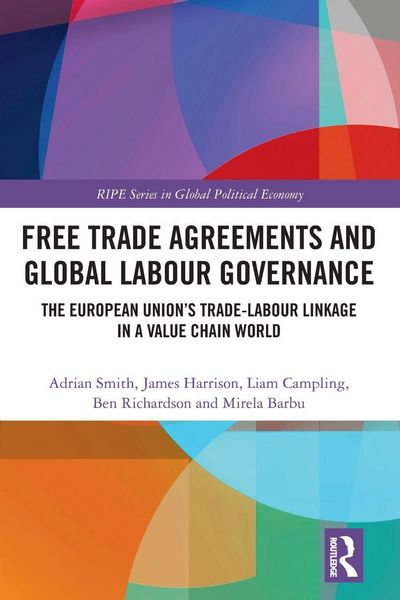
Free Trade Agreements and Global Labour Governance The European Union's Trade-Labour Linkage in a Value Chain World

72,99 €

inkl. gesetzl. MwSt., Versandkostenfrei


Beschreibung

Exploring the contentious relationship between trade and labour, this book looks at the impact of the EU's 'new generation' free trade agreements on workers. Drawing upon extensive original research, including over 200 interviews with key actors across the EU and its trading partners, it considers the...

Beschreibung

Exploring the contentious relationship between trade and labour, this book looks at the impact of the EU's 'new generation' free trade agreements on workers. Drawing upon extensive original research, including over 200 interviews with key actors across the EU and its trading partners, it considers the effectiveness of the trade-labour linkage in an era of global value chains.

The EU believes trade can work for all, claiming that labour provisions in its free trade agreements ensure that economic growth and high labour standards go hand-in-hand. Yet whether these actually make a difference to workers is strongly contested. This book explains why labour provisions have been profoundly limited in the EU's agreements with the CARIFORUM group, South Korea and Moldova. It also shows how the provisions were mismatched with the most pressing workplace concerns in the key export industries of sugar, automobiles and clothing, and how these concerns were exacerbated by the agreements' commercial provisions. This pioneering approach to studying the trade-labour linkage provides insights into key debates on the role of civil society in trade governance, the relationship between public and private labour regulation, and the progressive possibilities for trade policy in the twenty-first century.

This book will appeal to research scholars, post-graduate students, trade policy practitioners, policy researchers allied to labour movements, and informed activists.

Rezension

"The debates on the relationship between trade liberalisation and labour standards have long been hostage to ideological posturing, on both sides of the fence. This book at last looks at the evidence. It is theoretically robust, but it also provides an empirically informed assessment. It shall be impossible to ignore in the next stages of this vital discussion." - Olivier De Schutter, UN Special Rapporteur on Extreme Poverty and Human Rights, Office of the UN High Commissioner for Human Rights, Switzerland

"The authors have produced an extraordinary book. Their empirical contributions to the evaluation of labour standards provisions in major EU FTAs and their innovative methodological approach to the broader study of the trade-labour linkage represent a crucial intervention in the debate about global labour governance. Their account of the lived experience of workers clearly reveals the mismatch between the core labour standards which lie at the heart of the EU approach on the one hand, and the most pressing concerns which face workers on the other. By doing so, they invite us to think of the limits of the trade-labour linkage without abandoning the potential for progressive alliances, within and beyond the confines of trade law and policy." - Professor Donatella Alessandrini, Kent Law School, UK

"This book puts the EU's commitment to promoting labour standards via trade agreements to the test. Combining rich empirical data and real industry examples with astute political reasoning, it substantiates the fundamental problems with the EU's approach. In doing so, it presents trade as a re-organisation of labour on a massive scale, and invites us to re-establish the trade-labour linkage as a building block for global labour governance." - Yorgos Altintzis, Economic & Social Policy Department, International Trade Union Confederation, Belgium

"Does including labor standards in free trade agreements (FTAs) improve conditions for workers on the ground? Going beyond conventional discussions of the 'trade-labour linkage', this much needed book offers an incisive answer by examining EU FTAs in the context of the broader labour regime. The authors' comparative analysis concludes not only that labour provisions fail in most cases to meaningfully promote core labor standards, but that they are ill-equipped to protect the well-being of workers negatively affected by trade. Those who take up the authors' call for developing a new approach to labour governance will find this text essential reading for such an effort." - Dr Jennifer Bair, Sociology Department, University of Virginia, USA

"There is a longstanding debate on whether globalization hollows out or strengthens labour rights protection. The link between the two is recognized in current approaches towards trade policy. Trade agreements increasingly include provisions on labour rights protection. The European Union is a leader in this respect. Whether such an approach makes any difference is subject to a heated debate. This outstanding interdisciplinary book makes a huge contribution to the current debates. It combines legal and political-economic analysis to unravel the complexities involved in effectively achieving labour rights protection through trade policy. It contains a wealth of new information and insights. I strongly recommend this book to researchers and policy-makers alike. It is a must-read for anyone interested in labour rights protection in a globalized economy." - Dr Axel Marx, Leuven Centre for Global Governance Studies, University of Leuven, Belgium


Produktdetails

Einband

Taschenbuch

Erscheinungsdatum

29.04.2022

Abbildungen

8 SW-Zeichn., 13 Tabellen

Verlag Taylor & Francis

Produktdetails

Einband

Taschenbuch

Erscheinungsdatum

29.04.2022

Abbildungen

8 SW-Zeichn., 13 Tabellen

Verlag Taylor & Francis
Seitenzahl

206

Maße (L/B/H)

23,4/15,6/1,1 cm

Gewicht

322 g

Sprache

Englisch

ISBN

978-0-367-54230-6

Herstelleradresse

Produktsicherheitsverantwortliche/r
Europaallee 1
36244 Bad Hersfeld
DE

Email: gpsr@libri.de

Ein neues Kapitel für Ihre Bücher

Ein neues Kapitel für Ihre Bücher

Schenken Sie Ihren alten Schätzen ein zweites Leben und erhalten Sie dafür eine Thalia Geschenkkarte.

Jetzt verkaufen
Jetzt verkaufen

Noch keine Bewertungen vorhanden

Verfassen Sie die erste Bewertung zu diesem Artikel

Helfen Sie anderen Kundinnen und Kunden durch Ihre Meinung.

Kundinnen und Kunden meinen

Bewertungen (0)

Die Leseprobe wird geladen.
  • Produktbild: Free Trade Agreements and Global Labour Governance
  • Produktbild: Free Trade Agreements and Global Labour Governance
  • Chapter 1: The Trade-Labour Linkage Revisited Chapter 2: Historicising the Trade-Labour Linkage Chapter 3: Assessing the Effectiveness of the Trade-Labour Linkage Chapter 4: The EU-CARIFORUM Economic Partnership Agreement and the Guyanese Sugar Industry Chapter 5: The EU-Korea Free Trade Agreement and the Korean Automotive Industry Chapter 6: The EU-Moldova Association Agreement and the Moldovan Clothing Industry Chapter 7: The EU Trade-Labour Linkage: Present Limits, Future Possibilities