• Produktbild: Embedded Computer Systems: Architectures, Modeling, and Simulation
  • Produktbild: Embedded Computer Systems: Architectures, Modeling, and Simulation
Band 13227

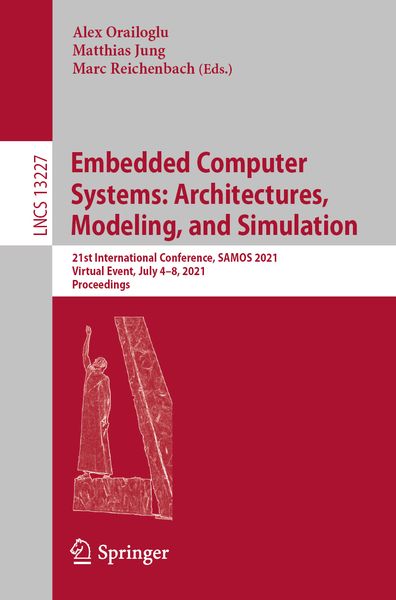
Embedded Computer Systems: Architectures, Modeling, and Simulation 21st International Conference, SAMOS 2021, Virtual Event, July 4–8, 2021, Proceedings

74,99 €

inkl. gesetzl. MwSt., Versandkostenfrei


Beschreibung

Produktdetails

Einband

Taschenbuch

Erscheinungsdatum

27.04.2022

Abbildungen

XVII, 525 p. 205 illus., 168 illus. in color.

Herausgeber

Alex Orailoglu + weitere

Verlag

Springer

Seitenzahl

525

Maße (L/B/H)

23,5/15,5/3 cm

Gewicht

814 g

Auflage

1st ed. 2022

Sprache

Englisch

ISBN

978-3-031-04579-0

Beschreibung

Produktdetails

Einband

Taschenbuch

Erscheinungsdatum

27.04.2022

Abbildungen

XVII, 525 p. 205 illus., 168 illus. in color.

Herausgeber

Verlag

Springer

Seitenzahl

525

Maße (L/B/H)

23,5/15,5/3 cm

Gewicht

814 g

Auflage

1st ed. 2022

Sprache

Englisch

ISBN

978-3-031-04579-0

Herstelleradresse

Springer-Verlag KG
Sachsenplatz 4-6
1201 Wien
AT

Email: ProductSafety@springernature.com

Ein neues Kapitel für Ihre Bücher

Ein neues Kapitel für Ihre Bücher

Schenken Sie Ihren alten Schätzen ein zweites Leben und erhalten dafür eine Thalia Geschenkkarte.

Jetzt verkaufen
Jetzt verkaufen

Noch keine Bewertungen vorhanden

Verfassen Sie die erste Bewertung zu diesem Artikel

Helfen Sie anderen Kundinnen und Kunden durch Ihre Meinung.

Kundinnen und Kunden meinen

Bewertungen (0)

  • Produktbild: Embedded Computer Systems: Architectures, Modeling, and Simulation
  • Produktbild: Embedded Computer Systems: Architectures, Modeling, and Simulation
  • Simulation and Design Space Exploration.- Accurate LLVM IR to Binary CFGs Mapping for Simulation of Optimized Embedded Software.- RVfplib: A Fast and Compact Open-Source Floating-Point Emulation Libbrary for Tiny RISC-V Processors.-Exploiting Similarity in Evolutionary Product Design for Improved Design Space Exploration.- Automatic Search-Space Compression in System-Level Design Space Exploration using Deep Generative Models.- The 3Cs - Cache, Cluster and Cloud.-A Case for Partial Co-Allocation Constraints in Compressed Caches.- PoCL-R: A Scalable Low Latency Distributed OpenCL Runtime.- An analytical model for loop tiling transformation.-Interference-aware workload placement for improving latency distribution of converged HPC/Big Data cloud infrastructures.- Energy-efficient and High-throughput CNN Inference on Embedded CPUsGPUs MPSoCs.- Evaluating System Identification Methods for Predicting Thermal Dissipation of Heterogeneous SoCs.- Embeddings of Task Mappings to Multicore Systems.- Novel CPU Architectures and Applications.- RT-LIFE: Portable RISC-V Interface for Real-Time Lightweight Security Enforcement.- Phase-Aware CPU Workload Forecasting.- WhiskEras 2.0: Fast and Accurate Whisker Tracking In Rodents.- Periodic Scheduling of Cyclo-Static Dataflow Models.- Efficient Operator Sharing Modulo Scheduling for Sum-Product Network Inference on FPGAs.- A Framework for Fixed Priority Periodic Scheduling Synthesis from Synchronous Data-flow Graphs.- Special Session on Innovative Architectures and tools for Security.- Hard edges: Hardware-based Control-Flow Integrity for Embedded Devices.- Deep Learning Techniques for Side-Channel Analysis on AES Datasets Collected from Hardware and Software Platforms.- Special Session on Reports from research projects – Digital services and platforms: Application areas automotive industry, energy, agriculture, healthcare and industry 4.0 workshop.- EDRA: A Hardware-assisted Decoupled Access/Execute Framework on the Digital Market.- Modeling the Scalability of the EuroExa Reconfigurable Accelerators - Preliminary Results? .-The Known Unknowns: Discovering Trade-offs Between Heterogeneous Code Changes.- Towards efficient HW acceleration in edge-cloud infrastructures: The SERRANO approach.- Cross-domain Modelling of Verification and Validation Workflows in the Large Scale European Research Project VALU3S.- Special Session on Next Generation Computing