















































KI-Beratung Beta

Gutscheinbedingungen

Gültig bis 11.11.2026 | Gültig für Spielzeug, Filme, Musik, Software, Games, Geschenke & Trends, Schreibwaren, Hörbücher und Hörbuch-Downloads (außer Abo & Shelfies), gebrauchte Bücher, nicht preisgebundene Bücher und Kalender | Einlösbar unter thalia.de und in der Thalia App | Click & Collect nur mit Online-Zahlung (Paypal/Kreditkarte) vorab | Einzelne Artikel können ausgeschlossen sein | Nicht kombinierbar mit anderen Gutscheinen oder Preisaktionen | Nur einmal pro Einkauf einlösbar | Gutschein wird auf max. 500€ Bestellwert angerechnet | Keine Barauszahlung | Digitale Hörbücher nur für Android  | Nicht gültig für preisgebundene Artikel (aufgrund der Buchpreisbindung sind Gutscheine nicht auf Bücher, eBooks, Presse einlösbar), tolino eReader & Zubehör, Abonnements & Flatrates, Geschenkkarten, Versandkosten und Services

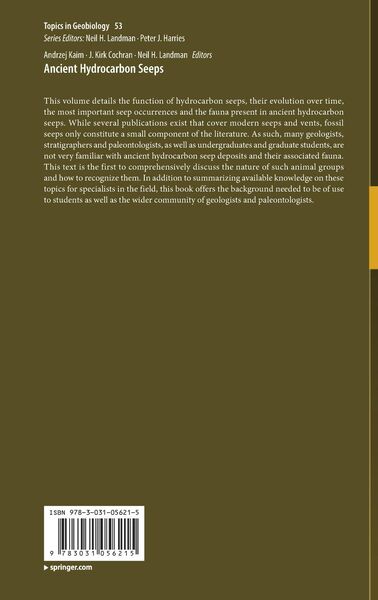
  • Produktbild: Ancient Hydrocarbon Seeps
  • Produktbild: Ancient Hydrocarbon Seeps
Band 53 - 12%

Ancient Hydrocarbon Seeps

Aus der Reihe Topics in Geobiology
12% sparen

139,99 € UVP 160,49 €

inkl. gesetzl. MwSt., Versandkostenfrei


Beschreibung

Produktdetails

Einband

Gebundene Ausgabe

Erscheinungsdatum

31.08.2022

Abbildungen

XVII, 687 p. 129 illus., 71 illus. in color.

Herausgeber

Andrzej Kaim + weitere

Verlag

Springer

Seitenzahl

687

Maße (L/B/H)

24,1/16/4,4 cm

Gewicht

1163 g

Auflage

1st ed. 2022

Sprache

Englisch

ISBN

978-3-031-05621-5

Beschreibung

Portrait

Dr. Andrzej Kaim is Associate Professor at the Institute of Paleobiology, Polish Academy of Sciences, Poland. His research interests include the early ontogeny and phylogeny of mollusks, in particular gastropods, and the recovery and paleodiversity patterns of benthic marine faunas after the Permian-Triassic extinction event. In the last 25 years he has worked on the origin and evolution of chemoautotrophic communities studying material from a variety of ancient hydrocarbon seeps, ranging from the Arctic to the Antarctic and the U.S. Pacific Coast to Japan. 


Dr. J. Kirk Cochran is Distinguished Professor Emeritus at the School of Marine and Atmospheric Sciences, Stony Brook University, New York. His research interests include the use of isotope systems as tracers for processes in modern aquatic environments, including the coastal and open ocean, lakes, rivers and groundwater. He has also used isotope geochemistry as a tool for deciphering ancient marine environments, including the Western Interior Seaway of North America and hydrocarbon seeps.   


Dr. Neil H. Landman is Curator Emeritus in the Division of Paleontology at the American Museum of Natural History, New York. His interests include the evolution of externally shelled cephalopods, especially ammonites, the Cretaceous/Paleogene boundary event, and the Upper Cretaceous Western Interior of North America. In the last 20 years, he has worked together with colleagues and students to study ancient hydrocarbon seeps.

Produktdetails

Einband

Gebundene Ausgabe

Erscheinungsdatum

31.08.2022

Abbildungen

XVII, 687 p. 129 illus., 71 illus. in color.

Herausgeber

Verlag

Springer

Seitenzahl

687

Maße (L/B/H)

24,1/16/4,4 cm

Gewicht

1163 g

Auflage

1st ed. 2022

Sprache

Englisch

ISBN

978-3-031-05621-5

Herstelleradresse

Springer-Verlag GmbH
Europaplatz 3
69115 Heidelberg
DE

Email: ProductSafety@springernature.com

Ein neues Kapitel für Ihre Bücher

Ein neues Kapitel für Ihre Bücher

Schenken Sie Ihren alten Schätzen ein zweites Leben und erhalten Sie dafür eine Thalia Geschenkkarte.

Jetzt verkaufen
Jetzt verkaufen

Noch keine Bewertungen vorhanden

Verfassen Sie die erste Bewertung zu diesem Artikel

Helfen Sie anderen Kundinnen und Kunden durch Ihre Meinung.

Kundinnen und Kunden meinen

Bewertungen (0)

  • Produktbild: Ancient Hydrocarbon Seeps
  • Produktbild: Ancient Hydrocarbon Seeps
  • Chapter 1-Introduction.- Chapter 2-Biogeochemical processes.- Chapter 3-Taphonomy and diagenesis of seeps.- Chapter 4-Biota.- Chapter 5-Seeps around the world.- Chapter 6-Seeps as ecosystems.- Chapter 7-Evolution of seep communities over geological time.- Chapter 8-Cognate communities.