















































KI-Beratung Beta

Gutscheinbedingungen

Gültig bis 11.11.2026 | Gültig für Spielzeug, Filme, Musik, Software, Games, Geschenke & Trends, Schreibwaren, Hörbücher und Hörbuch-Downloads (außer Abo & Shelfies), gebrauchte Bücher, nicht preisgebundene Bücher und Kalender | Einlösbar unter thalia.de und in der Thalia App | Click & Collect nur mit Online-Zahlung (Paypal/Kreditkarte) vorab | Einzelne Artikel können ausgeschlossen sein | Nicht kombinierbar mit anderen Gutscheinen oder Preisaktionen | Nur einmal pro Einkauf einlösbar | Gutschein wird auf max. 500€ Bestellwert angerechnet | Keine Barauszahlung | Digitale Hörbücher nur für Android  | Nicht gültig für preisgebundene Artikel (aufgrund der Buchpreisbindung sind Gutscheine nicht auf Bücher, eBooks, Presse einlösbar), tolino eReader & Zubehör, Abonnements & Flatrates, Geschenkkarten, Versandkosten und Services

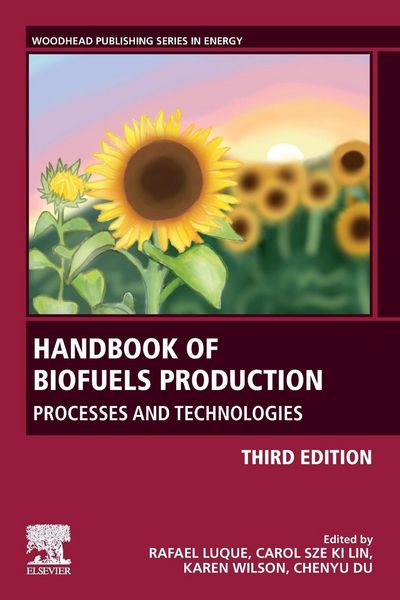
  • Produktbild: Handbook of Biofuels Production
  • Produktbild: Handbook of Biofuels Production

Handbook of Biofuels Production Processes and Technologies

334,99 €

inkl. gesetzl. MwSt., Versandkostenfrei


Beschreibung

Produktdetails

Einband

Taschenbuch

Erscheinungsdatum

09.12.2022

Herausgeber

Rafael Luque + weitere

Verlag

Elsevier Science & Technology

Seitenzahl

616

Maße (L/B/H)

22,9/15,2/3,1 cm

Gewicht

814 g

Auflage

3. Auflage

Sprache

Englisch

ISBN

978-0-323-91193-1

Beschreibung

Portrait

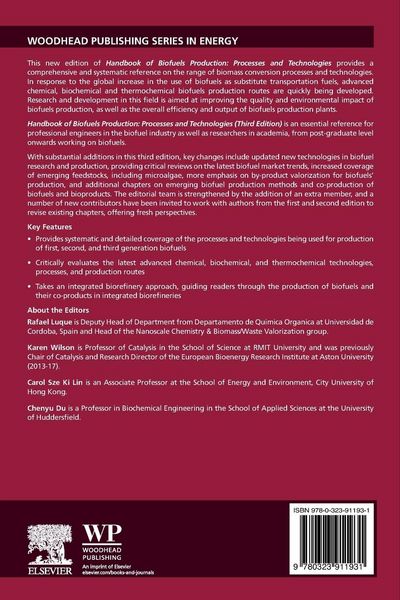
Rafael Luque (PhD 2005, Universidad de Cordoba, Spain) has significant experience in biomass and waste valorization practices to materials, fuels, and chemicals as well as nanoscale chemistry, green chemistry and (photo)catalysis (600+ publications, h-index 92, >39,000 citations, 7 patents, 10 edited books). He is Editor-in-chief of Molecular Catalysis (Elsevier) and has been named 2018, 2019, 2020, 2021 and 2022 Highly Cited Researcher (Clarivate Analytics).

Dr. Carol Sze Ki Lin is currently a Professor at the School of Energy and Environment at City University of Hong Kong (CityUHK). Her research interests lie in technological advancement and development of circular waste-based biorefinery for sustainable production of chemicals, materials and fuels, that contributes to reduction of environmental burden of waste disposal and enhancement of resource efficiency. She has been involved in over 30 research projects as Principal Investigator, which mainly focus on development of integrated biorefinery strategies includes valorization of agricultural residues, food, beverage, plastic and textile wastes. She has been a Fellow of the Royal Society of Chemistry (FRSC) since July 2024.

Karen Wilson is Professor of Catalysis in the School of Science at RMIT University and was previously Chair of Catalysis and Research Director of the European Bioenergy Research Institute at Aston University (2013-17), where she also held a Royal Society Industry Fellowship in collaboration with Johnson Matthey. She holds a BA and PhD from the University of Cambridge, and MSc in heterogeneous catalysis from the University of Liverpool and has held academic positions at the University of York and Cardiff University. Her research interests lie in the design of tunable porous materials for sustainable biofuels and chemicals production from renewable resources. She is currently Associate Editor of the academic journals Sustainable Energy & Fuels, and Energy & Environmental Materials.Chenyu Du is a Reader in Chemical Engineering in the School of Applied Sciences at the University of Huddersfield. His BEng was awarded in Chemical Engineering from Tsinghua University, China. He completed his PhD in the department of Chemical Engineering in Tsinghua University. He held a Postdoctoral Research Associate position at the University of Manchester working on a platform chemical production from sustainable raw materials. Following this he joined a research and development company in London contributing to the development of the 2nd generation of biofuel. In 2010 he was appointed as lecturer in the University of Nottingham. He has been involved in research pertaining to the Lignocellosic Conversion to Ethanol programme. He was responsible for developing and directing a new MSc course on Sustainable Bioenergy. His research interests focus on bioenergy, fermentation, metabolic engineering, bioprocess development and simulation. He has generated research income over £17 million as PI or Co-I.

Produktdetails

Einband

Taschenbuch

Erscheinungsdatum

09.12.2022

Herausgeber

Verlag

Elsevier Science & Technology

Seitenzahl

616

Maße (L/B/H)

22,9/15,2/3,1 cm

Gewicht

814 g

Auflage

3. Auflage

Sprache

Englisch

ISBN

978-0-323-91193-1

EU-Ansprechpartner

Elsevier B.V.
Radarweg 29
1043 NX Amsterdam
NL
productsafety@elsevier.com

Herstelleradresse

Elsevier Science & Technology
London Wall 125
EC2Y 5AS London
GB
tradeorders@elsevier.com

Ein neues Kapitel für Ihre Bücher

Ein neues Kapitel für Ihre Bücher

Schenken Sie Ihren alten Schätzen ein zweites Leben und erhalten Sie dafür eine Thalia Geschenkkarte.

Jetzt verkaufen
Jetzt verkaufen

Noch keine Bewertungen vorhanden

Verfassen Sie die erste Bewertung zu diesem Artikel

Helfen Sie anderen Kundinnen und Kunden durch Ihre Meinung.

Kundinnen und Kunden meinen

Bewertungen (0)

Die Leseprobe wird geladen.
  • Produktbild: Handbook of Biofuels Production
  • Produktbild: Handbook of Biofuels Production
  • Part One: Key Issues and Assessment of Biofuels Production
    1. Introduction: An Overview of Biofuels and Production Technologies
    2. Multiple Objectives Policy for Biofuels Production: Environmental, Socio-Economic and Regulatory Issues
    3. Life Cycle Sustainability Assessment of Biofuels
    4. Biofuels: Technology, Economics, And Policy Issues
    5. Feedstocks and Challenges to Biofuel Development

    Part Two: Biofuels from Chemical and Biochemical Conversion Processes and Technologies
    6. Production of Biofuel Via Catalytic Upgrading and Refining of Sustainable Oleagineous Feedstocks
    7. Biotechnological Production of Biofuels
    8. Biodiesel Production from Microbial Oil Using Oleagineous Microorganisms
    9. Biochemical Production of Bioalcohols
    10. Production of Biogas Via Anaerobic Digestion
    11. Lignocellulose Biorefinery Advances the Liquid Biofuels Platform
    12. Chemical Routes for The Conversion Of Cellulosic Platform Molecules Into High-Energy-Density Biofuels

    Part Three: Biofuels from Thermal and Thermo-Chemical Conversion Processes And Technologies
    13. Catalytic Fast Pyrolysis for Improved Liquid Quality
    14. Production of Bio-Syngas and Biohydrogen Via Gasification
    15. Production of Biofuels Via Hydrothermal Conversion
    16. Production of Biofuels Via Fischer-Tropsch Synthesis: Biomass-To-Liquids

    Part Four: Integrated Production and Application of Biofuels
    17. Integrated Biorefinery Production of Biofuels and Coproduction Of High Value Products
    18. Microalgae for Biofuels: A Prospective Feedstock
    19. Utilisation of Biofuels in Diesel Engines
    20. Power to X Technologies & CO2 Utilisation