KI-Beratung Beta

Gutscheinbedingungen

Gültig bis 30.11.2026 | Gültig für nicht preisgebundene fremdsprachige Bücher | Einzelne Artikel können ausgeschlossen sein | Online auf thalia.de und in der Thalia App einlösbar | Click & Collect nur mit Online-Zahlung (Paypal/Kreditkarte) vorab | Nicht kombinierbar mit anderen Gutscheinen oder Preisaktionen | Nur einmal pro Einkauf einlösbar | Gutschein wird auf max. 500€ Bestellwert angerechnet | Keine Barauszahlung | Nicht gültig für Versandkosten und Services

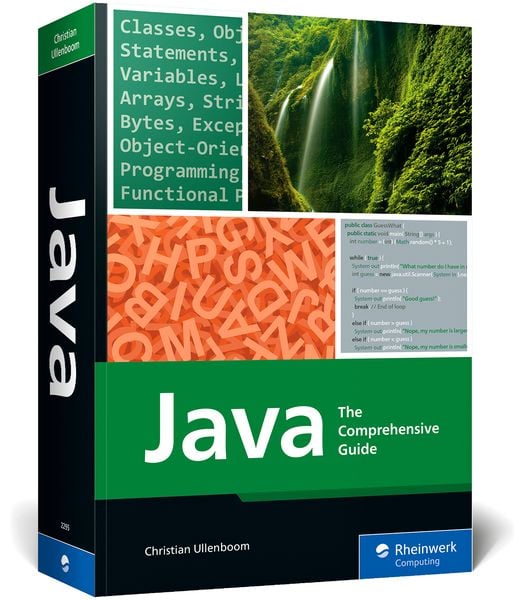
Produktbild: Java

Java The Comprehensive Guide

Aus der Reihe Rheinwerk Computing

59,95 €

inkl. gesetzl. MwSt., Versandkostenfrei


Beschreibung

This is the up-to-date, practical guide to Java you’ve been looking for! Whether you’re a beginner, you’re switching to Java from another language, or you’re just looking to brush up on your Java skills, this is the only book you need. You’ll get a thorough grounding in the basics of the Java language,...

Beschreibung

This is the up-to-date, practical guide to Java you’ve been looking for! Whether you’re a beginner, you’re switching to Java from another language, or you’re just looking to brush up on your Java skills, this is the only book you need. You’ll get a thorough grounding in the basics of the Java language, including classes, objects, arrays, strings, and exceptions. You'll also learn about more advanced topics: threads, algorithms, XML, JUnit testing, and much more. This book belongs on every Java programmer's shelf!·Your complete guide to the Java Platform, Standard Edition 17·Understand the Java language, from basic principles to advanced concepts·Work with expressions, statements, classes, objects, and much moreJava BasicsGet to know the inner workings of Java, from classes and objects to datastructures and algorithms. This book is up to date for Java SE 17!Advanced TopicsAlready mastered the basics? Explore what else Java can do, from floating point arithmetic to testing frameworks, threads, database management, and beyond.Practical ExamplesGain hands-on experience with Java using tried and tested downloadable programs. These code examples allow you to work your way through the book, testing your newfound skills and knowledge along the journey. The standard work on Java programming, updated for Java SE 17!Java books are a dime a dozen, but Java: The Comprehensive Guide should be your first choice when it comes to current and practical Java knowledge. For more than a decade, Java beginners, students, and those switching from other programming languages have benefited equally from this seminal work on Java, now available for the first time in English! Lecturers and trainers appreciate the book for its numerous examples, exercises, and model solutions. Readers celebrate it for its clear presentation of information and the subtle sense of humor; programming can also be fun!You will learn the Java language from A to Z, by following practical examples and step-by-step instructions. Java expert Christian Ullenboom will familiarize you with classes, objects, generics, lambda expressions, and modules and offer you easy-to-understand instructions on special topics.This book provides training on the syntax of this popular programming language, dealing with important standard libraries, development tools and development environments, object-oriented analysis and design, design patterns, and program conventions.Highlights:Classes and objectsArraysException handlingObject-oriented programmingCharacters and stringsGenericsClass libraryConcurrent programmingData structuresLambda expressionsJUnit testingJDK tools


Produktdetails

Einband

Taschenbuch

Erscheinungsdatum

10.11.2022

Verlag Rheinwerk Publishing
Seitenzahl

1126

Produktdetails

Einband

Taschenbuch

Erscheinungsdatum

10.11.2022

Verlag Rheinwerk Publishing
Seitenzahl

1126

Maße (L/B/H)

25,5/17,7/5,6 cm

Gewicht

1910 g

Auflage

1

Sprache

Englisch

ISBN

978-1-4932-2295-7

Herstelleradresse

Rheinwerk Verlag GmbH
Rheinwerkallee 4
53227 Bonn
DE

Email: service@rheinwerk-verlag.de

Ein neues Kapitel für Ihre Bücher

Ein neues Kapitel für Ihre Bücher

Schenken Sie Ihren alten Schätzen ein zweites Leben und erhalten Sie dafür eine Thalia Geschenkkarte.

Jetzt verkaufen
Jetzt verkaufen

Noch keine Bewertungen vorhanden

Verfassen Sie die erste Bewertung zu diesem Artikel

Helfen Sie anderen Kundinnen und Kunden durch Ihre Meinung.

Kundinnen und Kunden meinen

Bewertungen (0)

Die Leseprobe wird geladen.
  • Produktbild: Java

  • ... Preface ... 31


    ... Target Group ... 31


    ... What This Book Is Not ... 31


    ... My Life and Java, Or “Why a Java Book?” ... 32


    ... Software and Versions ... 33


    ... Which Java Version to Use ... 33


    ... Using This Book to Learn ... 33


    ... Personal Learning Strategies ... 34


    ... Focusing on the Essentials ... 35


    ... Special Sections ... 35


    ... Tasks ... 36


    ... Structure of This Book ... 36


    ... Conventions ... 38


    ... Program Listings ... 40


    ... Application Programming Interface Documentation in This Book ... 40


    ... Executable Programs ... 41


    ... Acknowledgments ... 41


    ... Resources for This Book ... 42


    ... Feedback ... 42


    1 ... Introduction ... 43


    1.1 ... Historical Background ... 43


    1.2 ... On the Popularity of Java: The Key Features ... 45


    1.3 ... Java versus Other Languages* ... 56


    1.4 ... Further Development and Losses ... 59


    1.5 ... Java Platforms ... 62


    1.6 ... Java Platform, Standard Edition, Implementations ... 67


    1.7 ... Installing the Java Development Kit ... 69


    1.8 ... Compiling and Testing the First Program ... 71


    1.9 ... Development Environments ... 75


    1.10 ... Further Reading ... 81


    2 ... Imperative Language Concepts ... 83


    2.1 ... Elements of the Java Programming Language ... 83


    2.2 ... From Classes to Statements ... 91


    2.3 ... Data Types, Typing, Variables, and Assignments ... 102


    2.4 ... Expressions, Operands, and Operators ... 119


    2.5 ... Conditional Statements or Case Distinctions ... 142


    2.6 ... Always the Same with Loops ... 160


    2.7 ... Methods of a Class ... 177


    2.8 ... Further Reading ... 200


    3 ... Classes and Objects ... 201


    3.1 ... Object-Oriented Programming ... 201


    3.2 ... Members of a Class ... 203


    3.3 ... Natural Modeling Using Unified Modeling Language* ... 204


    3.4 ... Creating New Objects ... 206


    3.5 ... ZZZZZnake ... 218


    3.6 ... Tying Packages, Imports, and Compilation Units ... 220


    3.7 ... Using References, Diversity, Identity, and Equality ... 228


    3.8 ... Further Reading ... 239


    4 ... Arrays and Their Areas of Use ... 241


    4.1 ... Simple Field Work ... 241


    4.2 ... The Extended for Loop ... 252


    4.3 ... A Method with a Variable Number of Arguments ... 256


    4.4 ... Multidimensional Arrays* ... 259


    4.5 ... Library Support for Arrays ... 264


    4.6 ... Using the Arrays Class for Comparing, Filling, Searching, and Sorting ... 267


    4.7 ... The Entry Point for the Runtime System: main(...) ... 281


    4.8 ... Further Reading ... 285


    5 ... Handling Characters and Strings ... 287


    5.1 ... From ASCII via ISO-8859-1 to Unicode ... 287


    5.2 ... Data Types for Characters and Strings ... 295


    5.3 ... The Character Class ... 296


    5.4 ... Strings ... 301


    5.5 ... The String Class and Its Methods ... 303


    5.6 ... Mutable Strings with StringBuilder and StringBuffer ... 333


    5.7 ... CharSequence as Base Type ... 342


    5.8 ... Converting Primitives and Strings ... 345


    5.9 ... Concatenating Strings ... 353


    5.10 ... Decomposing Strings ... 355


    5.11 ... Formatting Outputs ... 360


    5.12 ... Further Reading ... 367


    6 ... Writing Custom Classes ... 369


    6.1 ... Declaring Custom Classes with Members ... 369


    6.2 ... Privacy and Visibility ... 380


    6.3 ... One for All: Static Methods and Class Variables ... 390


    6.4 ... Constants and Enumerations ... 397


    6.5 ... Creating and Destroying Objects ... 405


    6.6 ... Class and Object Initialization* ... 418


    6.7 ... Conclusion ... 426


    7 ... Object-Oriented Relationship ... 427


    7.1 ... Associations between Objects ... 427


    7.2 ... Inheritance ... 436


    7.3 ... Types in Hierarchies ... 447


    7.4 ... Overriding Methods ... 457


    7.5 ... Testing Dynamic Bindings ... 463


    7.6 ... Final Classes and Final Methods ... 466


    7.7 ... Abstract Classes and Abstract Methods ... 468


    7.8 ... Further Information on Overriding and Dynamic Binding ... 476


    7.9 ... A Programming Task ... 482


    8 ... Interfaces, Enumerations, Sealed Classes, Records ... 483


    8.1 ... Interfaces ... 483


    8.2 ... Enumeration Types ... 513


    8.3 ... Sealed Classes and Interfaces ... 523


    8.4 ... Records ... 529


    9 ... There Must Be Exceptions ... 539


    9.1 ... Fencing In Problem Areas ... 539


    9.2 ... Redirecting Exceptions and throws at the Head of Methods/Constructors ... 549


    9.3 ... The Class Hierarchy of Exceptions ... 550


    9.4 ... Final Handling Using finally ... 558


    9.5 ... Triggering Custom Exceptions ... 564


    9.6 ... try with Resources (Automatic Resource Management) ... 579


    9.7 ... Special Features of Exception Handling* ... 588


    9.8 ... Hard Errors: Error* ... 593


    9.9 ... Assertions* ... 594


    9.10 ... Conclusion ... 597


    10 ... Nested Types ... 599


    10.1 ... Nested Classes, Interfaces, and Enumerations ... 599


    10.2 ... Static Nested Types ... 601


    10.3 ... Non-Static Nested Types ... 603


    10.4 ... Local Classes ... 605


    10.5 ... Anonymous Inner Classes ... 607


    10.6 ... Nests ... 613


    10.7 ... Conclusion ... 614


    11 ... Special Types of Java SE ... 615


    11.1 ... Object Is the Mother of All Classes ... 616


    11.2 ... Weak References and Cleaners ... 638


    11.3 ... The java.util.Objects Utility Class ... 639


    11.4 ... Comparing Objects and Establishing Order ... 643


    11.5 ... Wrapper Classes and Autoboxing ... 651


    11.6 ... Iterator, Iterable* ... 670


    11.7 ... Annotations in Java Platform, Standard Edition ... 677


    11.8 ... Further Reading ... 682


    12 ... Generics ... 683


    12.1 ... Introduction to Java Generics ... 683


    12.2 ... Implementing Generics, Type Erasure, and Raw Types ... 699


    12.3 ... Restricting Types via Bounds ... 706


    12.4 ... Type Parameters in the throws Clause* ... 710


    12.5 ... Inheritance and Invariance with Generics ... 713


    12.6 ... Consequences of Type Erasure: Type Tokens, Arrays* ... 725


    12.7 ... Further Reading ... 729


    13 ... Lambda Expressions and Functional Programming ... 731


    13.1 ... Functional Interfaces and Lambda Expressions ... 731


    13.2 ... Method References ... 755


    13.3 ... Constructor References ... 759


    13.4 ... Functional Programming ... 762


    13.5 ... Functional Interfaces from the java.util.function Package ... 770


    13.6 ... Optional Is Not a Non-Starter ... 784


    13.7 ... What Is So Functional Now? ... 795


    13.8 ... Further Reading ... 797


    14 ... Architecture, Design, and Applied Object Orientation ... 799


    14.1 ... SOLID Modeling ... 799


    14.2 ... Architecture, Design, and Implementation ... 803


    14.3 ... Design Patterns ... 803


    14.4 ... Further Reading ... 811


    15 ... Java Platform Module System ... 813


    15.1 ... Class Loader and Module/Classpath ... 813


    15.2 ... Importing Modules ... 819


    15.3 ... Developing Custom Modules ... 825


    15.4 ... Further Reading ... 833


    16 ... The Class Library ... 835


    16.1 ... The Java Class Philosophy ... 835


    16.2 ... Simple Time Measurement and Profiling* ... 842


    16.3 ... The Class Class ... 843


    16.4 ... The Utility Classes System and Members ... 846


    16.5 ... The Languages of Different Countries ... 853


    16.6 ... Overview of Important Date Classes ... 857


    16.7 ... Date-Time API ... 860


    16.8 ... Logging with Java ... 864


    16.9 ... Maven: Resolving Build Management and Dependencies ... 867


    16.10 ... Further Reading ... 869


    17 ... Introduction to Concurrent Programming ... 871


    17.1 ... Concurrency and Parallelism ... 871


    17.2 ... Generating Existing Threads and New Threads ... 875


    17.3 ... Thread Members and States ... 882


    17.4 ... Enter the Executor ... 893


    17.5 ... Further Reading ... 907


    18 ... Introduction to Data Structures and Algorithms ... 909


    18.1 ... Lists ... 909


    18.2 ... Sets ... 928


    18.3 ... Associative Memory ... 938


    18.4 ... The Stream API ... 944


    18.5 ... Creating a Stream ... 947


    18.6 ... Terminal Operations ... 951


    18.7 ... Intermediary Operations ... 962


    18.8 ... Further Reading ... 968


    19 ... Files and Data Streams ... 969


    19.1 ... Old and New Worlds in java.io and java.nio ... 969


    19.2 ... File Systems and Paths ... 970


    19.3 ... Random Access Files ... 980


    19.4 ... Base Classes for Input/Output ... 985


    19.5 ... Reading from Files and Writing to Files ... 996


    19.6 ... Further Reading ... 1003


    20 ... Introduction to Database Management with JDBC ... 1005


    20.1 ... Relational Databases and Java Access ... 1005


    20.2 ... A Sample Query ... 1008


    20.3 ... Further Reading ... 1009


    21 ... Bits and Bytes, Mathematics and Money ... 1011


    21.1 ... Bits and Bytes ... 1011


    21.2 ... Floating Point Arithmetic in Java ... 1025


    21.3 ... The Members of the Math Class ... 1031


    21.4 ... Accuracy and the Value Range of Type and Overflow Control* ... 1042


    21.5 ... Random Numbers: Random, ThreadLocalRandom, and SecureRandom ... 1046


    21.6 ... Large Numbers* ... 1051


    21.7 ... Money and Currency ... 1064


    21.8 ... Further Reading ... 1066


    22 ... Testing with JUnit ... 1067


    22.1 ... Software Tests ... 1067


    22.2 ... The JUnit Testing Framework ... 1068


    22.3 ... Java Assertion Libraries and AssertJ ... 1081


    22.4 ... Structure of Large Test Cases ... 1083


    22.5 ... Good Design Enables Effective Testing ... 1085


    22.6 ... Dummy, Fake, Stub, and Mock ... 1087


    22.7 ... JUnit Extensions and Testing Add-Ons ... 1089


    22.8 ... Further Reading ... 1089


    23 ... The Tools of the JDK ... 1091



    23.1 ... Overview ... 1091


    23.2 ... Translating Java Sources ... 1092



    23.3 ... The Java Runtime Environment ... 1093


    23.4 ... Documentation Comments with Javadoc ... 1096


    23.5 ... The JAR Archive Format ... 1105


    23.6 ... Further Reading ... 1107


    ... The Author ... 1109


    ... Index ... 1111