















































KI-Beratung Beta

Gutscheinbedingungen

Gültig bis 30.11.2026 | Gültig für nicht preisgebundene fremdsprachige Bücher | Einzelne Artikel können ausgeschlossen sein | Online auf thalia.de und in der Thalia App einlösbar | Click & Collect nur mit Online-Zahlung (Paypal/Kreditkarte) vorab | Nicht kombinierbar mit anderen Gutscheinen oder Preisaktionen | Nur einmal pro Einkauf einlösbar | Gutschein wird auf max. 500€ Bestellwert angerechnet | Keine Barauszahlung | Nicht gültig für Versandkosten und Services

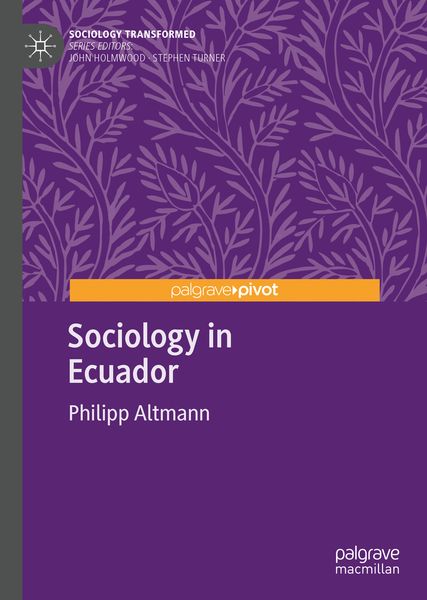
Produktbild: Sociology in Ecuador

Sociology in Ecuador

Aus der Reihe Sociology Transformed

43,99 €

inkl. gesetzl. MwSt., Versandkostenfrei


Beschreibung

This Palgrave Pivot presents a concise yet comprehensive history of sociology in Ecuador. The case of Ecuador is especially interesting, as Ecuadorian sociology oscillated between theoretical debates—some of them out of time—and a constant search for ways of applying them to the local reality. In the...

Beschreibung

This Palgrave Pivot presents a concise yet comprehensive history of sociology in Ecuador. The case of Ecuador is especially interesting, as Ecuadorian sociology oscillated between theoretical debates—some of them out of time—and a constant search for ways of applying them to the local reality. In the decades after its formal creation in 1915, early academic sociology in Ecuador worked creatively with already outdated theories around positivism and organicism to understand the indigenous population's position, the regional fragmentation, and the formation of a coherent nation-state in Ecuador. After a short attempt of installing a more technical sociology in the 1960s, those topics were taken up and re-read by Marxist-inspired critical sociology after the 1970s, leading to the nation-wide institutionalization of one particular tradition that could connect to continental debates. This book engages with several relevant debates in social sciences and humanities, particularly by adding tothe thriving research on social sciences and the role of the university and higher education in Latin America. Furthermore, it touches some recently influential topics in sociology: Ecuadorian sociology can be read as Southern Theory or engaged with from a postcolonial or decolonial perspective; the research on how ideas travel, are diffused or localized is vital for understanding sociology in Ecuador; the relation between academia and politics; and more.

Rezension

“Professor Altmann manages to provide an extremely comprehensive overview of Ecuadorian sociology with the available materials, drawing from a wide range of sources including sociology journals, newspapers, university library archives, political party debates, interviews with several key actors, amongst others. … The expert knowledge and details presented in this book offer valuable insights into the sociological tools employed throughout the 20th century to interpret the world and, with varying degrees of success, attempt to transform it.” (Cecilia M. Zsögön, Language, Discourse & Society, Vol. 11 (2), 2023)

Produktdetails

Einband

Gebundene Ausgabe

Erscheinungsdatum

25.11.2022

Abbildungen

VI, 164 p.

Verlag Springer

Produktdetails

Einband

Gebundene Ausgabe

Erscheinungsdatum

25.11.2022

Abbildungen

VI, 164 p.

Verlag Springer
Seitenzahl

164

Maße (L/B/H)

21,6/15,3/1,5 cm

Gewicht

304 g

Auflage

22001 Auflage 1st edition 2022

Sprache

Englisch

ISBN

978-3-031-14428-8

Herstelleradresse

Springer-Verlag GmbH
Europaplatz 3
69115 Heidelberg
DE

Email: ProductSafety@springernature.com

Ein neues Kapitel für Ihre Bücher

Ein neues Kapitel für Ihre Bücher

Schenken Sie Ihren alten Schätzen ein zweites Leben und erhalten Sie dafür eine Thalia Geschenkkarte.

Jetzt verkaufen
Jetzt verkaufen

Noch keine Bewertungen vorhanden

Verfassen Sie die erste Bewertung zu diesem Artikel

Helfen Sie anderen Kundinnen und Kunden durch Ihre Meinung.

Kundinnen und Kunden meinen

Bewertungen (0)

  • Produktbild: Sociology in Ecuador
  • 1. Introduction.- 2. The first sociology in Ecuador.- 3. The failed attempt to modernize sociology from the 1940s.- 4. Critical Sociology.- 5. Conclusions.