
















































KI-Beratung Beta

  • Produktbild: Hearing Music in a Different Key
  • Produktbild: Hearing Music in a Different Key
Band 74

Hearing Music in a Different Key Ideological Implications in Works of German Music

52,95 €

inkl. gesetzl. MwSt., Versandkostenfrei


Beschreibung

«This volume epitomizes Jost Hermand’s inimitable talent of synthesizing wide-ranging disciplines in an accessible and compelling style, bringing to life the experiences of musicians and their public in the context of their own times. These essays also give us a glimpse into how his own life experiences...

Beschreibung

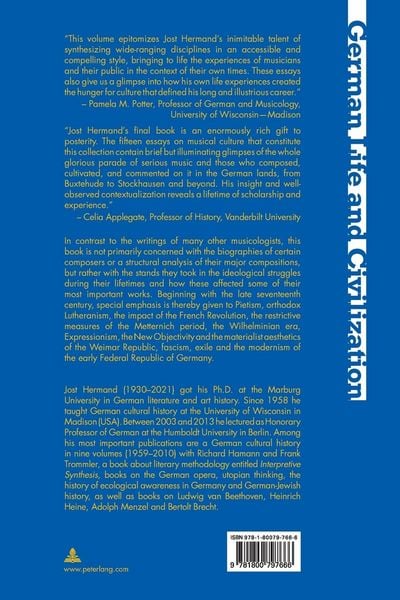
«This volume epitomizes Jost Hermand’s inimitable talent of synthesizing wide-ranging disciplines in an accessible and compelling style, bringing to life the experiences of musicians and their public in the context of their own times. These essays also give us a glimpse into how his own life experiences created the hunger for culture that defined his long and illustrious career.» (Pamela M. Potter, Professor of German and Musicology, University of Wisconsin—Madison) «Jost Hermand’s final book is an enormously rich gift to posterity. The fifteen essays on musical culture that constitute this collection contain brief but illuminating glimpses of the whole glorious parade of serious music and those who composed, cultivated, and commented on it in the German lands, from Buxtehude to Stockhausen and beyond. His insight and well-observed contextualization reveals a lifetime of scholarship and experience.» (Celia Applegate, Professor of History, Vanderbilt University) In contrast to the writings of many other musicologists, this book is not primarily concerned with the biographies of certain composers or a structural analysis of their major compositions, but rather with the stands they took in the ideological struggles during their lifetimes and how these affected some of their most important works. Beginning with the late seventeenth century, special emphasis is thereby given to Pietism, orthodox Lutheranism, the impact of the French Revolution, the restrictive measures of the Metternich period, the Wilhelminian era, Expressionism, the New Objectivity and the materialist aesthetics of the Weimar Republic, fascism, exile and the modernism of the early Federal Republic of Germany.

Produktdetails

Einband

Taschenbuch

Erscheinungsdatum

15.08.2022

Herausgeber Kristopher Imbrigotta
Verlag Peter Lang Ltd. International Academic Publishers

Produktdetails

Einband

Taschenbuch

Erscheinungsdatum

15.08.2022

Herausgeber Kristopher Imbrigotta
Verlag Peter Lang Ltd. International Academic Publishers
Seitenzahl

286

Maße (L/B/H)

22,9/15,2/1,7 cm

Gewicht

430 g

Auflage

1

Sprache

Englisch

ISBN

978-1-80079-766-6

EU-Ansprechpartner

Kolibri 360 GmbH
Ettore-Bugatti-Straße 6-14
51149 Köln
DE
produktsicherheit@kolibri360.de

Herstelleradresse

Peter Lang
Avenue du Théâtre 7
1005 Lausanne
CH
orders@peterlang.com

Ein neues Kapitel für Ihre Bücher

Ein neues Kapitel für Ihre Bücher

Schenken Sie Ihren alten Schätzen ein zweites Leben und erhalten Sie dafür eine Thalia Geschenkkarte.

Jetzt verkaufen
Jetzt verkaufen

Noch keine Bewertungen vorhanden

Verfassen Sie die erste Bewertung zu diesem Artikel

Helfen Sie anderen Kundinnen und Kunden durch Ihre Meinung.

Kundinnen und Kunden meinen

Bewertungen (0)

Die Leseprobe wird geladen.
  • Produktbild: Hearing Music in a Different Key
  • Produktbild: Hearing Music in a Different Key

  • Contents: Early Signs of Pietism in Protestant Church Music: Dieterich Buxtehude’s
    Evening Concerts
    in Lübeck (1667–1705) – More than Protestant Orthodoxy? Johann Sebastian Bach’s Church Cantatas (1713–1728) – Allons enfants de la musique: The Impact of the French Revolution on German Music (1789–1809) – «Moving Ahead» Even in «Desolate Times»: Ludwig van Beethoven’s Piano Sonata Op. 111 (1822) – Hope and Disillusionment: Franz Schubert’s 600 Art Songs (1813–1828) – A Checkered Past: The History of the German National Anthem (1842 to the Present) – Richard Wagner’s Last Cause: The Vegetarian Gospel of His
    Parsifal
    (1882) – From the Shtetl to Wunsiedel: Gustav Mahler’s Symphony No. 1 (1889) – The Two Revolutions against Older Forms of Bourgeois Music: Expressionism and Materialist Aesthetics (1910–1933) – Deepest Misery – Highest Art: Alban Berg’s
    Wozzeck
    (1925) – Conformism or Refusal? Paul Hindemith’s
    Mathis the Painter
    (1935) – More than an Aberration? Hanns Eisler’s
    Fourteen Ways to Describe the Rain
    (1941) – The Hidden Meaning: Richard Strauss’s
    Metamorphoses for 23 Solo String Players
    (1945) – The Supposedly Apolitical «Modernism» in the Serious Music of the Early Federal Republic of Germany: Karlheinz Stockhausen’s
    Groups for 3 Orchestras
    (1958) – Avant- Garde, Modern, Postmodern: The Music that (Almost) Nobody Wants to Hear Any Longer.