Beschreibung
Produktdetails
Einband
Gebundene Ausgabe
Erscheinungsdatum
06.10.2022
Verlag
Reichert, LSeitenzahl
380
Maße (L/B/H)
2,8/21,7/30,5 cm
Gewicht
1365 g
Sprache
Deutsch
ISBN
978-3-95490-517-1
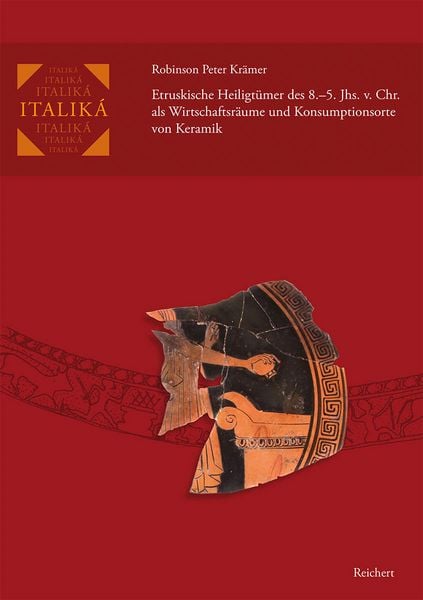
Although religion is a current and intensively discussed topic in Etruscan and Italic studies, there is still a need for detailed analyses of its economic significance and about a sacred economy in ‘Pre-Roman’ Italy. This volume analyzes Etruscan sanctuaries of the 8th–5th cent. BCE systematically as economic spaces. The specific area under investigation is the Etruscan core region between the rivers Arno and Tiber, the data set consists of 51 sacred contexts with statistically accessible pottery findings, and 334 pottery inscriptions. The investigation of the Etruscan sacred economy is performed on the basis of three main research questions:
(1) Pottery as consumption goods. The distribution and functions of vase forms and classes as well as activities and ritual practices in sacred contexts are reconstructed using statistical analyses of pottery. Additionally, this chapter traces chronological developments and consumption patterns, and examines the fundamental differences in pottery consumption between southern and northern Etruria. Other topics include the functions of ‘ritual vessels’, such as miniature vases, kernoi or thymiateria, and of depictions of altars and ritual scenes on Etruscan pottery. Finally, the role of Greek imported pottery in Etruscan sanctuaries, particularly with regards to vessel forms and imagery, is discussed in this chapter.
(2) Production and crafts. Pottery, metal processing and textile production in sanctuary contexts are systematically examined in terms of the Etruscan sacred economy. The main research questions deal with forms of organization for craft activities embedded in sacred places, as well as the significance of those crafts for the sanctuaries and the Etruscan economy as a whole. Another topic is the role of writing and literacy in Etruscan sanctuaries, such as the mechanics of writing spaces (scriptoria) or the processes for creating votive texts. Finally, this chapter discusses the significance of Etruscan sanctuaries as institutions responsible for standardized and calibrated weight systems, and locations of official weights (ponderaria).
(3) The development and political economy of the Etruscan sacred landscape. This chapter analyzes representative indicators of the Etruscan sacred landscape in order to reconstruct socio-political structures and processes. These indicators include, for example, the lifespans of sanctuaries, as well as sacred architecture, pottery and pottery inscriptions, and the names of clans and gentes contained in votive texts. On this basis, the author suggests a supraregional model with five main phases of socio-political significance for the religious sphere and sanctuaries in Etruscan society.
The results of these three main research questions provide a general picture of the Etruscan sacred economy during the 8th–5th cent. BCE, with a wide range of ritual practices, consumption patterns and mechanisms, craft activities and socio-political processes.
(1) Pottery as consumption goods. The distribution and functions of vase forms and classes as well as activities and ritual practices in sacred contexts are reconstructed using statistical analyses of pottery. Additionally, this chapter traces chronological developments and consumption patterns, and examines the fundamental differences in pottery consumption between southern and northern Etruria. Other topics include the functions of ‘ritual vessels’, such as miniature vases, kernoi or thymiateria, and of depictions of altars and ritual scenes on Etruscan pottery. Finally, the role of Greek imported pottery in Etruscan sanctuaries, particularly with regards to vessel forms and imagery, is discussed in this chapter.
(2) Production and crafts. Pottery, metal processing and textile production in sanctuary contexts are systematically examined in terms of the Etruscan sacred economy. The main research questions deal with forms of organization for craft activities embedded in sacred places, as well as the significance of those crafts for the sanctuaries and the Etruscan economy as a whole. Another topic is the role of writing and literacy in Etruscan sanctuaries, such as the mechanics of writing spaces (scriptoria) or the processes for creating votive texts. Finally, this chapter discusses the significance of Etruscan sanctuaries as institutions responsible for standardized and calibrated weight systems, and locations of official weights (ponderaria).
(3) The development and political economy of the Etruscan sacred landscape. This chapter analyzes representative indicators of the Etruscan sacred landscape in order to reconstruct socio-political structures and processes. These indicators include, for example, the lifespans of sanctuaries, as well as sacred architecture, pottery and pottery inscriptions, and the names of clans and gentes contained in votive texts. On this basis, the author suggests a supraregional model with five main phases of socio-political significance for the religious sphere and sanctuaries in Etruscan society.
The results of these three main research questions provide a general picture of the Etruscan sacred economy during the 8th–5th cent. BCE, with a wide range of ritual practices, consumption patterns and mechanisms, craft activities and socio-political processes.
Ein neues Kapitel für Ihre Bücher
Ein neues Kapitel für Ihre Bücher
Schenken Sie Ihren alten Schätzen ein zweites Leben und erhalten dafür eine Thalia Geschenkkarte.
Noch keine Bewertungen vorhanden
Verfassen Sie die erste Bewertung zu diesem Artikel
Helfen Sie anderen Kundinnen und Kunden durch Ihre Meinung.
Kurze Frage zu unserer Seite
Vielen Dank für Ihr Feedback
Wir nutzen Ihr Feedback, um unsere Produktseiten zu verbessern. Bitte haben Sie Verständnis, dass wir Ihnen keine Rückmeldung geben können. Falls Sie Kontakt mit uns aufnehmen möchten, können Sie sich aber gerne an unseren Kund*innenservice wenden.
zum Kundenservice