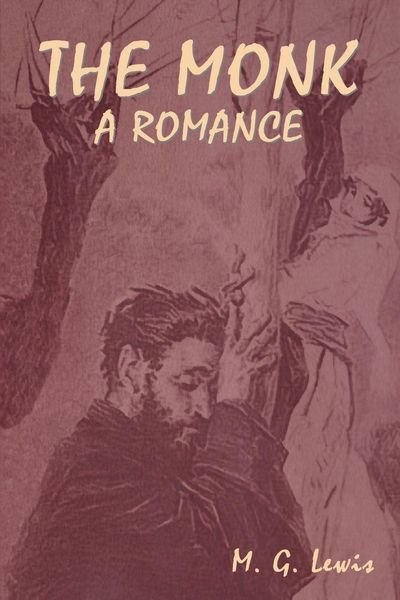

The Monk A Romance
-
- Hardcover
- Taschenbuch ausgewählt
- eBook
- Hörbuch
-
Sprache:Englisch
-
Verlag:Indoeuropeanpublishing.Com
- Lector House 22,99 €
- Flame Tree Publishing 9,99 €
- Poetic Justice Books & Arts 23,99 €
- Tredition 17,90 €
- Sharp Ink 14,00 €
- Alma Books 9,99 €
- Random House N.Y. 13,99 €
- Culturea 22,00 €
- Les prairies numériques 21,99 €
- Digireads.com 19,99 €
- Creative Media Partners, LLC 19,99 €
- Grove/Atlantic 19,99 €
- Penguin Books UK 10,99 €
- Simon & Brown 24,99 €
- Ingram Publishers Services 15,99 €
- E-artnow 13,99 €
- Indoeuropeanpublishing.Com 24,99 € ausgewählt
24,99 €
inkl. gesetzl. MwSt.,
Beschreibung
Produktdetails
Einband
Taschenbuch
Erscheinungsdatum
07.01.2023
Verlag
Indoeuropeanpublishing.ComSeitenzahl
272
Maße (L/B/H)
22,9/15,2/1,6 cm
Gewicht
446 g
Sprache
Englisch
ISBN
978-1-64439-990-3
The Monk: A Romance is a Gothic novel by Matthew Gregory Lewis, published in 1796. A quickly written book from early in Lewis's career (in one letter he claimed to have written it in ten weeks, but other correspondence suggests that he had at least started it, or something similar, a couple of years earlier), it was published before he turned twenty. It is a prime example of the male Gothic that specialises in the aspect of horror. Its convoluted and scandalous plot has made it one of the most important Gothic novels of its time, often imitated and adapted for the stage and the screen. In the same month as the second edition was published, Samuel Taylor Coleridge wrote a piece in The Critical Review, an important literary magazine of the day, in which he both praises and harshly criticises the novel. He acknowledges that it is "the offspring of no common genius," that the "underplot... is skilfully and closely connected with the main story, and is subservient to its development," that the story Lewis weaves in about the bleeding nun is "truly terrific" and that he cannot recall a "bolder or more happy conception than that of the burning cross on the forehead of the wandering Jew." Coleridge gives his highest praise to the character of Matilda, who he believes is "the author's master-piece. It is, indeed, exquisitely imagined, and as exquisitely supported. The whole work is distinguished by the variety and impressiveness of its incidents; and the author everywhere discovers an imagination rich, powerful, and fervid. Such are the excellencies". Coleridge continues by saying that "the errors and defects are more numerous, and (we are sorry to add) of greater importance." Because "the order of nature may be changed whenever the author's purposes demand it" there are no surprises in the work. Moral truth cannot be gleaned because Ambrosio was destroyed by spiritual beings, and no earthly being can sufficiently oppose the "power and cunning of supernatural beings." Scenes of grotesquery and horror abound, which are a proof of "a low and vulgar taste." The character of Ambrosio is "impossible... contrary to nature." Coleridge argues that the most "grievous fault... for which no literary excellence can atone" is that "our author has contrived to make [tales of enchantments and witchcraft] ' 'pernicious' ', by blending, with an irreverent negligence, all that is most awfully true in religion with all that is most ridiculously absurd in superstition," commenting with the immortal line that "the Monk is a romance, which if a parent saw in the hands of a son or daughter, he might reasonably turn pale." Coleridge finishes the piece by explaining that he was "induced to pay particular attention to this work, from the unusual success which it has experienced" and that "the author is a man of rank and fortune. Yes! the author of the Monk signs himself a LEGISLATOR! We stare and tremble." Thomas James Mathias followed Coleridge's lead in The Pursuits of Literature, a poem in the 18th-Century satiric tradition, but takes a step farther than Coleridge by claiming that a specific passage made the novel indictable under law. The passage, found in Chapter Seven Volume II, discusses an interpretation of the Bible as too lewd for youth to read. These two major pieces led the way for a multitude of other attacks on the novel, from such sources as the Monthly Review, the Monthly Magazine, and the Scots Magazine; the last of these attacked the novel six years after its publication.
Ein neues Kapitel für Ihre Bücher
Ein neues Kapitel für Ihre Bücher
Schenken Sie Ihren alten Schätzen ein zweites Leben und erhalten dafür eine Thalia Geschenkkarte.
Noch keine Bewertungen vorhanden
Verfassen Sie die erste Bewertung zu diesem Artikel
Helfen Sie anderen Kundinnen und Kunden durch Ihre Meinung.
Kurze Frage zu unserer Seite
Vielen Dank für Ihr Feedback
Wir nutzen Ihr Feedback, um unsere Produktseiten zu verbessern. Bitte haben Sie Verständnis, dass wir Ihnen keine Rückmeldung geben können. Falls Sie Kontakt mit uns aufnehmen möchten, können Sie sich aber gerne an unseren Kund*innenservice wenden.
zum Kundenservice