















































KI-Beratung Beta

Gutscheinbedingungen

Gültig bis 30.11.2026 | Gültig für nicht preisgebundene fremdsprachige Bücher | Einzelne Artikel können ausgeschlossen sein | Online auf thalia.de und in der Thalia App einlösbar | Click & Collect nur mit Online-Zahlung (Paypal/Kreditkarte) vorab | Nicht kombinierbar mit anderen Gutscheinen oder Preisaktionen | Nur einmal pro Einkauf einlösbar | Gutschein wird auf max. 500€ Bestellwert angerechnet | Keine Barauszahlung | Nicht gültig für Versandkosten und Services

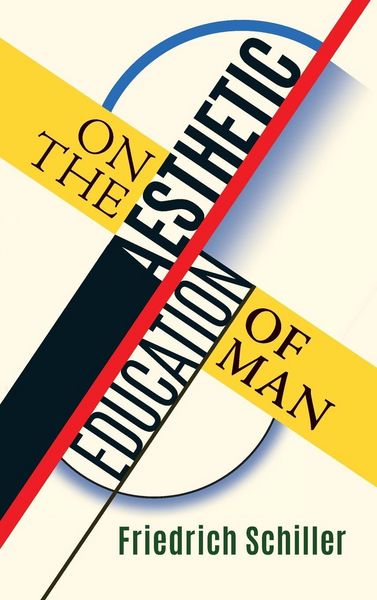
  • Produktbild: On the Aesthetic Education of Man
  • Produktbild: On the Aesthetic Education of Man

On the Aesthetic Education of Man

26,99 €

inkl. gesetzl. MwSt., Versandkostenfrei


Beschreibung

The history of education can easily be described as theme and variation on one motif: reform. From Plato's critique of the Sophists in Protagoras to John Henry Newman's considerations of education in The Idea of a University in 1854, from the educational projects of Maria Montessori, Rudolf Steiner,...

Beschreibung

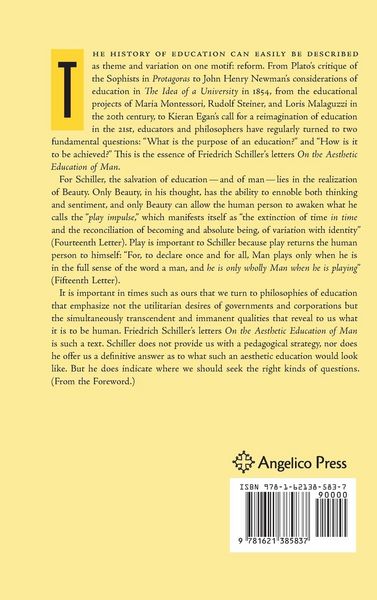
The history of education can easily be described as theme and variation on one motif: reform. From Plato's critique of the Sophists in Protagoras to John Henry Newman's considerations of education in The Idea of a University in 1854, from the educational projects of Maria Montessori, Rudolf Steiner, and Loris Malaguzzi in the 20th century to Kieran Egan's call for a reimagination of education in the 21st, educators and philosophers have regularly turned to two fundamental questions: "What is the purpose of an education?" and "How is it to be achieved?" This is the essence of Friedrich Schiller's letters On the Aesthetic Education of Man.

For Schiller, the salvation of education--and of man--lies in the realization of Beauty. Only Beauty, in his thought, has the ability to ennoble both thinking and sentiment, and only Beauty can allow the human person to awaken what he calls the "play impulse," which manifests itself as "the extinction of time in time and the reconciliation of becoming and absolute being, of variation with identity" (Fourteenth Letter). Play is important to Schiller because play returns the human person to himself: "For, to declare once and for all, Man plays only when he is in the full sense of the word a man, and he is only wholly Man when he is playing" (Fifteenth Letter).

It is important in times such as ours that we turn to philosophies of education that emphasize not the utilitarian desires of governments and corporations but the simultaneously transcendent and immanent qualities that reveal to us what it is to be human. Friedrich Schiller's letters On the Aesthetic Education of Man is such a text. Schiller does not provide us with a pedagogical strategy, nor does he offer us a definitive answer as to what such an aesthetic education would look like. But he does indicate where we should seek the right kinds of questions. (From the Foreword.)

Produktdetails

Einband

Gebundene Ausgabe

Erscheinungsdatum

12.01.2015

Verlag Angelico Press
Seitenzahl

130

Produktdetails

Einband

Gebundene Ausgabe

Erscheinungsdatum

12.01.2015

Verlag Angelico Press
Seitenzahl

130

Maße (L/B/H)

23,5/15,7/1,2 cm

Gewicht

302 g

Sprache

Englisch

ISBN

978-1-62138-583-7

Herstelleradresse

Libri GmbH
Europaallee 1
36244 Bad Hersfeld
DE

Email: gpsr@libri.de

Ein neues Kapitel für Ihre Bücher

Ein neues Kapitel für Ihre Bücher

Schenken Sie Ihren alten Schätzen ein zweites Leben und erhalten Sie dafür eine Thalia Geschenkkarte.

Jetzt verkaufen
Jetzt verkaufen

Noch keine Bewertungen vorhanden

Verfassen Sie die erste Bewertung zu diesem Artikel

Helfen Sie anderen Kundinnen und Kunden durch Ihre Meinung.

Kundinnen und Kunden meinen

Bewertungen (0)

Die Leseprobe wird geladen.
  • Produktbild: On the Aesthetic Education of Man
  • Produktbild: On the Aesthetic Education of Man