















































KI-Beratung Beta

Gutscheinbedingungen

Gültig bis 30.11.2026 | Gültig für nicht preisgebundene fremdsprachige Bücher | Einzelne Artikel können ausgeschlossen sein | Online auf thalia.de und in der Thalia App einlösbar | Click & Collect nur mit Online-Zahlung (Paypal/Kreditkarte) vorab | Nicht kombinierbar mit anderen Gutscheinen oder Preisaktionen | Nur einmal pro Einkauf einlösbar | Gutschein wird auf max. 500€ Bestellwert angerechnet | Keine Barauszahlung | Nicht gültig für Versandkosten und Services

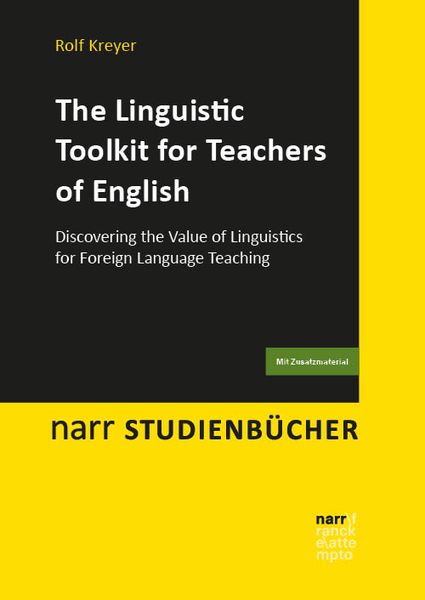
Produktbild: The Linguistic Toolkit for Teachers of English

The Linguistic Toolkit for Teachers of English Discovering the Value of Linguistics for Foreign Language Teaching

Aus der Reihe Narr Studienbücher

26,99 €

inkl. gesetzl. MwSt., Versandkostenfrei


Beschreibung

In contrast to literary or cultural studies linguistics is not taught in the EFL classroom, yet, it plays a major role in any English language teaching degree. Given this discrepancy it does not come as a surprise that students sometimes ask: "I want to be a teacher! Why do I need all this?" The main...

Beschreibung

In contrast to literary or cultural studies linguistics is not taught in the EFL classroom, yet, it plays a major role in any English language teaching degree. Given this discrepancy it does not come as a surprise that students sometimes ask: "I want to be a teacher! Why do I need all this?" The main goal of this textbook is to demonstrate the relevance of linguistic expertise for the EFL classroom. It explores a wide range of topics (phonetics/phonology, lexis, corpus linguistics, text linguistics and the power of language) with a clear focus on providing a convincing answer to the question above. With its highly accessible style and layout, a wealth of examples and exercises as well as a large range of additional innovative online materials this textbook sets out to convince its readers that they will be better teachers if they are good linguists.

Produktdetails

Verkaufsrang

39128

Einband

Taschenbuch

Erscheinungsdatum

23.10.2023

Verlag Narr Francke Attempto

Produktdetails

Verkaufsrang

39128

Einband

Taschenbuch

Erscheinungsdatum

23.10.2023

Verlag Narr Francke Attempto
Seitenzahl

305

Maße (L/B/H)

24,1/17,2/2,5 cm

Gewicht

578 g

Farbe

Schwarz / Goldgelb

Auflage

1. Auflage

Sprache

Englisch

ISBN

978-3-8233-8611-7

Herstelleradresse

Narr Dr. Gunter
Dischingerweg 5
72070 Tübingen
DE

Ein neues Kapitel für Ihre Bücher

Ein neues Kapitel für Ihre Bücher

Schenken Sie Ihren alten Schätzen ein zweites Leben und erhalten Sie dafür eine Thalia Geschenkkarte.

Jetzt verkaufen
Jetzt verkaufen

Noch keine Bewertungen vorhanden

Verfassen Sie die erste Bewertung zu diesem Artikel

Helfen Sie anderen Kundinnen und Kunden durch Ihre Meinung.

Kundinnen und Kunden meinen

Bewertungen (0)

Weitere Artikel finden Sie in

  • Produktbild: The Linguistic Toolkit for Teachers of English
  • INTRODUCTION
    1 "I just want to be a teacher"
    2 A toolkit and what's in it
    2.1 What tools are good for
    2.2 The art of repairing
    2.2.1 Errors and why they are a good thing
    2.2.2 Interlanguage
    2.2.3 What is an error
    SOUNDS
    3 "What are you sinking about?" - sounds in isolation
    3.1 The description of sounds
    3.2 A comparison of English and German consonants
    3.3 A comparison of English and German vowels
    4 "France is bacon" - Sounds in speech
    4.1 Phonemes, phones and allophones
    4.2 When Alastor Moody has a mat eye - allophonic contrasts
    4.3 "France is bacon" - sounds in speech
    4.3.1 Assimilation
    4.3.2 Weak forms
    4.3.3 Linking
    WORDS AND BEYOND
    5 Nodes and links - the mental lexicon
    5.1 Webs of words, not lists
    5.2 The mental lexicon - some basics
    5.3 Stay connected - links in the mental lexicon
    5.3.1 Defining features
    5.3.2 Encyclopaedic relations
    5.3.3 (Mostly) sense relations
    5.3.4 Collocation and other relations in language use
    5.4 What Taboo can teach us about teaching words
    6 Think big! More than words
    6.1 Why tea can be powerful ... and why it shouldn't
    6.2 Lexical phrases
    6.3 Patterns and their relevance for the classroom
    6.4 Teaching patterns
    THE CORPUS IN THE CLASSROOM
    7 The theory of practical corpus analysis
    7.1 The corpus as a collection of authentic language
    7.2 Words and their contexts
    7.3 More than words - annotation provided in corpora
    8 A more practical introduction to corpus analysis
    8.1 Wild cards, regular expressions and corpus queries
    8.2 Corpus queries - exploiting lemmatization and tagging
    8.3 Corpus queries - collocations
    8.4 Corpora in the classroom
    8.4.1 Benefits and opportunities
    8.4.2 Poblems and pitfalls
    TEXTS
    9 What makes a text a (good) text
    9.1 What makes a text a text - Standards of textuality
    9.2 The relevance of text structure
    9.2.1 Themes and rhemes
    9.2.2 Rhetorical Structure Theory
    10 Texts and the relevance of sentence structure
    10.1 Principles of text processing
    10.1.1 The Given-before-new Principle
    10.1.2 The Principle of End-focus
    10.1.3 The Principle of End-Weight
    10.2 Helpful sentence structures
    10.2.1 Non-canonical clause patterns
    10.2.2 Secondary clause patterns
    10.3 From text to good text - an example
    11 Texts and the relevance of the situation
    11.1 Spoken and written English
    11.2 The interpersonal dimension - politeness
    THE POWER OF LANGUAGE
    12 The recipient
    12.1 Humans - the not so rational animals
    12.2 Communication and the unpacking of information
    12.2.1 Exploiting the Co-operative Principle
    12.2.2 Background knowledge
    12.2.3 Don't think of an elephant!
    13 The producer
    13.1 Packaging information
    13.1.1 The right word at the right time
    13.1.2 Beyond the word level
    13.1.3 Of swarms and floods - the power of metaphor
    13.1.4 Framing
    13.1.5 (Faulty) logic and argumentation
    13.2 Walking uphill