
















































KI-Beratung Beta

Gutscheinbedingungen

Gültig bis 11.11.2026 | Gültig für Spielzeug, Filme, Musik, Software, Games, Geschenke & Trends, Schreibwaren, Hörbücher und Hörbuch-Downloads (außer Abo & Shelfies), gebrauchte Bücher, nicht preisgebundene Bücher und Kalender | Einlösbar unter thalia.de und in der Thalia App | Click & Collect nur mit Online-Zahlung (Paypal/Kreditkarte) vorab | Einzelne Artikel können ausgeschlossen sein | Nicht kombinierbar mit anderen Gutscheinen oder Preisaktionen | Nur einmal pro Einkauf einlösbar | Gutschein wird auf max. 500€ Bestellwert angerechnet | Keine Barauszahlung | Digitale Hörbücher nur für Android  | Nicht gültig für preisgebundene Artikel (aufgrund der Buchpreisbindung sind Gutscheine nicht auf Bücher, eBooks, Presse einlösbar), tolino eReader & Zubehör, Abonnements & Flatrates, Geschenkkarten, Versandkosten und Services

  • Produktbild: Distributed Perception
  • Produktbild: Distributed Perception

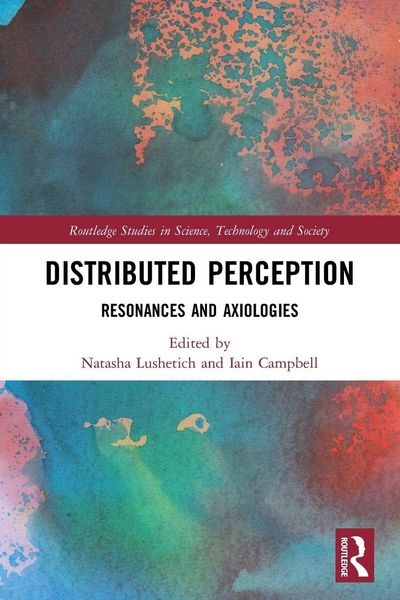
Distributed Perception Resonances and Axiologies

72,99 €

inkl. gesetzl. MwSt., Versandkostenfrei


Beschreibung

Who, what, and where perceives, and how? What are the sedimentations, inscriptions, and axiologies of animal, human, and machinic perception/s? What are their perceptibilities? Deleuze uses the word 'visibilities' to indicate that visual perception isn't just a physiological given but cues operations...

Beschreibung

Who, what, and where perceives, and how? What are the sedimentations, inscriptions, and axiologies of animal, human, and machinic perception/s? What are their perceptibilities? Deleuze uses the word 'visibilities' to indicate that visual perception isn't just a physiological given but cues operations productive of new assemblages. Perceptibilities are, by analogy, spatio-temporal, geolocative, kinaesthetic, audio-visual, and haptic operations that are always already memory. In the case of strong inscriptions, they are also epigenetic events.

In physics, resonance is the tendency of a system to vibrate with increasing amplitudes at certain frequencies of excitation. In cybernetics and in theories of technology, it refers to systems' feedback. In Native science, resonance denotes the axiology of positions and events. It's a form of multi-species perception that emphasises emergent directionality and protean mnemonics.

This transdisciplinary volume brings together key theorists and practitioners from media theory, Native science, bio-media and sound art, philosophy, art his- tory, and design informatics to examine: a) the becoming-technique of animal- human-machinic perceptibilities; and b) micro-perceptions that lie beneath the threshold of known perceptions yet create energetic vibrations. The volume shows distributed perception to be a key notion in addressing the emergence and peristence of plant, animal, human, and machine relations.

Rezension

"What is perception? A presentation, as Husserl said? A bodily shaping, as Merleau-Ponty defined it? Or the mere illusion of reality, as Derrida affirmed? Neither, Lushetich and Campbell answer. Delocalising perception from the scene of the human world, they show, through this extraordinary set of essays, that perception does not focus on objects but navigates between thresholds. Trans-materiality, trans-temporality, natural artificiality or biological mechanisms are currently deconstructing the deconstruction of presence itself. A major achievement."---Catherine Malabou, Kingston University, London

"Distributed Perception arrives just in time. Confusion is at a fever pitch about the technological qualities of perception and how natural and machine intelligence are inextricable from its cuts and continuities. This diverse collection provides multifaceted perspectives on what is at stake, what we know, what we don't know and what may have been forgotten."---Benjamin Bratton, University of California San Diego

"Distributed Perception is a truly imaginative and novel intervention into media studies of perception. A collection of some of the most innovative thinkers in digital media studies, the book creatively avoids reductive discourses concerning planetary scale computing and the denaturalization of human perception to ask a new set of questions. At stake in these many accounts is a fundamental investigation about how we produce and "feel" difference-in scales, in species, in social systems--and ultimately how we hope to construct our relationship to others and the world in the future."---Orit Halpern, Concordia University, Montreal

Produktdetails

Einband

Taschenbuch

Erscheinungsdatum

25.09.2023

Abbildungen

23 SW-Abb., 19 SW-Fotos, 4 SW-Zeichn.

Herausgeber Lushetich Natasha + weitere

Produktdetails

Einband

Taschenbuch

Erscheinungsdatum

25.09.2023

Abbildungen

23 SW-Abb., 19 SW-Fotos, 4 SW-Zeichn.

Herausgeber
Verlag Taylor & Francis
Seitenzahl

304

Maße (L/B/H)

23,4/15,6/1,6 cm

Gewicht

465 g

Sprache

Englisch

ISBN

978-0-367-74300-0

EU-Ansprechpartner

Taylor & Francis Verlag GmbH
Kaufingerstraße 24
80331 München
DE
GPSR@taylorandfrancis.com

Herstelleradresse

Taylor & Francis Group
5 Howick Place
SW1P 1WG London
UK
GPSR@taylorandfrancis.com

Ein neues Kapitel für Ihre Bücher

Ein neues Kapitel für Ihre Bücher

Schenken Sie Ihren alten Schätzen ein zweites Leben und erhalten Sie dafür eine Thalia Geschenkkarte.

Jetzt verkaufen
Jetzt verkaufen

Noch keine Bewertungen vorhanden

Verfassen Sie die erste Bewertung zu diesem Artikel

Helfen Sie anderen Kundinnen und Kunden durch Ihre Meinung.

Kundinnen und Kunden meinen

Bewertungen (0)

Die Leseprobe wird geladen.
  • Produktbild: Distributed Perception
  • Produktbild: Distributed Perception
  • Introduction Part I: Entanglement 1. Relational Philosophy: The Stars are Our Relatives 2. Turning Around and Upside Down: The Nomadic Rhythms of Rain Ants in Sarayaku 3. Do Media Have a Sense of Time? Chrono-technical Interoception 4. Oscilloscopes, Slide Rules and Nematodes: Towards Heterogenetic Perception in/of AI 5. Composing with Resonance, Sounding the Inaudible and Listening for More-than-One 6. The Discrete Charm of Systems Theories: Cybernetic Intelligence and Posthuman Art Environments Part II: Plasticity 7. Unstable Brains and Ordered Societies: On the Conceptual Origins of Plasticity, ca 1900 8. The Human and Nonhuman in the Capitalist production of Subjectivity 9. Resonance Between Sense, Plasticity and Biosemiosis 10. How We Never Became Posthuman: Homeostasis as Conflict from Claude Bernard to Norbert Wiener 11. Intra-Action in Data-Driven Systems: A Case Study in Creative Praxis Part III: Organology 12. Becoming-Distributed Matter: Dreaming and Extended Relationality Among Indigenous Australians 13. Two Painted Flies: Improvised Arts of Perception in Uexküll's Picture Book of Invisible Worlds 14. From Physiological Aesthetics to Anthropological Poetics: Activating the Pictographs of Cerro Azul 15. The Relativity of Life: Cinema as Time Microscope 16. Battlebots, Machine Surrogates and the Organology of Violence Televisual Entertainment 17. Autobiographing our Computing Organs: Rereading Pastw Uses of Intel CPUs as Xenotransplantation Concluding Thoughts