















































KI-Beratung Beta

Gutscheinbedingungen

Gültig bis 30.11.2026 | Gültig für nicht preisgebundene fremdsprachige Bücher | Einzelne Artikel können ausgeschlossen sein | Online auf thalia.de und in der Thalia App einlösbar | Click & Collect nur mit Online-Zahlung (Paypal/Kreditkarte) vorab | Nicht kombinierbar mit anderen Gutscheinen oder Preisaktionen | Nur einmal pro Einkauf einlösbar | Gutschein wird auf max. 500€ Bestellwert angerechnet | Keine Barauszahlung | Nicht gültig für Versandkosten und Services

  • Produktbild: Quantum Machine Learning
  • Produktbild: Quantum Machine Learning
- 12%

Quantum Machine Learning Thinking and Exploration in Neural Network Models for Quantum Science and Quantum Computing

12% sparen

121,99 € UVP 139,09 €

inkl. gesetzl. MwSt., Versandkostenfrei


Beschreibung

This book presents a new way of thinking about quantum mechanics and machine learning by merging the two. Quantum mechanics and machine learning may seem theoretically disparate, but their link becomes clear through the density matrix operator which can be readily approximated by neural network models,...

Beschreibung

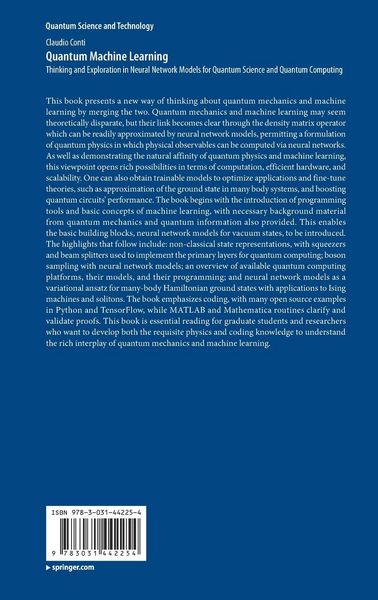
This book presents a new way of thinking about quantum mechanics and machine learning by merging the two. Quantum mechanics and machine learning may seem theoretically disparate, but their link becomes clear through the density matrix operator which can be readily approximated by neural network models, permitting a formulation of quantum physics in which physical observables can be computed via neural networks. As well as demonstrating the natural affinity of quantum physics and machine learning, this viewpoint opens rich possibilities in terms of computation, efficient hardware, and scalability. One can also obtain trainable models to optimize applications and fine-tune theories, such as approximation of the ground state in many body systems, and boosting quantum circuits’ performance. The book begins with the introduction of programming tools and basic concepts of machine learning, with necessary background material from quantum mechanics and quantum information also provided. This enables the basic building blocks, neural network models for vacuum states, to be introduced. The highlights that follow include: non-classical state representations, with squeezers and beam splitters used to implement the primary layers for quantum computing; boson sampling with neural network models; an overview of available quantum computing platforms, their models, and their programming; and neural network models as a variational ansatz for many-body Hamiltonian ground states with applications to Ising machines and solitons. The book emphasizes coding, with many open source examples in Python and TensorFlow, while MATLAB and Mathematica routines clarify and validate proofs. This book is essential reading for graduate students and researchers who want to develop both the requisite physics and coding knowledge to understand the rich interplay of quantum mechanics and machine learning.

Produktdetails

Einband

Gebundene Ausgabe

Erscheinungsdatum

03.01.2024

Abbildungen

XXIII, 378 p. 109 illus., 66 illus. in color.

Verlag Springer

Produktdetails

Einband

Gebundene Ausgabe

Erscheinungsdatum

03.01.2024

Abbildungen

XXIII, 378 p. 109 illus., 66 illus. in color.

Verlag Springer
Seitenzahl

378

Maße (L/B/H)

24,1/16/2,8 cm

Gewicht

718 g

Auflage

24001 Auflage 1st edition 2024

Sprache

Englisch

ISBN

978-3-031-44225-4

Herstelleradresse

Springer-Verlag KG
Sachsenplatz 4-6
1201 Wien
AT

Email: ProductSafety@springernature.com

Ein neues Kapitel für Ihre Bücher

Ein neues Kapitel für Ihre Bücher

Schenken Sie Ihren alten Schätzen ein zweites Leben und erhalten Sie dafür eine Thalia Geschenkkarte.

Jetzt verkaufen
Jetzt verkaufen

Noch keine Bewertungen vorhanden

Verfassen Sie die erste Bewertung zu diesem Artikel

Helfen Sie anderen Kundinnen und Kunden durch Ihre Meinung.

Kundinnen und Kunden meinen

Bewertungen (0)

  • Produktbild: Quantum Machine Learning
  • Produktbild: Quantum Machine Learning
  • Chapter 1: Quantum mechanics and data-driven physics.- Chapter 2: Kernelizing quantum mechanics.- Chapter 3: Qubit maps.- Chapter 4: One qubit transverse-field Ising model and variational quantum algorithms.- Chapter 5: Two-qubit transverse-field Ising model and entanglement.- Chapter 6: Variational Algorithms, Quantum Approximation Optimization and Neural Network Quantum States with two-qubits.- Chapter 7: Phase space representation.- Chapter 8: States as a neural networks and gates as pullbacks.- Chapter 9: Quantum reservoir computing.- Chapter 10: Squeezing, beam splitters, and detection.- Chapter 11: Uncertainties and entanglement.- Chapter 12: Gaussian boson sampling.- Chapter 13: Variational circuits for quantum solitons.