















































KI-Beratung Beta

Gutscheinbedingungen

Gültig bis 30.11.2026 | Gültig für nicht preisgebundene fremdsprachige Bücher | Einzelne Artikel können ausgeschlossen sein | Online auf thalia.de und in der Thalia App einlösbar | Click & Collect nur mit Online-Zahlung (Paypal/Kreditkarte) vorab | Nicht kombinierbar mit anderen Gutscheinen oder Preisaktionen | Nur einmal pro Einkauf einlösbar | Gutschein wird auf max. 500€ Bestellwert angerechnet | Keine Barauszahlung | Nicht gültig für Versandkosten und Services

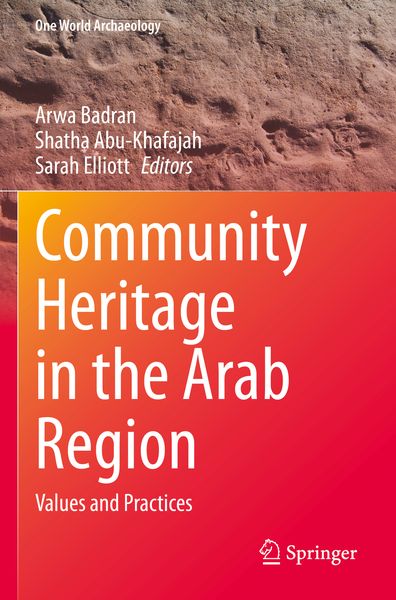
Produktbild: Community Heritage in the Arab Region
- 13%

Community Heritage in the Arab Region Values and Practices

Aus der Reihe One World Archaeology
13% sparen

59,99 € UVP 69,54 €

inkl. gesetzl. MwSt., Versandkostenfrei


Beschreibung

This book investigates approaches to community heritage within the Arab region and the underlying theories associated with these approaches. It aims, within the context of the region, to define ‘community’ and ‘heritage’, as well as examine the emergence and development of this field. The volume’s contributors...

Beschreibung

This book investigates approaches to community heritage within the Arab region and the underlying theories associated with these approaches. It aims, within the context of the region, to define ‘community’ and ‘heritage’, as well as examine the emergence and development of this field. The volume’s contributors deploy a wealth of case studies from the Middle East and North Africa to provide a unique forum for discussion, comparability, analysis and deeper understandings of current trends in community heritage. 

In particular, the volume explores the relationship between communities and their heritage, the meanings and values placed upon it, the nature and degree of community participation and engagement in its interpretation and management, and how its different registers affect and produce sometimes unexpected community heritage formations. It also examines the level of responsibility held within the profession towards this essentially democratic process of public participation in their heritage in a region shaped by controversial histories, political turmoil and tourism-driven economies.

The volume builds on current research and practice in community heritage globally by debating and re-centring a suite of familiar and new issues related to hitherto under-researched regional-specific methodologies, and developing fresh insight into the theoretical underpinning of these practices. It will be of value to heritage scholars and practitioners as well as those interested in politics, identity, education and the dynamics of heritage-based sustainable development.

Portrait


Arwa Badran is an Independent Researcher and consultant on museums and heritage education. She trained as an archaeologist at the University of Jordan, working in the field across multiple sites, before gaining her MA and PhD from Newcastle University, degrees that focused on building connections between museums and the public and introducing museums to the Jordanian school curricula. Her subsequent work as a lecturer in Museum Studies at the Hashemite University in Jordan was instrumental in the development and establishment of the first BA degree in Cultural Heritage and Museology in the Middle East. More recently, she worked as a course tutor and co-director on the International Cultural Heritage Management MA programme at Durham University, and as a researcher on an AHRC funded project on youth engagement in Jordan’s museums. She has worked as a consultant on many heritage education and community development projects, and has been involved at a senior level with the World Archaeological Congress for over a decade.  

Shatha Abu-Khafajah is an Associate Professor on the Architecture programme at the Hashemite University in Jordan. She graduated as an architect from the University of Jordan in 1997 and went on to specialize in the documentation and conservation of archaeological heritage while completing a Master’s degree in Archaeology. Her PhD in Cultural Heritage Management from Newcastle University, obtained in 2007, enabled her to synthesize architecture and archaeology with a special interest in establishing a sustainable approach to heritage management in the Arab region that is community-based and context-oriented.

Sarah Elliott is an Independent Scholar with research interests in ecomuseology, community museology and the theories of new museology, all positioned recently within Turkish Area Studies. The emergence and significance of postmodern approaches in contemporary Turkish museology has been the focus of British Academy funded work, and previous Arts and Humanities Research Council (AHRC) and British Institute at Ankara (BIAA) funded PhD research at Newcastle University examined the impact of large dams on the cultural heritage of southeast Turkey, addressed through an ecomuseum-centered methodology. Hasankeyf, a sui generis medieval town threatened by the Ilisu Dam, was the case study for the latter. Building on these projects, her current research concerns the historical and contemporary representation of ethnic minority communities in Turkey’s museums.

Produktdetails

Einband

Taschenbuch

Erscheinungsdatum

10.11.2023

Abbildungen

XLVII, 323 p. 1 illus.

Herausgeber Arwa Badran + weitere

Produktdetails

Einband

Taschenbuch

Erscheinungsdatum

10.11.2023

Abbildungen

XLVII, 323 p. 1 illus.

Herausgeber
Verlag Springer
Seitenzahl

323

Maße (L/B/H)

23,5/15,5/1,9 cm

Gewicht

631 g

Sprache

Englisch

ISBN

978-3-031-07448-6

Herstelleradresse

Springer-Verlag KG
Sachsenplatz 4-6
1201 Wien
AT

Email: ProductSafety@springernature.com

Ein neues Kapitel für Ihre Bücher

Ein neues Kapitel für Ihre Bücher

Schenken Sie Ihren alten Schätzen ein zweites Leben und erhalten Sie dafür eine Thalia Geschenkkarte.

Jetzt verkaufen
Jetzt verkaufen

Noch keine Bewertungen vorhanden

Verfassen Sie die erste Bewertung zu diesem Artikel

Helfen Sie anderen Kundinnen und Kunden durch Ihre Meinung.

Kundinnen und Kunden meinen

Bewertungen (0)

  • Produktbild: Community Heritage in the Arab Region

  • Introduction: Shifting the Gaze: Community Heritage Modalities in the Arab Region (Arwa Badran).- Part 1. Paradigm Shifts: The ‘Communities’ Factor.- Chapter 1. Prejudice, Military Intelligence and Neoliberalism: Examining the Local within Archaeology and Heritage Practices in Jordan (Shatha Abu-Khafajah).- Chapter 2. Community Archaeology at Umm el-Jimal: Including the Recently Settled Umm el-Jimal Community in the Heritage of the Ancient Site (Bert De Vries) .- Chapter 3. Making Social Engagement Sustainable: Insights from the Temple of the Winged Lions Cultural Resource Management Initiative in Petra, Jordan (Glenn J. Corbett) .- Chapter 4. Mobilizing Heritage Resources for Local Community Development: Dahshour as a Case Study (Fekri A. Hassan) .- PART 2. A Cross-Section of Practices.- Chapter 5. Public Archaeology and Engagement in the Origins of Doha and Qatar Project (Colleen Morgan) .- Chapter 6. The Siq Stability Project: A Pilot Approach to Community Engagement and Public Awareness in Petra (Giorgia Cesaro) .- Chapter 7. Heritage and Community Involvement: The Case of Sharjah Fort (Al Hisn) Museum (Manal Ataya) .- Chapter 8. Protecting the Heritage of Salt: Multidisciplinary Participation and Community Engagement (Leen A. Fakhoury).- PART 3. Heritage in Crisis: Acts of Resilience, Recovery and Reconfiguration.- Chapter 9. Conflicting Futures for Non-conflict Archaeology: A Lebanese Case Study (Alison Damick) .- Chapter 10. The Management of Syrian Archaeological Heritage Before and During the Syrian Conflict: A Comparison Study (Isber Sabrine) .- Chapter 11. Invoking Awneh: Community Heritage in Palestine (Hamdan Taha) .- Chapter 12. Renegotiating Landscapes Through Digital Imagery: Heritage Destruction in Syria and Iraq (Nicole D. Payntar).- PART 4. Giving Children Keys to the Past.- Chapter 13. ‘I Am Jarash’: A Resource Kit for Jordan (Arwa Badran) .- Chapter 14. Who Wants to be an Archaeologist? (Khawlah Goussous).