















































KI-Beratung Beta

Gutscheinbedingungen

Gültig bis 30.11.2026 | Gültig für nicht preisgebundene fremdsprachige Bücher | Einzelne Artikel können ausgeschlossen sein | Online auf thalia.de und in der Thalia App einlösbar | Click & Collect nur mit Online-Zahlung (Paypal/Kreditkarte) vorab | Nicht kombinierbar mit anderen Gutscheinen oder Preisaktionen | Nur einmal pro Einkauf einlösbar | Gutschein wird auf max. 500€ Bestellwert angerechnet | Keine Barauszahlung | Nicht gültig für Versandkosten und Services

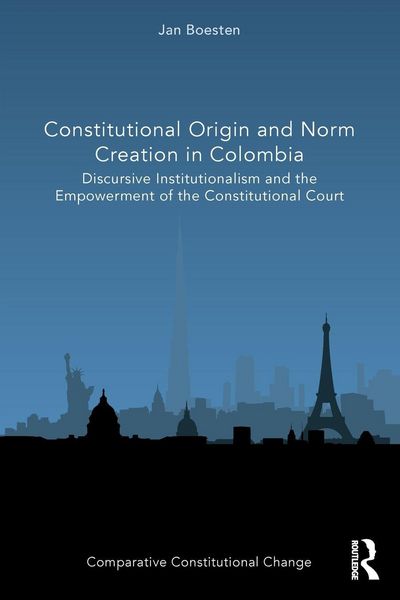
  • Produktbild: Constitutional Origin and Norm Creation in Colombia
  • Produktbild: Constitutional Origin and Norm Creation in Colombia

Constitutional Origin and Norm Creation in Colombia Discursive Institutionalism and the Empowerment of the Constitutional Court

72,99 €

inkl. gesetzl. MwSt., Versandkostenfrei


Beschreibung

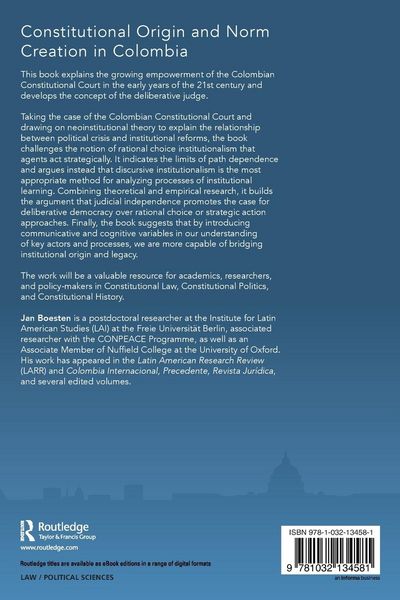
This book explains the growing empowerment of the Colombian Constitutional Court in the early years of the 21st century and develops the concept of the deliberative judge.

Taking the case of the Colombian Constitutional Court and drawing on neoinstitutional theory to explain the relationship between political...

Beschreibung

This book explains the growing empowerment of the Colombian Constitutional Court in the early years of the 21st century and develops the concept of the deliberative judge.

Taking the case of the Colombian Constitutional Court and drawing on neoinstitutional theory to explain the relationship between political crisis and institutional reforms, the book challenges the notion of rational choice institutionalism that agents act strategically. It indicates the limits of path dependence and argues instead that discursive institutionalism is the most appropriate method for analyzing processes of institutional learning. Combining theoretical and empirical research, it builds the argument that judicial independence promotes the case for deliberative democracy over rational choice or strategic action approaches. Finally, the book suggests that by introducing communicative and cognitive variables in our understanding of key actors and processes, we are more capable of bridging institutional origin and legacy.

The work will be a valuable resource for academics, researchers, and policy-makers in Constitutional Law, Constitutional Politics, and Constitutional History.

Rezension

"The Colombian Constitutional Court's 2010 decision striking down a constitutional amendment that would have allowed President Alvaro Uribe to run for a third term was a landmark ruling in defense of democracy. Jan Boesten develops a novel and convincing explanation for the decision, one which takes both law and history seriously. Students and scholars of comparative constitutional law and politics will learn much from his careful account."

David E. Landau, Mason Ladd Professor, Florida State University, College of Law, USA

"In 2010 Colombia's Constitutional Court blocked a constitutional ammendment that allowed then President Alvaro Uribe to run for a third term. It did so arguing the ammendment breached the spirit of the 1991 Constitution, threatening its integrity by upstetting a delicate system of checks and balances. In this book Jan Boesten sagely illustrates the audicity of this decision, by which a Court successfully challenged the ambitions of the most popular president in a century. In order to explain this counterintuitive result, Boesten delves into the complexities of the Court's collective excercise in public reasoning, the centrality of the lasting democratic legacy of the 1991 Constitution, and the challenges of democratic governance in a country torn by armed conflict. This book is required reading for scholars of comparative constitutionalism, as well as for anyone intersted in the complex politics of law in violent contexts, and the role of judges as `architects of peace'."

Julieta Lemaitre Ripoll, Associate Professor of Law, Universidad de los Andes

Judge, Justice Chambers of the Special Peace Jurisdiction in Bogotá, Colombia

"The Colombian case study is not only remarkable on its own terms, but is also highly relevant to the wider debates currently ongoing throughout the world's constitutional democracies concerning courts as political actors and the judicialization of politics. In particular it invites reflection on what basis they may uphold the separation of powers in a climate characterized by citizen distrust of remote institutions, and executive encroachment on all countervailing sources of restraint on the powers of government."

Laurence Whitehead, Nuffield College, University of Oxford

Produktdetails

Einband

Taschenbuch

Erscheinungsdatum

29.01.2024

Abbildungen

12 SW-Abb., 12 SW-Zeichn., 12 Tabellen

Verlag Taylor & Francis

Produktdetails

Einband

Taschenbuch

Erscheinungsdatum

29.01.2024

Abbildungen

12 SW-Abb., 12 SW-Zeichn., 12 Tabellen

Verlag Taylor & Francis
Seitenzahl

288

Maße (L/B/H)

23,4/15,6/1,6 cm

Gewicht

442 g

Sprache

Englisch

ISBN

978-1-03-213458-1

Herstelleradresse

Libri GmbH
Europaallee 1
36244 Bad Hersfeld
DE

Email: GPSR Kontakt

Ein neues Kapitel für Ihre Bücher

Ein neues Kapitel für Ihre Bücher

Schenken Sie Ihren alten Schätzen ein zweites Leben und erhalten Sie dafür eine Thalia Geschenkkarte.

Jetzt verkaufen
Jetzt verkaufen

Noch keine Bewertungen vorhanden

Verfassen Sie die erste Bewertung zu diesem Artikel

Helfen Sie anderen Kundinnen und Kunden durch Ihre Meinung.

Kundinnen und Kunden meinen

Bewertungen (0)

Die Leseprobe wird geladen.
  • Produktbild: Constitutional Origin and Norm Creation in Colombia
  • Produktbild: Constitutional Origin and Norm Creation in Colombia
  • 1. Introduction: Ethical Legal Discourse in Delegative Democracies 2. The Novelty of the 1991 Constitution: A Critical Juncture in Colombia's history 3. The Choque de Trenes between Colombia's High Courts: Path Dependence and Legal Argumentation 4. Discursive Institutionalism in Colombia's Constitutional Court: The Deliberative Judge and Norm Creation in a Politicized Context 5. Conclusion: The Preeminence of Democratic Legality over Democratic Security and Discursive Institutionalism 6. Epilogue