















































KI-Beratung Beta

Produktbild: Biochemistry and Cell Biology of Ageing: Part III Biomedical Science
Band 102 - 13%

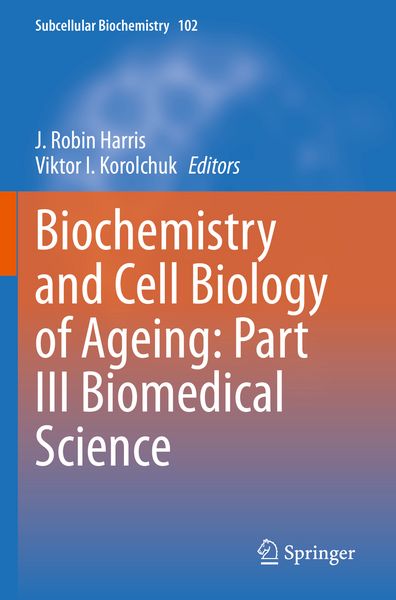
Biochemistry and Cell Biology of Ageing: Part III Biomedical Science

Aus der Reihe Subcellular Biochemistry
13% sparen

166,99 € UVP 192,59 €

inkl. gesetzl. MwSt., Versandkostenfrei


Beschreibung

This book provides a state-of-the-art overview of key areas of subcellular aging research in human cells.

The reader is introduced to the historical development and progress in biomedical aging research and learns, for example, about the role of microRNAs, circRNAs, mitochondria and extracellular vesicles...

Beschreibung

This book provides a state-of-the-art overview of key areas of subcellular aging research in human cells.


The reader is introduced to the historical development and progress in biomedical aging research and learns, for example, about the role of microRNAs, circRNAs, mitochondria and extracellular vesicles in cellular senescence. The reader will also learn more about how gap junctions, the nuclear pore complex and the proteasome are affecting the ageing processes. In addition, novel therapeutic opportunities through modulation of cellular senescence are discussed.


The book follows on from Parts I and II of 
Biochemistry and Cell Biology of Ageing
 (Volumes 90 and 91 of the
Subcellular Biochemistry
book series) by covering interesting and significant biomedical ageing topics not included in the earlier volumes. Comprehensive and cutting-edge, this book is a valuable resource for experienced researchers and early career scientist alike, who are interested in learning more about the fascinating and challenging question of why and how our cells age.


Portrait


Prof J. Robin Harris
is an Honorary Professor of the University of Mainz, who specialized in macromolecular electron microscopy.  He has been the Series Editor of the Subcellular Biochemistry Series for many years and his broad scientific interests are reflected in the diversity of content of the Series.

Dr Viktor Korolchuk
is Reader in Molecular Cell Biology at Newcastle University. His scientific interests lie in the area of intracellular protein trafficking and degradation pathways. The current focus of research in his laboratory is autophagy (literally self-eating) where portions of cytoplasm are recruited into intracellular vesicles called autophagosomes and transported for degradation by lysosomal hydrolases. 

Produktdetails

Einband

Taschenbuch

Erscheinungsdatum

07.01.2024

Abbildungen

IX, 424 p. 1 illus.

Herausgeber J. Robin Harris + weitere

Produktdetails

Einband

Taschenbuch

Erscheinungsdatum

07.01.2024

Abbildungen

IX, 424 p. 1 illus.

Herausgeber
Verlag Springer
Seitenzahl

424

Maße (L/B/H)

23,5/15,5/2,4 cm

Gewicht

657 g

Auflage

24001 Auflage 1st ed. 2023

Sprache

Englisch

ISBN

978-3-031-21412-7

Herstelleradresse

Springer-Verlag KG
Sachsenplatz 4-6
1201 Wien
AT

Email: ProductSafety@springernature.com

Ein neues Kapitel für Ihre Bücher

Ein neues Kapitel für Ihre Bücher

Schenken Sie Ihren alten Schätzen ein zweites Leben und erhalten Sie dafür eine Thalia Geschenkkarte.

Jetzt verkaufen
Jetzt verkaufen

Noch keine Bewertungen vorhanden

Verfassen Sie die erste Bewertung zu diesem Artikel

Helfen Sie anderen Kundinnen und Kunden durch Ihre Meinung.

Kundinnen und Kunden meinen

Bewertungen (0)

  • Produktbild: Biochemistry and Cell Biology of Ageing: Part III Biomedical Science

  • Chapter 1: Introduction: Progression of the Science of Ageing.- Chapter 2: Chromatin structure from development to ageing.- Chapter 3: The nuclear envelope in ageing and progeria.- Chapter 4: Mitochondrial DNA mutations and ageing.- Chapter 5: The Proteasome and Ageing.- Chapter 6: Gap junctions and Ageing.- Chapter 7: Cellular senescence and ageing.- Chapter 8: Therapeutic opportunities presented by modulation of cellular senescence.- Chapter 9: Ageing at Molecular Level: Role of MicroRNAs.- Chapter 10: CircRNAandAgeing.- Chapter 11: Extracellular vesicles and cellular ageing.- Chapter 12: Fibrinogen, Coagulation and Ageing.- Chapter 13: An Insight intoPlateletsat Older Age:Cellular and Clinical Perspectives.- Chapter 14: Ageing skeletal muscle: The ubiquitous muscle stem cell.- Chapter 15: Age-related changes in central nervous system 5-hydroxytryptamine signalling and its potential effects on the regulation of lifespan.- Chapter 16: Systems Biology of Ageing.