















































KI-Beratung Beta

Gutscheinbedingungen

Gültig bis 30.11.2026 | Gültig für nicht preisgebundene fremdsprachige Bücher | Einzelne Artikel können ausgeschlossen sein | Online auf thalia.de und in der Thalia App einlösbar | Click & Collect nur mit Online-Zahlung (Paypal/Kreditkarte) vorab | Nicht kombinierbar mit anderen Gutscheinen oder Preisaktionen | Nur einmal pro Einkauf einlösbar | Gutschein wird auf max. 500€ Bestellwert angerechnet | Keine Barauszahlung | Nicht gültig für Versandkosten und Services

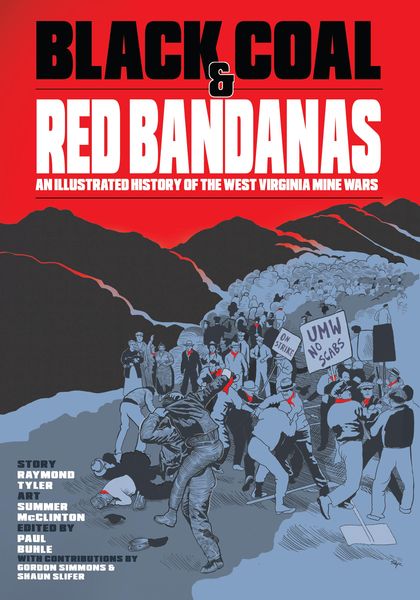
Produktbild: Black Coal and Red Bandanas

Black Coal and Red Bandanas An Illustrated History of the West Virginia Mine Wars

19,99 €

inkl. gesetzl. MwSt., Versandkostenfrei


Beschreibung

In the early-20th century, strikes and union battles were common in industrial centers throughout the US. But nothing compared to the class warfare of the West Virginia Mine Wars. The origins of this protracted rebellion were in the dictatorial rule of the coal companies over the proud, multi-racial,...

Beschreibung

In the early-20th century, strikes and union battles were common in industrial centers throughout the US. But nothing compared to the class warfare of the West Virginia Mine Wars. The origins of this protracted rebellion were in the dictatorial rule of the coal companies over the proud, multi-racial, immigrant and native-born miners of Appalachia.
Our illustrated history begins with Mary Harris "Mother" Jones's arrival at the turn of the century. White-haired, matronly, and fiercely socialist, Jones became known as the "miners’ angel," and helped turn the fledgling United Mine Workers into the nation’s most powerful labor union. "Pray for the dead and fight like hell for the living," was her famous battle cry.
In 1912, miners led by stubborn Frank Keeney struck against harsh conditions in the work camps of Paint and Cabin Creeks. Coal operators responded by enlisting violent Baldwin-Felts guards. The ensuing battles and murderous events caused the governor to declare and execute martial law on a scale unprecedented in the US.
On May 19, 1920, in response to evictions by coal company agents, gunshots rang through the streets of a small-town in "Bloody Mingo" county. In an event soon known as the "Matewan Massacre"; the pro-union, quick-draw chief of police Smilin’ Sid Hatfield became an unexpected celebrity—but also a marked man.
Events climax with the dramatic Battle of Blair Mountain that pitched the spontaneous Red Neck Army of 10,000 armed strikers against a paid army of gun thugs in the largest labor uprising in US history and the largest armed uprising since the American Civil War.
This graphic interpretation of people’s history features unforgettable main characters while also displaying the diverse rank and file workers who stood in solidarity during this struggle.

Produktdetails

Einband

Taschenbuch

Erscheinungsdatum

29.10.2024

Abbildungen

Illustrationen, nicht spezifiziert

Illustriert von

Summer McClinton

Produktdetails

Einband

Taschenbuch

Erscheinungsdatum

29.10.2024

Abbildungen

Illustrationen, nicht spezifiziert

Illustriert von

Summer McClinton

Herausgeber Paul Buhle
Verlag Ingram Publishers Services
Seitenzahl

136

Maße (L/B/H)

25,4/17,4/0,7 cm

Gewicht

296 g

Farbe

Kaffee / Lichtgrau

Sprache

Englisch

EAN

9798887440590

Herstelleradresse

Libri GmbH
Europaallee 1
36244 Bad Hersfeld
DE

Email: gpsr@libri.de

Ein neues Kapitel für Ihre Bücher

Ein neues Kapitel für Ihre Bücher

Schenken Sie Ihren alten Schätzen ein zweites Leben und erhalten Sie dafür eine Thalia Geschenkkarte.

Jetzt verkaufen
Jetzt verkaufen

Noch keine Bewertungen vorhanden

Verfassen Sie die erste Bewertung zu diesem Artikel

Helfen Sie anderen Kundinnen und Kunden durch Ihre Meinung.

Kundinnen und Kunden meinen

Bewertungen (0)

Weitere Artikel finden Sie in

Die Leseprobe wird geladen.
  • Produktbild: Black Coal and Red Bandanas
  • Foreword

    In Matewan, a Museum from Below

    Chapter 1: The Struggle Begins, Mother Jones and Frank Keeney

    Chapter 2: The Paint Creek & Cabin Creek Strikes
    Chapter 3: The Matewan Massacre

    Chapter 4: The Battle for Blair Mountain

    Afterword