















































KI-Beratung Beta

Gutscheinbedingungen

Gültig bis 11.11.2026 | Gültig für Spielzeug, Filme, Musik, Software, Games, Geschenke & Trends, Schreibwaren, Hörbücher und Hörbuch-Downloads (außer Abo & Shelfies), gebrauchte Bücher, nicht preisgebundene Bücher und Kalender | Einlösbar unter thalia.de und in der Thalia App | Click & Collect nur mit Online-Zahlung (Paypal/Kreditkarte) vorab | Einzelne Artikel können ausgeschlossen sein | Nicht kombinierbar mit anderen Gutscheinen oder Preisaktionen | Nur einmal pro Einkauf einlösbar | Gutschein wird auf max. 500€ Bestellwert angerechnet | Keine Barauszahlung | Digitale Hörbücher nur für Android  | Nicht gültig für preisgebundene Artikel (aufgrund der Buchpreisbindung sind Gutscheine nicht auf Bücher, eBooks, Presse einlösbar), tolino eReader & Zubehör, Abonnements & Flatrates, Geschenkkarten, Versandkosten und Services

  • Produktbild: Dealing with Totalitarian Regimes and Human Rights
  • Produktbild: Dealing with Totalitarian Regimes and Human Rights
Band 11 - 13%

Dealing with Totalitarian Regimes and Human Rights A Polish-German Dialogue

13% sparen

157,99 € UVP 181,89 €

inkl. gesetzl. MwSt., Versandkostenfrei


Beschreibung

This book delves into the intertwined narratives of Poland and Germany's post-war experiences, shedding light on their shared trauma from World War II and subsequent confrontations with communism. Authored by scholars from Faculty of Law and Administration, University of Warsaw and Law School of Friedrich-Alexander...

Beschreibung

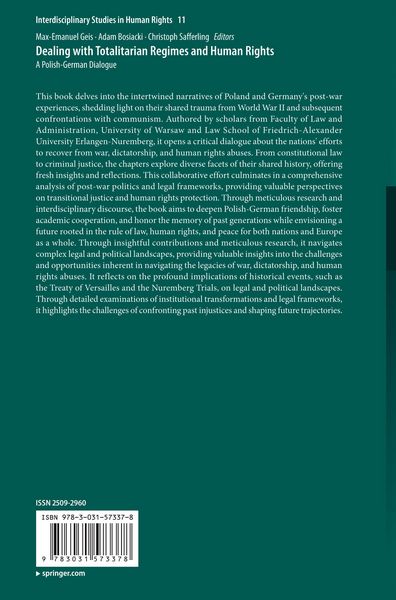
This book delves into the intertwined narratives of Poland and Germany's post-war experiences, shedding light on their shared trauma from World War II and subsequent confrontations with communism. Authored by scholars from Faculty of Law and Administration, University of Warsaw and Law School of Friedrich-Alexander University Erlangen-Nuremberg, it opens a critical dialogue about the nations' efforts to recover from war, dictatorship, and human rights abuses. From constitutional law to criminal justice, the chapters explore diverse facets of their shared history, offering fresh insights and reflections. This collaborative effort culminates in a comprehensive analysis of post-war politics and legal frameworks, providing valuable perspectives on transitional justice and human rights protection. Through meticulous research and interdisciplinary discourse, the book aims to deepen Polish-German friendship, foster academic cooperation, and honor the memory of past generations while envisioning a future rooted in the rule of law, human rights, and peace for both nations and Europe as a whole. Through insightful contributions and meticulous research, it navigates complex legal and political landscapes, providing valuable insights into the challenges and opportunities inherent in navigating the legacies of war, dictatorship, and human rights abuses. It reflects on the profound implications of historical events, such as the Treaty of Versailles and the Nuremberg Trials, on legal and political landscapes. Through detailed examinations of institutional transformations and legal frameworks, it highlights the challenges of confronting past injustices and shaping future trajectories.

Portrait

Dr. Max-Emanuel Geis is professor of German and Bavarian public and administrative law at the Friedrich-Alexander-University Erlangen-Nuremberg. Furthermore he is a Justice at the Bavarian Constitutional Court. He is also a member of the evaluation committee of the German Council of Science.

Dr. Adam Bosiacki is professor of public law and legal history at the University of Warsaw. He is the Director of the institute of sciences on state and law and head of the department of the history of political and legal thought. He has been a visiting scholar in a number of academic units, including Max-Planck-Institute in Frankfurt, Harvard University and the Hoover Institute at Stanford University. He is also teaching at the Jagiellonian University in Krakow.

Dr. Christoph Safferling , LL.M. (LSE) is professor of criminal law, criminal procedure and international law at the Friedrich-Alexander-University ErlangenNuremberg and the director of the International Criminal Law Research Unit. He is Director of the International Nuremberg Principles Academy and the Whitney R. Harris Fellow of the Robert H. Jackson Center in Jamestown, New York, USA.

Produktdetails

Einband

Gebundene Ausgabe

Erscheinungsdatum

30.06.2024

Abbildungen

XII, 257 p.

Herausgeber Max-Emanuel Geis + weitere

Produktdetails

Einband

Gebundene Ausgabe

Erscheinungsdatum

30.06.2024

Abbildungen

XII, 257 p.

Herausgeber
Verlag Springer
Seitenzahl

257

Maße (L/B/H)

24,1/16/2,1 cm

Gewicht

524 g

Auflage

2024

Sprache

Englisch

ISBN

978-3-031-57337-8

Herstelleradresse

Springer-Verlag KG
Sachsenplatz 4-6
1201 Wien
AT

Email: ProductSafety@springernature.com

Ein neues Kapitel für Ihre Bücher

Ein neues Kapitel für Ihre Bücher

Schenken Sie Ihren alten Schätzen ein zweites Leben und erhalten Sie dafür eine Thalia Geschenkkarte.

Jetzt verkaufen
Jetzt verkaufen

Noch keine Bewertungen vorhanden

Verfassen Sie die erste Bewertung zu diesem Artikel

Helfen Sie anderen Kundinnen und Kunden durch Ihre Meinung.

Kundinnen und Kunden meinen

Bewertungen (0)

  • Produktbild: Dealing with Totalitarian Regimes and Human Rights
  • Produktbild: Dealing with Totalitarian Regimes and Human Rights
  • Part I – Treaties and Trials: Historical Backdrop.- The Nuremberg Trial against the Major German War Criminal before the International Military Tribunal (1945-1946).- Failed justice and the victims of the Eastern Front of the First World War: Criminal justice – vigilante justice – political justice.- The Nuremberg Principles from Historical, Philosophical and Contemporary Legal Perspectives.- Criminal Defence at the Nuremberg Trial of the Major War Criminals: Strategies and Impact.- Part II – Observing and Restructuring: Institutional Emancipation.- The Long Shadows of the Past: The Federal Ministry of Justice and the Nazi Era.- Protecting the Democratic State Through Criminal Law – Legislation History and the Role of the Federal Public Prosecutor.- The Combat of Communist Ideology and Propaganda in the Legal Order of the Second Republic of Poland, 1918-1939.- Towards totalitarian regime: Legal and organisational aspects of transformation of defence and security forces.- Part III – Becoming Second Nature: Constitutional Lessons.- The Weimarian Methodological Debate In The Doctrine Of Constitutional Law.- The Development of the “Fortified Democracy” Concept.- Dealing with the National Socialist Past in Germany.- Reconciliation, transformation, historical policy. Legal aspects of settlements with totalitarian systems towards Poland since 1989.- Polish Property Transformations in the Context of Transitional Justice (since 1988).- The Legal Status of the Institute of National Remembrance - Commission for the Prosecution of Crimes Against the Polish Nation.