















































KI-Beratung Beta

Gutscheinbedingungen

Gültig bis 11.11.2026 | Gültig für Spielzeug, Filme, Musik, Software, Games, Geschenke & Trends, Schreibwaren, Hörbücher und Hörbuch-Downloads (außer Abo & Shelfies), gebrauchte Bücher, nicht preisgebundene Bücher und Kalender | Einlösbar unter thalia.de und in der Thalia App | Click & Collect nur mit Online-Zahlung (Paypal/Kreditkarte) vorab | Einzelne Artikel können ausgeschlossen sein | Nicht kombinierbar mit anderen Gutscheinen oder Preisaktionen | Nur einmal pro Einkauf einlösbar | Gutschein wird auf max. 500€ Bestellwert angerechnet | Keine Barauszahlung | Digitale Hörbücher nur für Android  | Nicht gültig für preisgebundene Artikel (aufgrund der Buchpreisbindung sind Gutscheine nicht auf Bücher, eBooks, Presse einlösbar), tolino eReader & Zubehör, Abonnements & Flatrates, Geschenkkarten, Versandkosten und Services

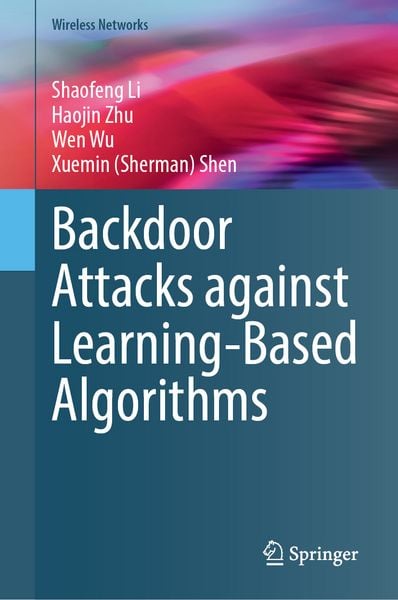
Produktbild: Backdoor Attacks against Learning-Based Algorithms
- 12%

Backdoor Attacks against Learning-Based Algorithms

Aus der Reihe Wireless Networks
12% sparen

139,99 € UVP 160,49 €

inkl. gesetzl. MwSt., Versandkostenfrei


Beschreibung

This book introduces a new type of data poisoning attack, dubbed, backdoor attack. In backdoor attacks, an attacker can train the model with poisoned data to obtain a model that performs well on a normal input but behaves wrongly with crafted triggers. Backdoor attacks can occur in many scenarios where...

Beschreibung

This book introduces a new type of data poisoning attack, dubbed, backdoor attack. In backdoor attacks, an attacker can train the model with poisoned data to obtain a model that performs well on a normal input but behaves wrongly with crafted triggers. Backdoor attacks can occur in many scenarios where the training process is not entirely controlled, such as using third-party datasets, third-party platforms for training, or directly calling models provided by third parties. Due to the enormous threat that backdoor attacks pose to model supply chain security, they have received widespread attention from academia and industry. This book focuses on exploiting backdoor attacks in the three types of DNN applications, which are image classification, natural language processing, and federated learning.
Based on the observation that DNN models are vulnerable to small perturbations, this book demonstrates that steganography and regularization can be adopted to enhance the invisibility of backdoor triggers. Based on image similarity measurement, this book presents two metrics to quantitatively measure the invisibility of backdoor triggers. The invisible trigger design scheme introduced in this book achieves a balance between the invisibility and the effectiveness of backdoor attacks. In the natural language processing domain, it is difficult to design and insert a general backdoor in a manner imperceptible to humans. Any corruption to the textual data (e.g., misspelled words or randomly inserted trigger words/sentences) must retain context-awareness and readability to human inspectors. This book introduces two novel hidden backdoor attacks, targeting three major natural language processing tasks, including toxic comment detection, neural machine translation, and question answering, depending on whether the targeted NLP platform accepts raw Unicode characters.
The emerged distributed training framework, i.e., federated learning, has advantages in preserving users' privacy. It has been widely used in electronic medical applications, however, it also faced threats derived from backdoor attacks. This book presents a novel backdoor detection framework in FL-based e-Health systems. We hope this book can provide insightful lights on understanding the backdoor attacks in different types of learning-based algorithms, including computer vision, natural language processing, and federated learning. The systematic principle in this book also offers valuable guidance on the defense of backdoor attacks against future learning-based algorithms.

Produktdetails

Einband

Gebundene Ausgabe

Erscheinungsdatum

30.05.2024

Abbildungen

XI, 153 p. 58 illus., 56 illus. in color.

Verlag Springer

Produktdetails

Einband

Gebundene Ausgabe

Erscheinungsdatum

30.05.2024

Abbildungen

XI, 153 p. 58 illus., 56 illus. in color.

Verlag Springer
Seitenzahl

153

Maße (L/B/H)

24,1/16/1,5 cm

Gewicht

372 g

Auflage

2024

Sprache

Englisch

ISBN

978-3-031-57388-0

Herstelleradresse

Springer-Verlag KG
Sachsenplatz 4-6
1201 Wien
AT

Email: ProductSafety@springernature.com

Ein neues Kapitel für Ihre Bücher

Ein neues Kapitel für Ihre Bücher

Schenken Sie Ihren alten Schätzen ein zweites Leben und erhalten Sie dafür eine Thalia Geschenkkarte.

Jetzt verkaufen
Jetzt verkaufen

Noch keine Bewertungen vorhanden

Verfassen Sie die erste Bewertung zu diesem Artikel

Helfen Sie anderen Kundinnen und Kunden durch Ihre Meinung.

Kundinnen und Kunden meinen

Bewertungen (0)

  • Produktbild: Backdoor Attacks against Learning-Based Algorithms

  • Introduction.- Literature Review of Backdoor Attacks.- Invisible Backdoor Attacks in Image Classification Based Network Services.- Hidden Backdoor Attacks in NLP Based Network Services.- Backdoor Attacks and Defense in FL.- Summary and Future Directions.