















































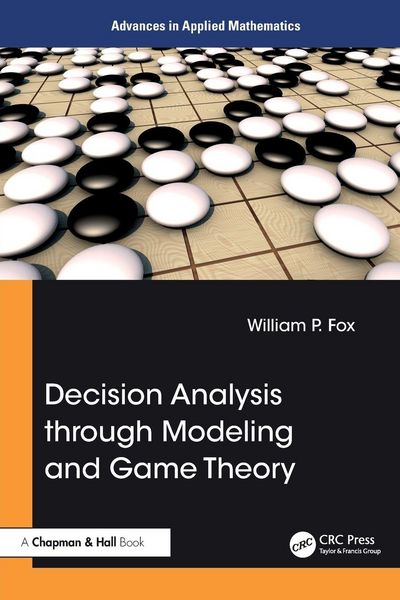
Decision Analysis through Modeling and Game Theory
-
- Hardcover
- Taschenbuch ausgewählt
- eBook
-
Sprache:Englisch
99,99 €
UVP
121,00 €
inkl. gesetzl. MwSt.,
Beschreibung
Produktdetails
Einband
Taschenbuch
Erscheinungsdatum
08.11.2024
Abbildungen
67 SW-Abb., 4 SW-Fotos, 63 SW-Zeichn., 20 Tabellen
Verlag
Taylor & FrancisSeitenzahl
316
Maße (L/B/H)
23,4/15,6/1,7 cm
Gewicht
483 g
Sprache
Englisch
ISBN
978-1-03-272691-5
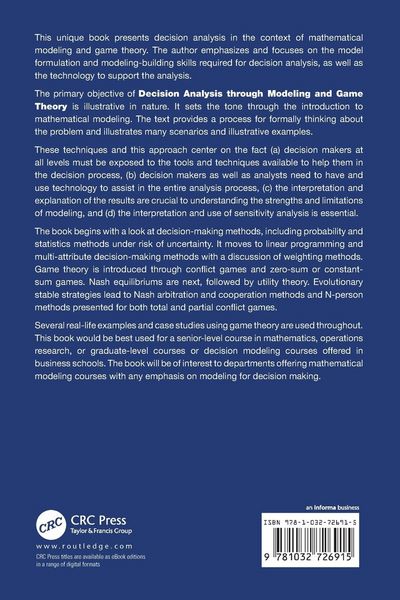
This unique book presents decision analysis in the context of mathematical modeling and game theory. The author emphasizes and focuses on the model formulation and modeling-building skills required for decision analysis, as well as the technology to support the analysis.
The primary objective of Decision Analysis through Modeling and Game Theory is illustrative in nature. It sets the tone through the introduction to mathematical modeling. The text provides a process for formally thinking about the problem and illustrates many scenarios and illustrative examples.
These techniques and this approach center on the fact (a) decision makers at all levels must be exposed to the tools and techniques available to help them in the decision process, (b) decision makers as well as analysts need to have and use technology to assist in the entire analysis process, (c) the interpretation and explanation of the results are crucial to understanding the strengths and limitations of modeling, and (d) the interpretation and use of sensitivity analysis is essential.
The book begins with a look at decision-making methods, including probability and statistics methods under risk of uncertainty. It moves to linear programming and multi-attribute decision-making methods with a discussion of weighting methods. Game theory is introduced through conflict games and zero-sum or constant-sum games. Nash equilibriums are next, followed by utility theory. Evolutionary stable strategies lead to Nash arbitration and cooperation methods and N-person methods presented for both total and partial conflict games.
Several real-life examples and case studies using game theory are used throughout. This book would be best used for a senior-level course in mathematics, operations research, or graduate-level courses or decision modeling courses offered in business schools. The book will be of interest to departments offering mathematical modeling courses with any emphasis on modeling for decision making.
Ein neues Kapitel für Ihre Bücher
Ein neues Kapitel für Ihre Bücher
Schenken Sie Ihren alten Schätzen ein zweites Leben und erhalten Sie dafür eine Thalia Geschenkkarte.
Noch keine Bewertungen vorhanden
Verfassen Sie die erste Bewertung zu diesem Artikel
Helfen Sie anderen Kundinnen und Kunden durch Ihre Meinung.
Kurze Frage zu unserer Seite
Vielen Dank für Ihr Feedback
Wir nutzen Ihr Feedback, um unsere Produktseiten zu verbessern. Bitte haben Sie Verständnis, dass wir Ihnen keine Rückmeldung geben können. Falls Sie Kontakt mit uns aufnehmen möchten, können Sie sich aber gerne an unseren Kund*innenservice wenden.
zum Kundenservice