















































KI-Beratung Beta

Gutscheinbedingungen

Gültig bis 11.11.2026 | Gültig für Spielzeug, Filme, Musik, Software, Games, Geschenke & Trends, Schreibwaren, Hörbücher und Hörbuch-Downloads (außer Abo & Shelfies), gebrauchte Bücher, nicht preisgebundene Bücher und Kalender | Einlösbar unter thalia.de und in der Thalia App | Click & Collect nur mit Online-Zahlung (Paypal/Kreditkarte) vorab | Einzelne Artikel können ausgeschlossen sein | Nicht kombinierbar mit anderen Gutscheinen oder Preisaktionen | Nur einmal pro Einkauf einlösbar | Gutschein wird auf max. 500€ Bestellwert angerechnet | Keine Barauszahlung | Digitale Hörbücher nur für Android  | Nicht gültig für preisgebundene Artikel (aufgrund der Buchpreisbindung sind Gutscheine nicht auf Bücher, eBooks, Presse einlösbar), tolino eReader & Zubehör, Abonnements & Flatrates, Geschenkkarten, Versandkosten und Services

Produktbild: Urban Metabolism and Climate Change
- 12%

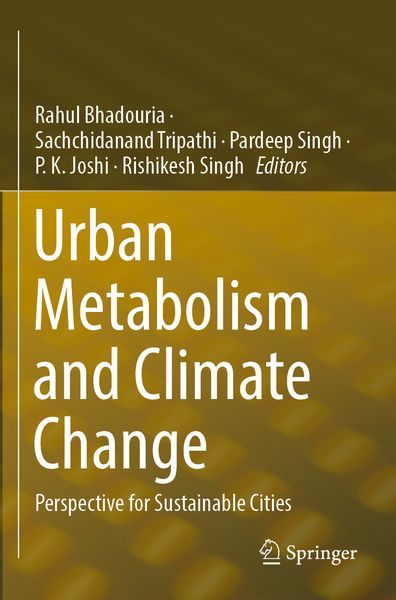
Urban Metabolism and Climate Change Perspective for Sustainable Cities

12% sparen

139,99 € UVP 160,49 €

inkl. gesetzl. MwSt., Versandkostenfrei


Beschreibung

Produktdetails

Einband

Taschenbuch

Erscheinungsdatum

25.05.2024

Abbildungen

XIV, 363 p. 69 illus., 64 illus. in color.

Herausgeber

Rahul Bhadouria + weitere

Verlag

Springer

Seitenzahl

363

Maße (L/B/H)

23,5/15,5/2 cm

Gewicht

644 g

Auflage

2023

Sprache

Englisch

ISBN

978-3-031-29424-2

Beschreibung

Portrait


Rahul Bhadouria
is working as an assistant professor at the Department of Environmental Studies, Delhi College of Arts and Commerce, University of Delhi, New Delhi, India. He obtained his doctoral degree from the Department of Botany, Banaras Hindu University, Varanasi, India. He has published more than 22 papers, 22 book chapters, and 8 edited books in internationally reputed journals/publishers. His current research areas are, management of soil C dynamics to mitigate climate change, a perspective on tree seedling survival and growth attributes in tropical dry forests under the realm of climate change, plant community assembly, functional diversity and soil attributes along the forest-savanna-grassland continuum in India, recovery of degraded mountains in central Himalayas and urban ecology.  


Sachchidanand Tripathi
 is presently working as Associate Professor, Department of Botany, Deen Dayal Upadhyaya College, University of Delhi, Delhi, India. Heobtained his doctoral degree from the Department of Botany, Banaras Hindu University, India. The areas of his interest are plant ecology, soil ecology, ecophysiology and urban ecology.  He has published more than 50 publications (including research publications, books and book chapters, conference proceedings) with reputed international journals and publishers.


Pardeep Singh
 is presently working as an Assistant Professor, Department of Environmental Science, PGDAV College University of Delhi, New Delhi, India. He obtained his doctoral degree from Indian Institute of Technology (Banaras Hindu University) Varanasi. He has published more than 75 papers in international journals in the field of Environmental Management. He has also edited more than 30 books with various publishers (Springer Nature, Elsevier, CRC, Wiley).


P K Joshi
is Professor School of Environmental Sciences and Chairperson Special Centre for Disaster Research, Jawaharlal Nehru University, New Delhi. He has immensely contributed in understanding geosphere and biosphere interactions. His present research work contributes to disaster risk reduction, assessing impact and vulnerability of climate change. Now, he has spent more than two decades in actively contributing to a wide range of training, research and academic programmes in the field of geospatial analysis. He possesses a scholastic record coupled with strong leadership skills and networking capabilities. He has made significant contribution as a ‘Scientific Administrator’, and in promoting ‘Scientific Research’ inter-alia through both publications and outreach activities. 


Rishikesh Singh
is working as National Post-doctoral Fellow (NPDF) at Panjab University, Chandigarh, India. Dr. Singh obtained his doctoral degree from Institute of Environment & Sustainable Development, Banaras Hindu University, Varanasi. He is an environmental scientist with his research interests in soil carbon dynamics, land-use change and management, waste management, environmental contaminants, biochar, and carbon sequestration. He has published several research and review articles, and is a reviewer of several international journals of Elsevier, Wiley, Taylor and Francis, Frontiers, PLoS, and Springer Nature groups. He has published six books in leading international publishers such as Elsevier, Springer Nature, Wiley.  Dr. Singh has 56 Scopus publications with 886 citations and a Scopus h-index 18.


Produktdetails

Einband

Taschenbuch

Erscheinungsdatum

25.05.2024

Abbildungen

XIV, 363 p. 69 illus., 64 illus. in color.

Herausgeber

Verlag

Springer

Seitenzahl

363

Maße (L/B/H)

23,5/15,5/2 cm

Gewicht

644 g

Auflage

2023

Sprache

Englisch

ISBN

978-3-031-29424-2

Herstelleradresse

Springer-Verlag KG
Sachsenplatz 4-6
1201 Wien
AT

Email: ProductSafety@springernature.com

Ein neues Kapitel für Ihre Bücher

Ein neues Kapitel für Ihre Bücher

Schenken Sie Ihren alten Schätzen ein zweites Leben und erhalten Sie dafür eine Thalia Geschenkkarte.

Jetzt verkaufen
Jetzt verkaufen

Noch keine Bewertungen vorhanden

Verfassen Sie die erste Bewertung zu diesem Artikel

Helfen Sie anderen Kundinnen und Kunden durch Ihre Meinung.

Kundinnen und Kunden meinen

Bewertungen (0)

  • Produktbild: Urban Metabolism and Climate Change

  • Urban Metabolism and Global Climate Change: An overview.- Interlinkages between Urban Metabolism and Sustainability: An overview.- Urban Metabolism - An Analytical approach for enhancing resilience.- Urban metabolism to understand changes in urban ecology: a case of Bengaluru.- City core and Urban sprawl.- Adaptive reuse of historic buildings: an ecological indicator.- Integrating ecological and social concepts for urban metabolism studies.- Sustainable urban metabolism and urban planning.- Urban metabolism in the circular bio-economy of tomorrow.- Closing the Urban Waste Loop: Delivering Environmental and Financial Sustainability .- Transitioning Urban Agriculture to a Circular Metabolism at a Neighbourhood Level.- Eight years to go, to meet the SDG targets: Waste management as enabler and enabled.- Emerging approaches for sustainable urban metabolism.- Species Selection in Urban Forestry - towards Urban Metabolism.- Geospatial analyses for urban metabolism and climate change work.- Smart Urban Metabolism: A Big-data and Machine Learning Perspective.- Policy initiatives on urban metabolism in Ghana (2002-2021).