















































KI-Beratung Beta

Gutscheinbedingungen

Gültig bis 30.11.2026 | Gültig für nicht preisgebundene fremdsprachige Bücher | Einzelne Artikel können ausgeschlossen sein | Online auf thalia.de und in der Thalia App einlösbar | Click & Collect nur mit Online-Zahlung (Paypal/Kreditkarte) vorab | Nicht kombinierbar mit anderen Gutscheinen oder Preisaktionen | Nur einmal pro Einkauf einlösbar | Gutschein wird auf max. 500€ Bestellwert angerechnet | Keine Barauszahlung | Nicht gültig für Versandkosten und Services

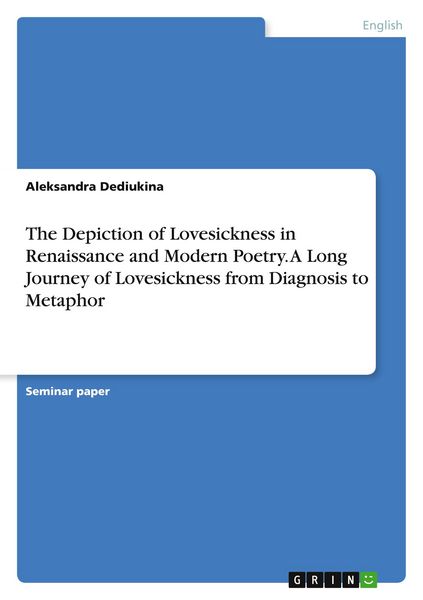
Produktbild: The Depiction of Lovesickness in Renaissance and Modern Poetry. A Long Journey of Lovesickness from Diagnosis to Metaphor

The Depiction of Lovesickness in Renaissance and Modern Poetry. A Long Journey of Lovesickness from Diagnosis to Metaphor

16,95 €

inkl. gesetzl. MwSt., Versandkostenfrei


Beschreibung

Once commonly perceived as a serious medical condition, lovesickness transformed into a widely used fruitful metaphor in poetry and song lyrics. The Renaissance doctors viewed erotic passion as an unwanted condition with a range of symptoms, certain pattern of development, and suitable ways of treatment....

Beschreibung

Once commonly perceived as a serious medical condition, lovesickness transformed into a widely used fruitful metaphor in poetry and song lyrics. The Renaissance doctors viewed erotic passion as an unwanted condition with a range of symptoms, certain pattern of development, and suitable ways of treatment. This can be stated with certainty by virtue of a wide number of specialised texts focused on the subject that were written at that time. Among them, in particular, there is "Treatise on Lovesickness" (quoted as T.L.) by a French physician Jacques Ferrand - in the first part of the theory chapter titled "Renaissance Physicians Warn", the most relevant key points of this work would be provided. Similar findings from other medical works of the time will also be briefly mentioned. Apart from scientific texts concerned with lovesickness, a clinical approach to love and its manifestation in the 'patient's' body can be registered in Renaissance drama and poetry. William Shakespeare's most famous texts, such as "Romeo and Juliet", "Othello", as well as his love sonnets, are evidence to that. The second part of the theory chapter titled "Renaissance Lovers Suffer" introduces the analysis of such instances in Shakespeare's and Sir Philip Sydney's works. The symptoms of lovesickness found in their texts will be explored in comparison with the medical description given by Ferrand. Today, the scientific community does not identify romantic passion as a disease any longer. However, we widely and often unconsciously conceptualise love as such. For poets, it opens a richest source of metaphoric language. 'Love is sickness' rapidly became one of the most common metaphors in love poetry, allowing for endless artistic solutions, but at the same time engendering the risk of repetitiveness and the effect of 'familiarisation', in Viktor Shklovsky's terms.

Produktdetails

Einband

Taschenbuch

Erscheinungsdatum

20.05.2024

Verlag GRIN
Seitenzahl

24

Produktdetails

Einband

Taschenbuch

Erscheinungsdatum

20.05.2024

Verlag GRIN
Seitenzahl

24

Maße (L/B/H)

21/14,8/0,3 cm

Gewicht

51 g

Auflage

1. Auflage

Sprache

Englisch

ISBN

978-3-389-02587-1

Herstelleradresse


Email: info@bod.de

Ein neues Kapitel für Ihre Bücher

Ein neues Kapitel für Ihre Bücher

Schenken Sie Ihren alten Schätzen ein zweites Leben und erhalten Sie dafür eine Thalia Geschenkkarte.

Jetzt verkaufen
Jetzt verkaufen

Noch keine Bewertungen vorhanden

Verfassen Sie die erste Bewertung zu diesem Artikel

Helfen Sie anderen Kundinnen und Kunden durch Ihre Meinung.

Kundinnen und Kunden meinen

Bewertungen (0)

  • Produktbild: The Depiction of Lovesickness in Renaissance and Modern Poetry. A Long Journey of Lovesickness from Diagnosis to Metaphor