















































KI-Beratung Beta

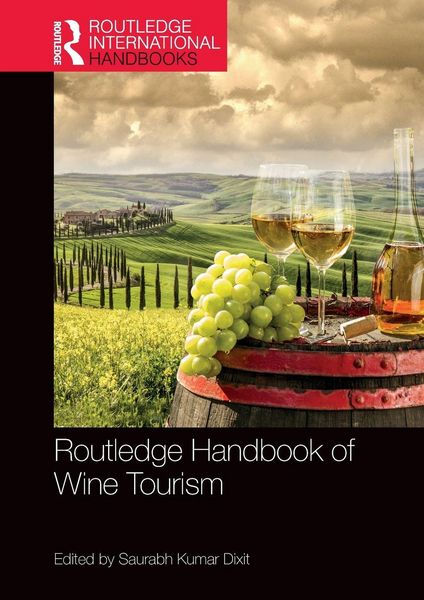
  • Produktbild: Routledge Handbook of Wine Tourism
  • Produktbild: Routledge Handbook of Wine Tourism

Routledge Handbook of Wine Tourism

79,99 €

inkl. gesetzl. MwSt., Versandkostenfrei


Beschreibung

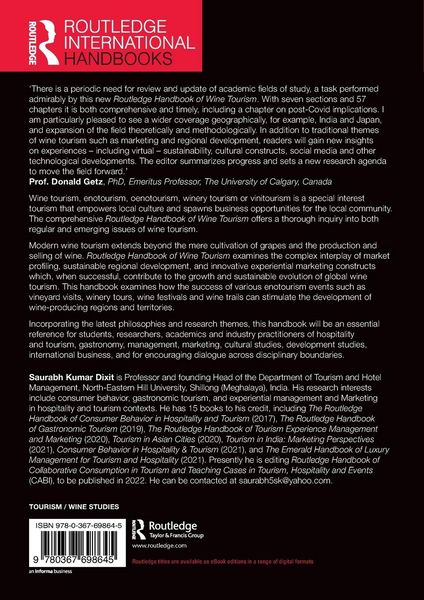
Wine tourism or enotourism or oenotourism or winery tourism or vinitourism is a special interest tourism that empowers local culture and spawns business opportunities for the local community. The comprehensive Routledge Handbook of Wine Tourism offers a thorough inquiry into both regular and emerging...

Beschreibung

Wine tourism or enotourism or oenotourism or winery tourism or vinitourism is a special interest tourism that empowers local culture and spawns business opportunities for the local community. The comprehensive Routledge Handbook of Wine Tourism offers a thorough inquiry into both regular and emerging issues of wine tourism.

Modern wine tourism extends beyond the mere cultivation of grapes and the production and selling of wine. The Routledge Handbook of Wine Tourism examines the complex interplay of market profiling, sustainable regional development, and innovative experiential marketing constructs which, when successful, contribute to the growth and sustainable evolution of global wine tourism. This handbook examines how the success of various enotourism events such as vineyard visits, winery tours, wine festivals and wine trails can stimulate the development of wine-producing regions and territories.

Incorporating the latest philosophies and research themes, this handbook will be an essential reference for students, researchers, academics and industry practitioners of hospitality and tourism, gastronomy, management, marketing, cultural studies, development studies, international business and for encouraging dialogue across disciplinary boundaries.

Rezension

'There is a periodic need for review and update of academic fields of study, a task performed admirably by this new Routledge Handbook of Wine Tourism. With seven sections and 57 chapters it is both comprehensive and timely, including a chapter on post-Covid implications. I am particularly pleased to see a wider coverage geographically, for example, India and Japan, and expansion of the field theoretically and methodologically. In addition to traditional themes of wine tourism such as marketing and regional development, readers will gain new insights on experiences - including virtual - sustainability, cultural constructs, social media and other technological developments. The editor summarizes progress and sets a new research agenda to move the field forward.'- Prof. Donald Getz, PhD, Emeritus Professor, The University of Calgary, Canada

'This handbook provides a wide-ranging, multidisciplinary examination of wine tourism. Chapters draw from both established and emerging scholars in the field and span traditional wine tourism destinations and relative newcomers around the world. Topics engage with diverse perspectives and exciting new directions in wine tourism research, from studies of underrepresented winery visitors to the wine tourism developments in the post-COVID-19 environment. This state-of-the-art volume provides essential reading for scholars and students interested in this dynamic area of tourism.' - Prof. Velvet Nelson, PhD, Department of Environmental and Geosciences, Sam Houston State University, Huntsville, Texas, USA

'This handbook is an extensive and multidisciplinary effort to frame the complexity of wine tourism, with an interesting focus on its role to boost regional development, local economy, and community empowerment. 57 up-to-date chapters covering theoretical and practical contents through the contribution of renowned scholars, emerging talented researchers and practitioners. Prof. Saurabh Kumar Dixit, in his 4th experience as editor of a Routledge Handbook, has been able to set up an outstanding review of the main challenges that wine tourism stakeholders have to face, as well as appropriate methods and tools to address them.' -Prof. Alessio Cavicchi, PhD, Department of Agriculture, Food and Environment, University of Pisa, Pisa, Italy

Produktdetails

Einband

Taschenbuch

Erscheinungsdatum

26.08.2024

Abbildungen

85 SW-Abb., 36 SW-Fotos, 49 SW-Zeichn., 64 Tabellen

Herausgeber Saurabh Kumar Dixit

Produktdetails

Einband

Taschenbuch

Erscheinungsdatum

26.08.2024

Abbildungen

85 SW-Abb., 36 SW-Fotos, 49 SW-Zeichn., 64 Tabellen

Herausgeber Saurabh Kumar Dixit
Verlag Taylor & Francis
Seitenzahl

794

Maße (L/B/H)

24,6/17,4/4,2 cm

Gewicht

1386 g

Sprache

Englisch

ISBN

978-0-367-69864-5

Herstelleradresse

Libri GmbH
Europaallee 1
36244 Bad Hersfeld
DE

Email: GPSR Kontakt

Ein neues Kapitel für Ihre Bücher

Ein neues Kapitel für Ihre Bücher

Schenken Sie Ihren alten Schätzen ein zweites Leben und erhalten Sie dafür eine Thalia Geschenkkarte.

Jetzt verkaufen
Jetzt verkaufen

Noch keine Bewertungen vorhanden

Verfassen Sie die erste Bewertung zu diesem Artikel

Helfen Sie anderen Kundinnen und Kunden durch Ihre Meinung.

Kundinnen und Kunden meinen

Bewertungen (0)

Die Leseprobe wird geladen.
  • Produktbild: Routledge Handbook of Wine Tourism
  • Produktbild: Routledge Handbook of Wine Tourism
  • Part I: Setting the Scene for Wine Tourism. 1.The growth and evolution of global wine tourism. 2.Nature and significance of wine tourism: An Australian perspective. 3.Conceptualization of a winescape framework. 4.Contributions of wine routes and trails to wine tourism experiences. 5.Regulatory and ethical influences and predicaments of wine tourism development: A case from Nashik, India. 6.Exploring co-creation process in the wineries: the relevance of social partner characteristics. 7.Wine tourism in Canada. 8.Key challenges in global wine tourism. PART II: PROFILING AND SEGMENTATION OF THE WINE TOURISM MARKET. 9.Understanding the wine tourism markets. 10.Wine tourism and consumer behavior. 11.Preferences and characteristics of wine tourists. 12.Wine tourism´s institutional framework and governing system: evidence from Portugal and six international reference markets as benchmarks. 13.Wine tourist motivations and perceptions of destination attributes. 14.Wine consumers' knowledge of wine and their wine self-confidence in different sales contexts. 15.The emerging wine tourist: perspectives of multicultural, first-time winery visitors. 16.Senior travelers and wine tourism experience: opportunities of an evolving market segment. PART III: WINE TOURISM AS AN INSTRUMENT FOR THE REGIONAL DEVELOPMENT. 17.Wine tourism: A story rooted in place. 18.Strategies for developing wine tourism destination: the case of the Douro Valley (Portugal). 19.Wine tourism development: From the host community's perspective. 20.Winery owners' perceptions and motivations towards wine tourism: discourses of winery owners in Langhe, Northern Italy. 21.Wine tourism in rural Japan: an integrated development instrument. 22.Wine tourism gentrification: transforming rural agricultural regions in the USA. 23.Role of great wine capitals network in making wine tourism a competitive factor of a territory. 24.From wine to vermouth: events as guardians of the territory. PART IV: NEW APPROACHES AND PRACTICES IN WINE TOURISM MARKETING. 25.Marketing destinations through wine tourism - using the example of developing wine tourism in Austria. 26.The role of wine festivals in Swedish wine tourism marketing. 27.The emergence of a new wine tourism field: entrepreneurial struggles. 28.Creative star wine districts: an exploratory research. 29.Folk wine festivals in Italy: a grassroot strategy for developing wine tourism. 30.Matching business travel with wine tourism - the case of the Canton of Grisons, Switzerland. 31.Memorability, satisfaction, and intention to recommend to others: a segmentation-based study of winery visitors in Australia. PART V: WINE TOURISM EXPERIENCE: MANAGEMENT AND SUCCESS STORIES. 32.Introducing the wine tourism experience (WTE) framework to design the ultimate tourist experience. 33.The staging of wine tourism experiences in Australia. 34.The taste of experience: the sensitivities of wine tourists. 35.Antecedents, elements, and outcomes of the wine tourism experience at the destination. 36.Multisensory experience of wine tourism. 37.The influence of wine involvement on wine tourism motivations and experiences. 38.Wine tasting and appreciation experiences at wine