
















































Embracing the Messy Complexities of Co-Creation A Dialogic Approach to Participatory Qualitative Inquiry
-
- Hardcover
- Taschenbuch ausgewählt
- eBook
-
Sprache:Englisch
43,99 €
UVP
62,00 €
inkl. gesetzl. MwSt.,
Beschreibung
Produktdetails
Einband
Taschenbuch
Erscheinungsdatum
30.12.2024
Abbildungen
12 SW-Abb., 11 SW-Fotos, 1 SW-Zeichn., 3 Tabellen
Verlag
Taylor & FrancisSeitenzahl
256
Maße (L/B/H)
23,4/15,6/1,4 cm
Gewicht
395 g
Sprache
Englisch
ISBN
978-1-03-236968-6
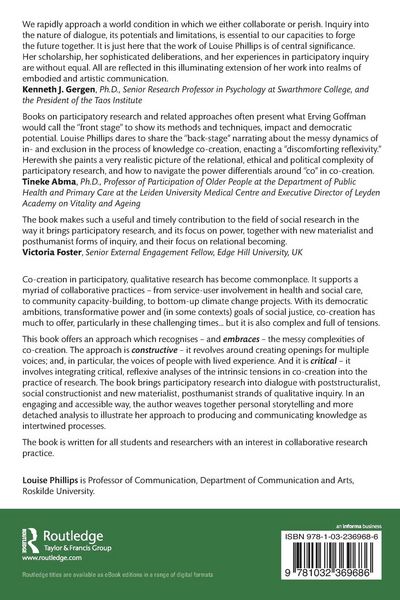
Co-creation in participatory, qualitative research has become commonplace. It supports a myriad of collaborative practices - from service-user involvement in health and social care, to community capacity-building, to bottom-up climate change projects. With its democratic ambitions, transformative power and (in some contexts) goals of social justice, co-creation has much to offer, particularly in these challenging times... but it is also complex and full of tensions.
This book offers an approach which recognises - and embraces - the messy complexities of co-creation. The approach is constructive - it revolves around creating openings for multiple voices; and, in particular, the voices of people with lived experience. And it is critical - it involves integrating critical, reflexive analyses of the intrinsic tensions in co-creation into the practice of research. The book brings participatory research into dialogue with poststructuralist, social constructionist and new materialist, posthumanist strands of qualitative inquiry. In an engaging and accessible way, the author weaves together personal storytelling and more detached analysis to illustrate her approach to producing and communicating knowledge as intertwined processes.
The book is written for all students and researchers with an interest in collaborative research practice.
Ein neues Kapitel für Ihre Bücher
Ein neues Kapitel für Ihre Bücher
Schenken Sie Ihren alten Schätzen ein zweites Leben und erhalten Sie dafür eine Thalia Geschenkkarte.
Noch keine Bewertungen vorhanden
Verfassen Sie die erste Bewertung zu diesem Artikel
Helfen Sie anderen Kundinnen und Kunden durch Ihre Meinung.
Kurze Frage zu unserer Seite
Vielen Dank für Ihr Feedback
Wir nutzen Ihr Feedback, um unsere Produktseiten zu verbessern. Bitte haben Sie Verständnis, dass wir Ihnen keine Rückmeldung geben können. Falls Sie Kontakt mit uns aufnehmen möchten, können Sie sich aber gerne an unseren Kund*innenservice wenden.
zum Kundenservice