















































KI-Beratung Beta

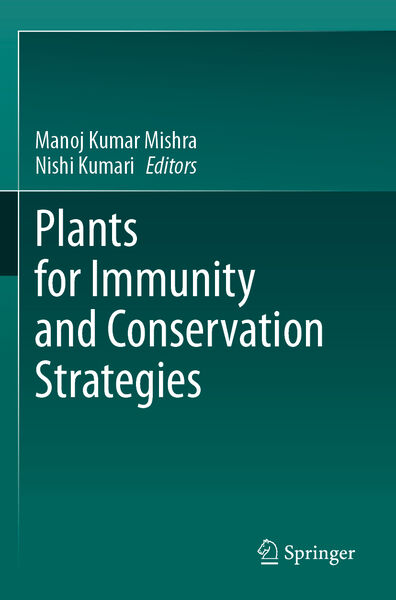
Produktbild: Plants for Immunity and Conservation Strategies
- 12%

Plants for Immunity and Conservation Strategies

12% sparen

187,99 € UVP 213,99 €

inkl. gesetzl. MwSt., Versandkostenfrei


Beschreibung

Produktdetails

Einband

Taschenbuch

Erscheinungsdatum

27.07.2024

Abbildungen

XII, 383 p. 1 illus.

Herausgeber

Manoj Kumar Mishra + weitere

Verlag

Springer Singapore

Seitenzahl

383

Maße (L/B/H)

23,5/15,5/2,2 cm

Gewicht

598 g

Auflage

2023

Sprache

Englisch

ISBN

978-981-9928-26-2

Beschreibung

Portrait


Dr. Manoj Kumar Mishra is currently working as an Assistant Professor in the Department of Biotechnology, at Rama University Kanpur. He completed his Ph.D. from Banaras Hindu University, Varanasi. After Ph.D , He joined as Postdoctoral researcher at CISH, Rahman Khera Lucknow. He was awarded the prestigious Dr. D.C. Kothari postdoc Fellowship in 2015. He also served as Senior Project Associate and Senior Research Associate in CSIR- NBRI, Lucknow, and ICAR- NBFGR, Lucknow respectively.

Dr. Nishi Kumari is Professor and Section in-charge at the Department of Botany MMV. She completed her graduation, postgraduation and Ph.D. from BHU, Varanasi. After Ph. D, she joined postdoc fellowship at Delhi University for three years. She joined BHU in 2004 as a lecturer in Botany.


Produktdetails

Einband

Taschenbuch

Erscheinungsdatum

27.07.2024

Abbildungen

XII, 383 p. 1 illus.

Herausgeber

Verlag

Springer Singapore

Seitenzahl

383

Maße (L/B/H)

23,5/15,5/2,2 cm

Gewicht

598 g

Auflage

2023

Sprache

Englisch

ISBN

978-981-9928-26-2

Herstelleradresse

Springer-Verlag KG
Sachsenplatz 4-6
1201 Wien
AT

Email: ProductSafety@springernature.com

Ein neues Kapitel für Ihre Bücher

Ein neues Kapitel für Ihre Bücher

Schenken Sie Ihren alten Schätzen ein zweites Leben und erhalten Sie dafür eine Thalia Geschenkkarte.

Jetzt verkaufen
Jetzt verkaufen

Noch keine Bewertungen vorhanden

Verfassen Sie die erste Bewertung zu diesem Artikel

Helfen Sie anderen Kundinnen und Kunden durch Ihre Meinung.

Kundinnen und Kunden meinen

Bewertungen (0)

  • Produktbild: Plants for Immunity and Conservation Strategies
  • Chapter 1. A Literature update on strategies for harnessing and conserving the bioactive phytochemicals from Tinospora cordifolia: current status, challenges and future prospects.- Chapter 2. Medicinally important phytoconstituents and conservation strategies of neem: A critical overview.- Chapter 3. An Insight into Coptis teeta Wall. an endangered medicinal plant and their conservation strategies.- Chapter 4. Strategies for Conservation and Production of Bioactive Phytoconstituents in Commercially Important Ocimum Species: A Review.- Chapter 5. Studies of natural product synthesis of Withania somnifera and their conservation strategy through in-vitro method.- Chapter 6. In vitro studies in Andrographis paniculata pertaining to Andrographolides accumulation. Chapter 7. Identification of bioactive compounds in Berberis species and in-vitro propagation for conservation and quality.- Chapter 8. Bioactive compounds in Solanum viarum: medicinal properties, in vitro propagation, and conservation.- Chapter 9. Biosynthesis of essential oils in Artemisia species and conservation through in vitro propagation.- Chapter 10. Immunostimulatory properties of Echinacea purpurea and conservation strategy.- Chapter 11. An insight of phytochemicals of Satavari (Asparagus racemosus).- Chapter 12. Ex-situ conservation of Shatavari (Asparagus racemosus). Chapter 13. Recent developments in natural compounds of Guggul and production of plant material for conservation and pharmaceutical demand Commiphora wightii (Arn.) Bhandari.- Chapter 14. Assessment of economically and medicinally important plant resources in Sangla Valley region of Indian Himalaya.- Chapter 15. Ethnomedicinal Pertinence and Antibacterial Prospective of Himalayan Medicinal Plants of Uttarakhand in India.- Chapter 16. An immune modulator constituent in Mucuna pruriens L. (DC) and biotechnological approach for conservation.- Chapter 17. In vitro cultures: Challenges and limitations.