















































KI-Beratung Beta

Gutscheinbedingungen

Gültig bis 30.11.2026 | Gültig für nicht preisgebundene fremdsprachige Bücher | Einzelne Artikel können ausgeschlossen sein | Online auf thalia.de und in der Thalia App einlösbar | Click & Collect nur mit Online-Zahlung (Paypal/Kreditkarte) vorab | Nicht kombinierbar mit anderen Gutscheinen oder Preisaktionen | Nur einmal pro Einkauf einlösbar | Gutschein wird auf max. 500€ Bestellwert angerechnet | Keine Barauszahlung | Nicht gültig für Versandkosten und Services

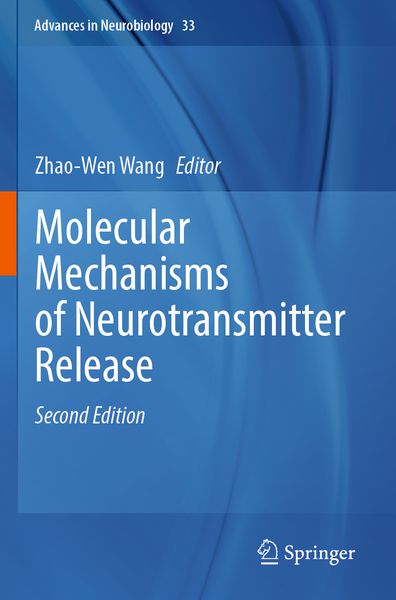
Produktbild: Molecular Mechanisms of Neurotransmitter Release
Band 33 - 13%

Molecular Mechanisms of Neurotransmitter Release

Aus der Reihe Advances in Neurobiology
13% sparen

185,99 € UVP 213,99 €

inkl. gesetzl. MwSt., Versandkostenfrei


Beschreibung

Neurons communicate with each other by releasing neurotransmitters. This book provides comprehensive coverage of the molecular mechanisms involved in neurotransmitter release. The topics covered in the book range from the architecture and cytomatrix proteins of presynaptic sites, to the modes of synaptic...

Beschreibung

Neurons communicate with each other by releasing neurotransmitters. This book provides comprehensive coverage of the molecular mechanisms involved in neurotransmitter release. The topics covered in the book range from the architecture and cytomatrix proteins of presynaptic sites, to the modes of synaptic vesicle exocytosis (full-collapse and kiss-and-run), and from the key molecules mediating synaptic vesicle fusion (SNAREs) to those that closely interact with them (UNC-13/Munc13, UNC-18/Munc18, tomosyn, and complexins). The book also delves into the calcium sensors of synaptic vesicle fusion (synaptotagmins and Doc2s), the sources of calcium that trigger synaptic exocytosis (voltage-gated calcium channels and ryanodine receptors), and the regulation of neurotransmitter release by potassium channels, cell adhesion molecules, lipids, aryl hydrocarbon receptor-interacting protein (AIP), presenilins, and calstabins. To aid in understanding and illustrate key concepts, the book includes sufficient background information and a wealth of illustrations and diagrams. The new edition includes major updates to previous chapters, as well as several new chapters that reflect the recent advances in the field. Comprehensive and cutting-edge,  Molecular Mechanisms of Neurotransmitter Release ,  2nd edition , is a valuable learning resource for neuroscience students and a solid reference for neuroscientists.

Portrait

Zhao-Wen Wang, PhD, is Professor of Neuroscience in the Faculty of Neuroscience, Cell Biology, and Genetics and Developmental Biology, University of Connecticut Health Center, Farmington, Connecticut.  His major research interests are on the functions and regulation of the BK channel and gap junctions, and molecular mechanisms of neurotransmitter release. 

Produktdetails

Einband

Taschenbuch

Erscheinungsdatum

25.08.2024

Abbildungen

XI, 401 p. 77 illus., 62 illus. in color.

Herausgeber Zhao-Wen Wang

Produktdetails

Einband

Taschenbuch

Erscheinungsdatum

25.08.2024

Abbildungen

XI, 401 p. 77 illus., 62 illus. in color.

Herausgeber Zhao-Wen Wang
Verlag Springer
Seitenzahl

401

Maße (L/B/H)

23,5/15,5/2,3 cm

Gewicht

628 g

Auflage

Second Edition 2023

Sprache

Englisch

ISBN

978-3-031-34231-8

Herstelleradresse

Springer-Verlag KG
Sachsenplatz 4-6
1201 Wien
AT

Email: ProductSafety@springernature.com

Ein neues Kapitel für Ihre Bücher

Ein neues Kapitel für Ihre Bücher

Schenken Sie Ihren alten Schätzen ein zweites Leben und erhalten Sie dafür eine Thalia Geschenkkarte.

Jetzt verkaufen
Jetzt verkaufen

Noch keine Bewertungen vorhanden

Verfassen Sie die erste Bewertung zu diesem Artikel

Helfen Sie anderen Kundinnen und Kunden durch Ihre Meinung.

Kundinnen und Kunden meinen

Bewertungen (0)

  • Produktbild: Molecular Mechanisms of Neurotransmitter Release
  • The Architecture of the Presynaptic Release Site.-Cytomatrix Proteins in Presynaptic Terminal. -  Multiple Modes of Fusion and Retrieval at the Calyx of Held Synapse.-  Roles of SNARE Proteins in Synaptic Vesicle Fusion.- Calcium Sensors of Neurotransmitter Release. - Roles and Sources of Calcium in Synaptic Exocytosis.- Regulation of Presynaptic Calcium Channels.-  Roles of mUnc13/UNC-13 and mUnc18/UNC-18 in Neurotransmitter Release. - The role of tomosyn in the regulation of neurotransmitter exocytosis. -Roles of complexins in Neurotransmitter Release. -Regulation of Neurotransmitter Release by AIPR-1/AIP and calstabins. - The Role of Potassium Channels in the Regulation of Neurotransmitter Release.- Roles of Neuropeptides in Synaptic Function. - Transsynaptic Regulation of Presynaptic Release Machinery in Central Synapses by Cell Adhesion Molecules. - Lipids and Secretory Vesicle Exocytosis.- Synaptic Vesicle Endocytosis.