Produktbild: Dragonfly Behavior
- 13%

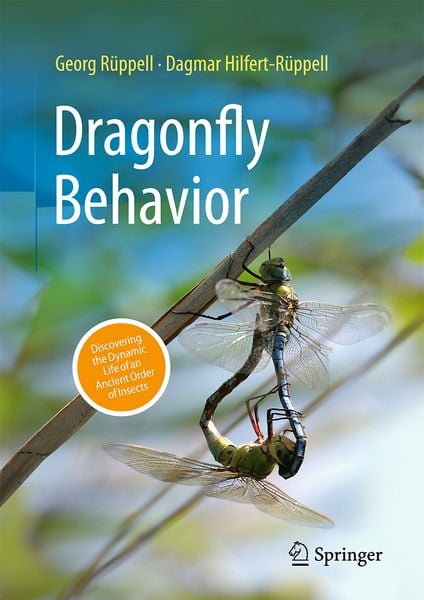
Dragonfly Behavior Discovering the Dynamic Life of an Ancient Order of Insects

13% sparen

36,99 € UVP 42,79 €

inkl. gesetzl. MwSt., Versandkostenfrei


Beschreibung

Produktdetails

Einband

Gebundene Ausgabe

Erscheinungsdatum

10.12.2024

Verlag

Springer Berlin

Seitenzahl

229

Maße (L/B/H)

24,6/17,3/1,9 cm

Gewicht

647 g

Originaltitel

Verhalten von Libellen

Sprache

Englisch

ISBN

978-3-662-70233-8

Beschreibung

Rezension

“This beautiful book is rounded off by the excellent  design by book designer Stephan Meyer from Leipzig. The book could be inspiring and valuable for possible future studies even in Australia where we do not have members of the family Calopterygidae.” (Günther Theischinger, Australian Entomologist, Vol. 52 (2), July 18, 2025) 


"A comprehensive book of their findings was written in German and is now also available in English. ... This beautiful book is very exciting in words and pictures and reads like a dragonfly thriller." (Günther Theischinger, News Bulletin of the Entomological Society of Queensland, Vol. 53 (3), May, 2025)


"This new publication now brings this together in print covering every aspect of dragonflies’ life cycle illustrated with many unique images taken from high speed film sequences. … This book contains a wealth of information about dragonflies ... highly recommended to anyone with an interest in Dragonfly behaviour." (British Dragonfly Society, british-dragonflies.org.uk, February 20, 2025) 

Produktdetails

Einband

Gebundene Ausgabe

Erscheinungsdatum

10.12.2024

Verlag

Springer Berlin

Seitenzahl

229

Maße (L/B/H)

24,6/17,3/1,9 cm

Gewicht

647 g

Originaltitel

Verhalten von Libellen

Sprache

Englisch

ISBN

978-3-662-70233-8

Herstelleradresse

Springer-Verlag GmbH
Tiergartenstr. 17
69121 Heidelberg
DE

Email: ProductSafety@springernature.com

Ein neues Kapitel für Ihre Bücher

Ein neues Kapitel für Ihre Bücher

Schenken Sie Ihren alten Schätzen ein zweites Leben: Einfach Barcode scannen, Versandetikett ausdrucken, Bücher verschicken und Thalia Geschenkkarte erhalten.

Jetzt verkaufen
Jetzt verkaufen

Kundinnen und Kunden meinen

0 Bewertungen

Informationen zu Bewertungen

Zur Abgabe einer Bewertung ist eine Anmeldung im Konto notwendig. Die Authentizität der Bewertungen wird von uns nicht überprüft. Wir behalten uns vor, Bewertungstexte, die unseren Richtlinien widersprechen, entsprechend zu kürzen oder zu löschen.

Die Bewertungen sind nach Format, Anzahl Sterne und Datum sortiert.

Verfassen Sie die erste Bewertung zu diesem Artikel

Helfen Sie anderen Kund*innen durch Ihre Meinung

Kundinnen und Kunden meinen

0 Bewertungen filtern

  • Produktbild: Dragonfly Behavior
  • Appearance  The construction plan as a high-performance aircraft; structure of the body and streamlined distribution of the body masses.-  Eyes  Huge compound eyes enable all-round vision and slow-motion vision.-  Wings  Large ultralight wings with bionic tricks. bionic observations of the wings.-  Flight artists Moving all four wings independently of each other leads to breathtaking maneuvers.-  Turning flight.- Extreme bank angles and wing kinematics are described.-  Colored wings.- flap differently Species with colored wings move them not only to fly, but also to communicate. They have therefore changed their flapping modes.-  Catching prey.- Unique catching of flying insects in the air with specially equipped catching legs.-  Fighting  Never before seen images document collisions, rollovers and injuries. The legs with claws and bristles as well as the mouthparts have proven to be the main weapons.-  Defense of males  Females mitigate sexual conflicts with sophisticated defenses. At high densities, males always and everywhere try to catch females and bring them to mate, females fly better and often fight successfully.-  Interspecific discord  in competition for territories or perches also occurs between species. An unusual behavior was documented: a male damselfly carries a tandem of feather dragonflies away with its legs.-  Colors Dragonflies often look very colorful. These colors are caused by light refractions on structures or by color pigments.-  Threatening  is carried out by presenting wings or by a large number of threatening flights. It is energetically more favorable than fighting and reduces the risk of injury. Males display courtship with colored wings. In the case of damselflies, the flapping frequency is doubledand a species-typical phase relationship of the fore and hind wings is used. This provides females with information for their choice of mate (female choice).-  Mating of damselflies gave famous data on genegoism, as the males almost completely remove the seed of a predecessor from the female and replace it with their own.-  Oviposition is a dangerous activity for damselflies and some damselflies that bore their eggs into plants. More modern groups drop the eggs from flight. Some females dive under water to lay their eggs. At high densities, alternative methods are used to avoid the males.-  Larvae are ambush hunters under water with a range extension of the unique capture mask, which can reach very high speeds.-  Hunting More than half of them are eaten by frogs and birds when they hatch and lay their eggs. Egg-laying dragonflies flee sideways in order to get as quickly and far away from the frogsas possible. Hatching often takes place at night and in groups. This reduces the risk of being eaten.-  Hatching metamorphosis with risk of accident, as the moist body tissues of the larval skin and the flying insect have to separate before drying sets in. Hatching accidents are not uncommon.-  Maiden flight is an important moment in which the innate flight pattern must function immediately.-  Ecological significance.- Response to climate change.