















































KI-Beratung Beta

Gutscheinbedingungen

Gültig bis 30.11.2026 | Gültig für nicht preisgebundene fremdsprachige Bücher | Einzelne Artikel können ausgeschlossen sein | Online auf thalia.de und in der Thalia App einlösbar | Click & Collect nur mit Online-Zahlung (Paypal/Kreditkarte) vorab | Nicht kombinierbar mit anderen Gutscheinen oder Preisaktionen | Nur einmal pro Einkauf einlösbar | Gutschein wird auf max. 500€ Bestellwert angerechnet | Keine Barauszahlung | Nicht gültig für Versandkosten und Services

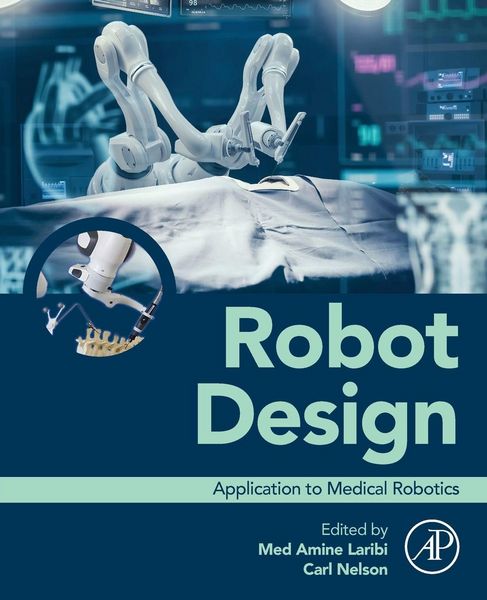
Produktbild: Robot Design
Band 123

Robot Design Application to Medical Robotics

203,99 €

inkl. gesetzl. MwSt., Versandkostenfrei


Beschreibung

Robot Design: Application to Medical Robotics offers a blend of theory and applications, with a focus on robot design to aid researchers in developing innovative robotic solutions in the healthcare domain. The book addresses this evolutionary journey by amalgamating various fields of expertise, guiding...

Beschreibung

Robot Design: Application to Medical Robotics offers a blend of theory and applications, with a focus on robot design to aid researchers in developing innovative robotic solutions in the healthcare domain. The book addresses this evolutionary journey by amalgamating various fields of expertise, guiding readers through fundamental concepts using real-world requirements and applications. Chapters are authored by experts in collaboration with clinicians and specialists from specific areas, spanning the technical realm (mechanics of machinery, control theory, informatics, mechatronics) to the clinical sphere (surgery, sonography, rehabilitation therapy).
This book serves as an excellent reference for young professionals and researchers, providing an overview of the most significant aspects of medical robotics and guiding them towards the most suitable approaches for robot design.

Portrait

Med Amine Laribi is a Professor in the Faculty of Fundamental and Applied Sciences at the University of Poitiers (UP), where he teaches robotics and mechanics. He holds a Mechanical Engineering Degree with a specialization in Mechanical Design from École Nationale d'Ingénieurs de Monastir (E.N.I.M.), which he obtained in 2001. He earned an M.S. degree in Mechanical Design in 2002 and a Ph.D. in Mechanics from the University of Poitiers in 2005. Additionally, he received a National Habilitation in Mechanics from the University of Poitiers in 2018. His research interests include robot design, mechanism synthesis, cable-driven robots, parallel robots, haptic interfaces, and collaborative robots.

Carl Nelson is a Professor in the Department of Mechanical and Materials Engineering at the University of Nebraska-Lincoln. He obtained his degrees in Mechanical Engineering: a Bachelor of Science (B.S.) from The University of Oklahoma in 2000, a Master of Science (M.S.) from Purdue University in 2002, and a Doctorate (Ph.D.) from Purdue University in 2005. His research activities encompass robot design and kinematics, medical devices, and the medical applications of robotics.

Produktdetails

Einband

Taschenbuch

Erscheinungsdatum

29.10.2025

Herausgeber Med Amine Laribi + weitere
Verlag Elsevier Science & Technology

Produktdetails

Einband

Taschenbuch

Erscheinungsdatum

29.10.2025

Herausgeber
Verlag Elsevier Science & Technology
Seitenzahl

340

Maße (L/B/H)

23,4/19,2/2 cm

Gewicht

710 g

Sprache

Englisch

ISBN

978-0-443-24778-1

EU-Ansprechpartner

Elsevier B.V.
Radarweg 29
1043 NX Amsterdam
NL
productsafety@elsevier.com

Herstelleradresse

Elsevier Science & Technology
London Wall 125
EC2Y 5AS London
GB
tradeorders@elsevier.com

Ein neues Kapitel für Ihre Bücher

Ein neues Kapitel für Ihre Bücher

Schenken Sie Ihren alten Schätzen ein zweites Leben und erhalten Sie dafür eine Thalia Geschenkkarte.

Jetzt verkaufen
Jetzt verkaufen

Noch keine Bewertungen vorhanden

Verfassen Sie die erste Bewertung zu diesem Artikel

Helfen Sie anderen Kundinnen und Kunden durch Ihre Meinung.

Kundinnen und Kunden meinen

Bewertungen (0)

  • Produktbild: Robot Design
  • Part 1. Fundamentals (Theory)
    1. A historical outline on medical robot design
    2. Design methodology and application to medical robotics
    3. Robot performance in the context of medical applications
    4. Human interfaces for medical robotics
    5. Materials and component selection for medical robot design
    6. Remote Center of Motion mechanism modeling and optimization
    7. Reconfigurable robots for medical applications
    8. Haptics in medicine with simulation and training
    9. Control strategies / visual-servoing / shared human-robot control

    Part 2. Applications
    10. Endoscopic Robotic System
    11. Rehabilitation robotics
    12. Microsurgical Robots
    13. Maxillofacial laser assisted surgery