















































KI-Beratung Beta

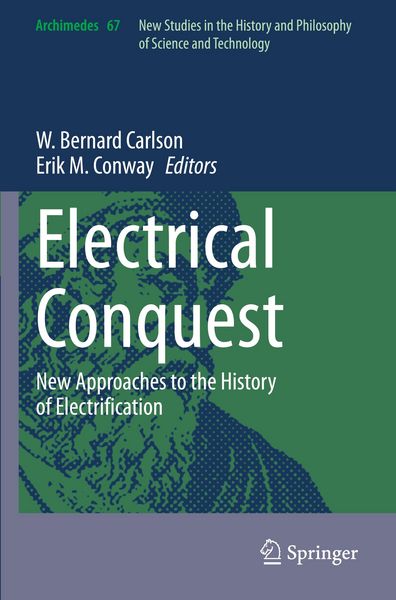
Produktbild: Electrical Conquest
Band 67 - 10%

Electrical Conquest New Approaches to the History of Electrification

Aus der Reihe Archimedes
10% sparen

124,99 € UVP 139,09 €

inkl. gesetzl. MwSt., Versandkostenfrei


Beschreibung

This book, drawing on fresh scholarship, investigates electrification in new places and across different time periods. While much of our understanding of electrification as a historical process is based on the seminal work done by Thomas P. Hughes in Networks of Power (1983), the scholars in this volume...

Beschreibung

This book, drawing on fresh scholarship, investigates electrification in new places and across different time periods. While much of our understanding of electrification as a historical process is based on the seminal work done by Thomas P. Hughes in Networks of Power (1983), the scholars in this volume expand and revise Hughes’ systems approach to suggest that electrification is a heterogeneous and contingent process. Moreover, the contributors suggest that the conquest of the world by electricity remains incomplete despite more than a century elapsing. Above all, though, this book provides context for thinking about what lies ahead as humans continue their conquest of the earth through electricity. As we become increasingly dependent on electricity to power our lights, heat and cool our homes, turn the wheels of industry, and keep our information systems humming, so we are ever more vulnerable when the grid runs into trouble.

Portrait

W. Bernard Carlson manages the M.Sc programs in TechInnovation and AgInnovation at the University of Galway in Ireland.  He is also the Joseph L. Vaughan Emeritus Professor of Humanities  at the University of Virginia. He is also a lecturer in the Tech Innovate program at the National University of Ireland Galway. He has written widely on inventors and electrical history, and his books include Innovation as a Social Process: Elihu Thomson and the Rise of General Electric, 1870-1900 (Cambridge University Press, 1991) and Tesla: Inventor of the Electrical Age (Princeton University Press, 2013).

Erik M Conway is an independent scholar and an author on seven books, including  Merchants of Doubt  and  The Big Myth , both with Naomi Oreskes, and  Exploration and Engineering: The Jet Propulsion Laboratory and the Quest for Mars .

Produktdetails

Einband

Taschenbuch

Erscheinungsdatum

09.01.2025

Abbildungen

IX, 280 p. 1 illus.

Herausgeber W. Bernard Carlson + weitere

Produktdetails

Einband

Taschenbuch

Erscheinungsdatum

09.01.2025

Abbildungen

IX, 280 p. 1 illus.

Herausgeber
Verlag Springer
Seitenzahl

280

Maße (L/B/H)

23,5/15,5/1,6 cm

Gewicht

446 g

Sprache

Englisch

ISBN

978-3-031-44593-4

Herstelleradresse

Springer-Verlag GmbH
Tiergartenstr. 17
69121 Heidelberg
DE

Email: ProductSafety@springernature.com

Ein neues Kapitel für Ihre Bücher

Ein neues Kapitel für Ihre Bücher

Schenken Sie Ihren alten Schätzen ein zweites Leben und erhalten Sie dafür eine Thalia Geschenkkarte.

Jetzt verkaufen
Jetzt verkaufen

Noch keine Bewertungen vorhanden

Verfassen Sie die erste Bewertung zu diesem Artikel

Helfen Sie anderen Kundinnen und Kunden durch Ihre Meinung.

Kundinnen und Kunden meinen

Bewertungen (0)

  • Produktbild: Electrical Conquest
  • Acknowledgements.- Chapter 1. Introduction.- Chapter 2. A Model for Heterogeneous Energy Transitions.- Chapter 3. Surveying the Landscape: The Oil Industry and Alternative Energy in the 1970s.- Chapter 4. We Have No Niagara”: Electrifying the “Britain of the South.- Chapter 5. Formation and Transformations of the Cuban Electric Company/Unión Eléctrica, 1920s-1980s.- Chapter 6. Between Material Dependencies, Natural Commons and Politics of Electrical Transitions: The State as Networks of Power in Greece, 1940-2010.- Chapter 7. Large-scale Renewables and Infrastructure Gatekeepers: How Local Actors Shaped the Texas Competitive Renewable Energy Zones (CREZ) Initiative.- Chapter 8. Co-ops Against Castroism: USAID and the Electrification of the Global Countryside.- Chapter 9. Vehicle-to-Grid, Regulated Deregulation, and the Energy Conversion Imaginary.