











































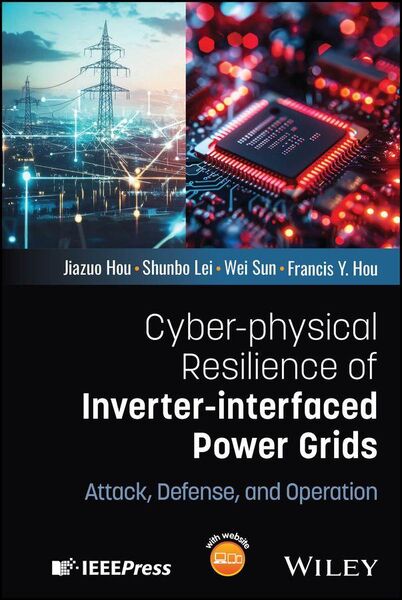
Cyber-Physical Resilience of Inverter-Interfaced Power Grids Attack, Defense, and Operation
149,99 €
inkl. gesetzl. MwSt.,
Beschreibung
Produktdetails
Einband
Gebundene Ausgabe
Erscheinungsdatum
03.08.2026
Verlag
WILEYSeitenzahl
272
Maße (L/B/H)
23,5/15,7/2,1 cm
Gewicht
522 g
Sprache
Englisch
ISBN
978-1-394-39718-1
Presents cybersecurity practices for inverter-interfaced power grids
Cyber-physical Resilience of Inverter-interfaced Power Grids delivers a comprehensive and systematic introduction to the cyber-physical resilience of inverter-interfaced power grids against cyber-attack incidents, covering three closely related and critical problems in the field: attack situation awareness, defense resource allocation, and operation region characterization.
Related state-of-the-art methods are introduced and illustrated in detail with hands-on examples so that readers can learn how to use them to address realistic problems and improve today's practices. This book also includes information on:
- Catastrophic cyber-vulnerabilities that contribute to tiny-attack-high-impact phenomena in inverter-interfaced power grids, helping readers quantify attack-induced losses in grid security, stability, and efficiency
- Spatial-temporal defense strategies with not only event-triggered responses as attacks unfold over time but also collaborative mechanisms as attacks spread across regions, yielding cost-benefit trade-off for conflicting cyber-stakeholders
- Geometrical properties of cyber insecurity regions and physical security regions, particularly in the context of the paradigm shift of cyber-physical resilience towards inverter-interfaced power grids
This book contains the latest knowledge on the subject for academics in the fields of cyber-physical systems, renewable energy integration, and power systems engineering, power grid operators, cybersecurity professionals within the energy sector, and policy-makers responsible for regulatory frameworks on cybersecurity.
Ein neues Kapitel für Ihre Bücher
Ein neues Kapitel für Ihre Bücher
Schenken Sie Ihren alten Schätzen ein zweites Leben und erhalten Sie dafür eine Thalia Geschenkkarte.
Noch keine Bewertungen vorhanden
Verfassen Sie die erste Bewertung zu diesem Artikel
Helfen Sie anderen Kundinnen und Kunden durch Ihre Meinung.
Kurze Frage zu unserer Seite
Vielen Dank für Ihr Feedback
Wir nutzen Ihr Feedback, um unsere Produktseiten zu verbessern. Bitte haben Sie Verständnis, dass wir Ihnen keine Rückmeldung geben können. Falls Sie Kontakt mit uns aufnehmen möchten, können Sie sich aber gerne an unseren Kund*innenservice wenden.
zum Kundenservice