















































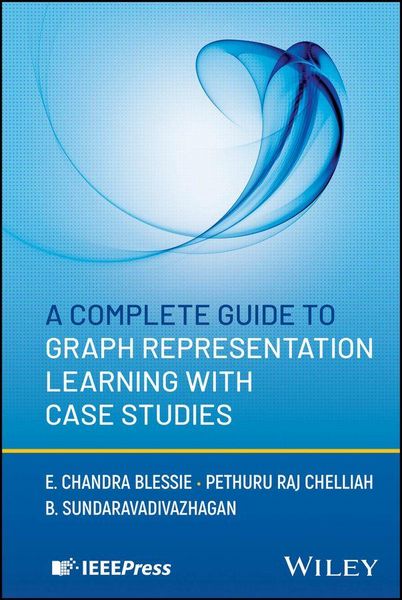
A Complete Guide to Graph Representation Learning with Case Studies
143,99 €
inkl. gesetzl. MwSt.,
Beschreibung
Produktdetails
Einband
Gebundene Ausgabe
Erscheinungsdatum
24.08.2026
Verlag
John Wiley & SonsSeitenzahl
448
Maße (L/B/H)
23,4/16/3 cm
Gewicht
748 g
Sprache
Englisch
ISBN
978-1-394-31484-3
Comprehensive resource on graph representation learning (GRL), exploring fundamental principles, advanced methodologies, and case studies
A Complete Guide to Graph Representation Learning with Case Studies provides a concise understanding of the subject of graph representation learning (GRL), a rapidly advancing field in the domain of machine learning. The book explores basic concepts to state-of-the-art techniques, enabling readers to progress from a fundamental understanding of the approach to mastering its application. The authors also cover the topics of graph embedding methods, graph neural network (GNN) -based approaches, and the latest trends in GRL such as deep learning, transfer learning, graph pooling, alignment, and matching, and graph machine learning.
The book includes examples of applications of graph learning methods with real-world case studies in which the covered methods can be utilized. It also includes innovative solutions to graph machine learning problems such as node classification, link prediction, and unsupervised learning, and discusses neighborhood overlap visualization techniques and overlapping neighborhoods in heterogeneous graphs. Finally, the book provides an overview of open and ongoing research directions and student projects, providing a glimpse into potential avenues for future work.
The book also includes information on:
- Node-level features such as node degree, node centrality, closeness, betweenness, eigenvector, page rank centrality, clustering coefficient, closed triangles, egograph, and motifs
- Neighborhood sampling techniques such as breadth-first sampling, depth-first sampling, snowball sampling, random walk, shallow walk, edge sampling, link-based sampling, and metapath-based sampling
- Deep learning models including Graph Autoencoder (GAE), Variational Graph Encoder (VGAE), and Graph Attention Network (GAN)
- Graph alignment and matching, covering subgraph matching and embedding for matching
A Complete Guide to Graph Representation Learning with Case Studies is a thorough and up-to-date reference on the subject for engineers and researchers in data science and machine learning as well as graduate students in related programs of study.
Ein neues Kapitel für Ihre Bücher
Ein neues Kapitel für Ihre Bücher
Schenken Sie Ihren alten Schätzen ein zweites Leben und erhalten Sie dafür eine Thalia Geschenkkarte.
Noch keine Bewertungen vorhanden
Verfassen Sie die erste Bewertung zu diesem Artikel
Helfen Sie anderen Kundinnen und Kunden durch Ihre Meinung.
Kurze Frage zu unserer Seite
Vielen Dank für Ihr Feedback
Wir nutzen Ihr Feedback, um unsere Produktseiten zu verbessern. Bitte haben Sie Verständnis, dass wir Ihnen keine Rückmeldung geben können. Falls Sie Kontakt mit uns aufnehmen möchten, können Sie sich aber gerne an unseren Kund*innenservice wenden.
zum Kundenservice