















































KI-Beratung Beta

Gutscheinbedingungen

Gültig bis 11.11.2026 | Gültig für Spielzeug, Filme, Musik, Software, Games, Geschenke & Trends, Schreibwaren, Hörbücher und Hörbuch-Downloads (außer Abo & Shelfies), gebrauchte Bücher, nicht preisgebundene Bücher und Kalender | Einlösbar unter thalia.de und in der Thalia App | Click & Collect nur mit Online-Zahlung (Paypal/Kreditkarte) vorab | Einzelne Artikel können ausgeschlossen sein | Nicht kombinierbar mit anderen Gutscheinen oder Preisaktionen | Nur einmal pro Einkauf einlösbar | Gutschein wird auf max. 500€ Bestellwert angerechnet | Keine Barauszahlung | Digitale Hörbücher nur für Android  | Nicht gültig für preisgebundene Artikel (aufgrund der Buchpreisbindung sind Gutscheine nicht auf Bücher, eBooks, Presse einlösbar), tolino eReader & Zubehör, Abonnements & Flatrates, Geschenkkarten, Versandkosten und Services

Produktbild: Handbook of Politeness and Impoliteness in Persian
- 10%

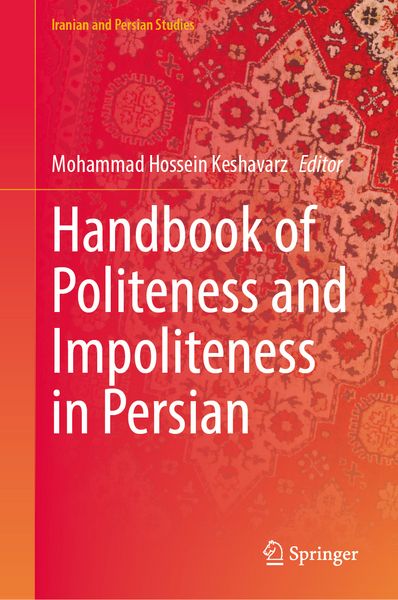
Handbook of Politeness and Impoliteness in Persian

10% sparen

142,99 € UVP 160,49 €

inkl. gesetzl. MwSt., Versandkostenfrei


Beschreibung

This ground-breaking book offers an in-depth exploration of the multifaceted nature of politeness and impoliteness in Persian, shedding light on how these communicative strategies are deeply woven into the sociocultural fabric of Iranian society. Anchored in rigorous scholarship, it examines the ways...

Beschreibung

This ground-breaking book offers an in-depth exploration of the multifaceted nature of politeness and impoliteness in Persian, shedding light on how these communicative strategies are deeply woven into the sociocultural fabric of Iranian society. Anchored in rigorous scholarship, it examines the ways in which Persian speakers manage face, navigate social hierarchies, and express solidarity or dissent through language. From the ritualized and often paradoxical practice of 
ta’ārof
to subtle pragmatic cues that signal respect, resistance, or relational alignment, the chapters reveal how linguistic behavior reflects broader cultural values and social expectations. Bringing together leading scholars and experienced practitioners
in the fields of pragmatics, sociolinguistics, and cultural studies, the volume offers a rich interdisciplinary perspective on Persian interactional norms. It investigates both everyday exchanges and institutional discourse, highlighting the dynamic interplay between language, identity, and power. By situating Persian politeness phenomena within a global framework, the book challenges Western-centric models and contributes to a more inclusive understanding of linguistic etiquette and interpersonal communication. It is an essential resource for scholars, educators, and students in the fields of pragmatics, sociolinguistics, anthropology, and cultural linguistics, in particular those interested in the politeness features of non-Western languages and the cultural dimensions of discourse.

Portrait


Mohammad Hossein Keshavarz
 is Professor of Applied Linguistics and Head of ELT Department at Girne American University in North Cyprus. He holds an MA in Applied Linguistics and TEFL from Ohio University, USA, and a PhD in Applied Linguistics from the University of Wales, UK. He has published extensively in peer-reviewed international journals, including Pragmatics and Society, International Journal of Applied Linguistics, Language in Society, International Journal of Bilingualism, Contrastive Pragmatics, WORD, English for Academic Purposes, Journal of Psycholinguistic Research, Communication Disorders Quarterly, International Journal of Bilingual Education and Bilingualism, Reading in a Foreign Language, Educational Research, and TESOL Journal. He has also authored or co-authored over twenty academic books in English. His recently published books include:
The Handbook of Persian Carpets: Cultural and Semiotic Perspectives
(Springer Nature, 2025),
Trends in Persian Language, Literature, and Pedagogy
(Springer Nature, 2025),
A New Analytical Model of Cultural Linguistics
(Cambridge Scholars, 2023), and
Parse Two-Volume Bilingual Dictionary
(Rahnama Press, 2023). His research interests span Sociolinguistics, Pragmatics, Cultural Linguistics, First and Second Language Acquisition, and Semiotics.


Produktdetails

Einband

Gebundene Ausgabe

Erscheinungsdatum

19.05.2026

Abbildungen

XIX, 440 p. 23 illus., 21 illus. in color.

Herausgeber Mohammad Hossein Keshavarz

Produktdetails

Einband

Gebundene Ausgabe

Erscheinungsdatum

19.05.2026

Abbildungen

XIX, 440 p. 23 illus., 21 illus. in color.

Herausgeber Mohammad Hossein Keshavarz
Verlag Springer Singapore
Seitenzahl

440

Maße (L/B/H)

24,1/16/3,1 cm

Gewicht

800 g

Auflage

1. Auflage

Sprache

Englisch

ISBN

978-981-9545-92-6

Herstelleradresse

Springer-Verlag GmbH
Europaplatz 3
69115 Heidelberg
DE

Email: ProductSafety@springernature.com

Ein neues Kapitel für Ihre Bücher

Ein neues Kapitel für Ihre Bücher

Schenken Sie Ihren alten Schätzen ein zweites Leben und erhalten Sie dafür eine Thalia Geschenkkarte.

Jetzt verkaufen
Jetzt verkaufen

Noch keine Bewertungen vorhanden

Verfassen Sie die erste Bewertung zu diesem Artikel

Helfen Sie anderen Kundinnen und Kunden durch Ihre Meinung.

Kundinnen und Kunden meinen

Bewertungen (0)

  • Produktbild: Handbook of Politeness and Impoliteness in Persian

  • Politeness and Impoliteness: With Special Emphasis on Persian.- Native Persian Speakers' Perceptions of Impoliteness of Requestive Speech Act: A Cross-generational Perspective.- A Mixed-Methods Investigation of Politeness in Iranian Human-AI Interaction: A Culturally Situated Approach to Politeness.- Teaching ‘Conduct’ and ‘Etiquette’ Politeness by Non-native Persian Teachers: A Qualitative Study.- Navigating Politeness in Persian WhatsApp Messages: Insights from Applied Linguistics Discourse Community.- The use of directive speech acts in Persian with emphasis on gender and exposure to English.- Inclusive Pronoun Meshma in the Sistani Dialect of Persian as a Pragmatic Indicator of Politeness.- A Semio-Cultural Exploration of Politeness and Social Dynamics in About Elly.- A Comparative Study of Suggestion Strategies in Persian and English: Evidence from Two Movies.- Over-politeness among the New Generation of Iranian Youth: “Ta’ārof” and “Rudarbāyesti” in Focus.- Cinematic Impoliteness in Marginalized Persian Families: A Cultural Linguistics and Pragmatic Analysis.- Politeness Markers in Persian Requests: A Pragmatic Analysis.- Exploring Face-Threatening Acts and (Im)politeness in Persian Discourse: A Study in Tehran.