















































KI-Beratung Beta

Gutscheinbedingungen

Gültig bis 11.11.2026 | Gültig für Spielzeug, Filme, Musik, Software, Games, Geschenke & Trends, Schreibwaren, Hörbücher und Hörbuch-Downloads (außer Abo & Shelfies), gebrauchte Bücher, nicht preisgebundene Bücher und Kalender | Einlösbar unter thalia.de und in der Thalia App | Click & Collect nur mit Online-Zahlung (Paypal/Kreditkarte) vorab | Einzelne Artikel können ausgeschlossen sein | Nicht kombinierbar mit anderen Gutscheinen oder Preisaktionen | Nur einmal pro Einkauf einlösbar | Gutschein wird auf max. 500€ Bestellwert angerechnet | Keine Barauszahlung | Digitale Hörbücher nur für Android  | Nicht gültig für preisgebundene Artikel (aufgrund der Buchpreisbindung sind Gutscheine nicht auf Bücher, eBooks, Presse einlösbar), tolino eReader & Zubehör, Abonnements & Flatrates, Geschenkkarten, Versandkosten und Services

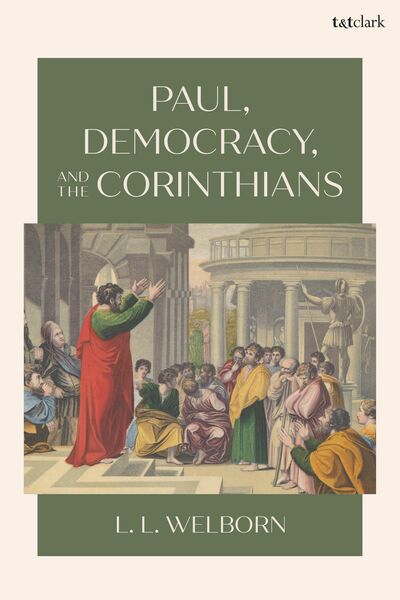
Produktbild: Paul, Democracy, and the Corinthians

Paul, Democracy, and the Corinthians

28,99 €

inkl. gesetzl. MwSt., Versandkostenfrei


Beschreibung

In this short and remarkable book L.L. Welborn outlines the complex and contested nature of 'democracy' in the Greek cities of the Roman East, where the apostle Paul established Christ groups, showing that writings of Paul and the development of Christianity reveal a strong and radical form of democracy...

Beschreibung

In this short and remarkable book L.L. Welborn outlines the complex and contested nature of 'democracy' in the Greek cities of the Roman East, where the apostle Paul established Christ groups, showing that writings of Paul and the development of Christianity reveal a strong and radical form of democracy that holds ever-greater relevance in today's contentious political landscape.
Welborn begins by showing how, paradoxically, language around the concept of democracy is largely absent from political thinkers in the first century. By contrast, we learn that Paul's Corinthian correspondence is full of vocabulary associated with democracy, not only the term we know as "Church" (ekkesia) or "people's assembly", which the Christ-group adopted as a self-designation, but other terms with a democratic history and resonance such as eleutheria ("freedom"), paressia ("freedom of speech"), koinomia ("partnership"), isotes ("equality"). Moreover, as Welborn shows, several passages give evidence of democratic practices, such as voting (2 Cor. 2:6-8). Especially significant is the revelation that women were praying and prophesying in the assembly (1 Cor. 11:5), enacting a radical extension of the democratic-egalitarian ethos.
In these chapters Welborn assesses the complex evidence of Paul's Corinthian epistles in an attempt to answer the question: How "democratic" was the assembly of Christ followers at Corinth? If, as Welborn suggests, the answer is exceptionally "democratic," at least in comparison with the political regime of first-century Roman Corinth, what consequence might this discovery have for those who are concerned about the failure of democracy today?

Produktdetails

Einband

Taschenbuch

Erscheinungsdatum

19.03.2026

Verlag T. & T. Clark Ltd.
Seitenzahl

240

Produktdetails

Einband

Taschenbuch

Erscheinungsdatum

19.03.2026

Verlag T. & T. Clark Ltd.
Seitenzahl

240

Maße (L/B/H)

22,9/15,3/1,8 cm

Gewicht

280 g

Sprache

Englisch

ISBN

978-0-567-72533-2

Herstelleradresse

Libri GmbH
Europaallee 1
36244 Bad Hersfeld
DE

Email: gpsr@libri.de

Ein neues Kapitel für Ihre Bücher

Ein neues Kapitel für Ihre Bücher

Schenken Sie Ihren alten Schätzen ein zweites Leben und erhalten Sie dafür eine Thalia Geschenkkarte.

Jetzt verkaufen
Jetzt verkaufen

Noch keine Bewertungen vorhanden

Verfassen Sie die erste Bewertung zu diesem Artikel

Helfen Sie anderen Kundinnen und Kunden durch Ihre Meinung.

Kundinnen und Kunden meinen

Bewertungen (0)

Die Leseprobe wird geladen.
  • Produktbild: Paul, Democracy, and the Corinthians
  • Acknowledgements
    Abbreviations
    Prologue
    1. Democracy, Real and Imagined, in Early Christianity and in Greco-Roman Antiquity
    2. "Any Woman Praying or Prophesying" (1 Corinthians 11:5): The Radicalization of a Democratic Ethos in the Christ Group at Corinth
    3. "There Must Be Factions" (1 Corinthians 11:19): Paul's Revival of a Subterranean Stream of Greek Political Thought
    4. "Has Christ Been Split into Parties?" (1 Corinthians 1:10): Paul's Attempt to Restrain Factional Conflict in the Body of Christ
    5. "That There May Be Equality" (2 Corinthians 8:13-15): Paul's Extension of a Democratic Principle into the Economic Sphere
    6. How "democratic" was the ekklesia of Christ Followers at Corinth?
    7. Epilogue
    Bibliography
    Index of Ancient References
    Index of Names