















































KI-Beratung Beta

Gutscheinbedingungen

Gültig bis 30.11.2026 | Gültig für nicht preisgebundene fremdsprachige Bücher | Einzelne Artikel können ausgeschlossen sein | Online auf thalia.de und in der Thalia App einlösbar | Click & Collect nur mit Online-Zahlung (Paypal/Kreditkarte) vorab | Nicht kombinierbar mit anderen Gutscheinen oder Preisaktionen | Nur einmal pro Einkauf einlösbar | Gutschein wird auf max. 500€ Bestellwert angerechnet | Keine Barauszahlung | Nicht gültig für Versandkosten und Services

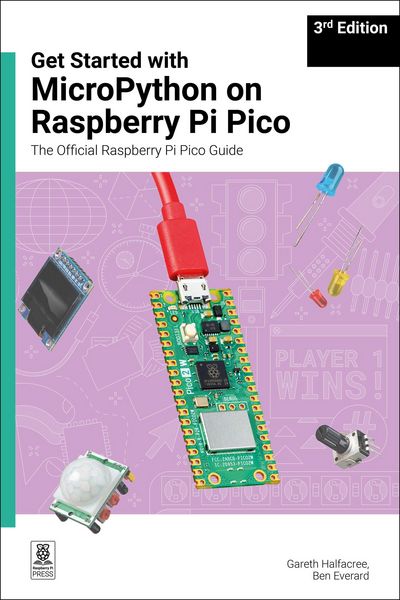
Produktbild: Get Started with MicroPython on Raspberry Pi Pico
Vorbesteller Neu

Get Started with MicroPython on Raspberry Pi Pico The Official Raspberry Pi Pico Guide

19,99 €

inkl. gesetzl. MwSt., Versandkostenfrei


Beschreibung

Microcontrollers, like the RP2350 chip at the heart of Raspberry Pi Pico 2, are computers stripped back to their bare essentials. You don't use monitors or keyboards with them — instead, you program them over USB to take their input from (and send their output to) on-board input/output pins.

Using these...

Beschreibung

Microcontrollers, like the RP2350 chip at the heart of Raspberry Pi Pico 2, are computers stripped back to their bare essentials. You don't use monitors or keyboards with them — instead, you program them over USB to take their input from (and send their output to) on-board input/output pins.

Using these programmable connections, you can light LEDs, make noises, send text to screens, and much more. In Get started with MicroPython on Raspberry Pi Pico 2nd Edition, you will learn how to use the beginner-friendly MicroPython language to write programs, and you’ll connect up hardware to make your Raspberry Pi Pico interact with the world around it. Using these skills, you can create your own electromechanical projects.

Fully updated for the latest version of MicroPython and Raspberry Pi Pico boards, this book shows you how to:

  • Get started with Raspberry Pi Pico 2 and Pico 2 W, as well as the original Pico and Pico W
  • Work with various electronic components
  • Create your own programmable electronic contraptions
  • Turn Pico 2 W into a network-connected node for the Internet of Things
  • Link your Pico 2 W to your smartphone, tablet, or another Pico 2 W with Bluetooth Low Energy (BLE)

Whether you’re using Raspberry Pi Pico for a home project, industrial automation, or learning (or teaching!) electronics and programming, this book will show you how.

  • Chapter 1: Get to know your Raspberry Pi Pico
  • Chapter 2: Programming with MicroPython
  • Chapter 3: Physical computing
  • Chapter 4: Physical computing with Raspberry Pi Pico
  • Chapter 5: Traffic light controller
  • Chapter 6: Reaction game
  • Chapter 7: Burglar alarm
  • Chapter 8: Temperature gauge
  • Chapter 9: Data logger
  • Chapter 10: Digital communication protocols: I2C and SPI
  • Chapter 11: Wi-Fi connectivity with Pico W
  • Chapter 12: Bluetooth connectivity with Pico W
  • Appendix A: Raspberry Pi Pico specifications
  • Appendix B: Pinout guide
  • Appendix C: Programmable I/O

Produktdetails

Einband

Taschenbuch

Erscheinungsdatum

27.03.2027

Verlag Raspberry Pi Press
Seitenzahl

192

Produktdetails

Einband

Taschenbuch

Erscheinungsdatum

27.03.2027

Verlag Raspberry Pi Press
Seitenzahl

192

Auflage

3 Revised edition

Sprache

Englisch

ISBN

978-1-916868-69-4

Herstelleradresse

Libri GmbH
Europaallee 1
36244 Bad Hersfeld
DE

Email: gpsr@libri.de

Ein neues Kapitel für Ihre Bücher

Ein neues Kapitel für Ihre Bücher

Schenken Sie Ihren alten Schätzen ein zweites Leben und erhalten Sie dafür eine Thalia Geschenkkarte.

Jetzt verkaufen
Jetzt verkaufen

Noch keine Bewertungen vorhanden

Verfassen Sie die erste Bewertung zu diesem Artikel

Helfen Sie anderen Kundinnen und Kunden durch Ihre Meinung.

Kundinnen und Kunden meinen

Bewertungen (0)

Die Leseprobe wird geladen.
  • Produktbild: Get Started with MicroPython on Raspberry Pi Pico
    • Chapter 1: Get to know your Raspberry Pi Pico
    • Chapter 2: Programming with MicroPython
    • Chapter 3: Physical computing
    • Chapter 4: Physical computing with Raspberry Pi Pico
    • Chapter 5: Traffic light controller
    • Chapter 6: Reaction game
    • Chapter 7: Burglar alarm
    • Chapter 8: Temperature gauge
    • Chapter 9: Data logger
    • Chapter 10: Digital communication protocols: I2C and SPI
    • Chapter 11: Wi-Fi connectivity with Pico W
    • Chapter 12: Bluetooth connectivity with Pico W
    • Appendix A: Raspberry Pi Pico specifications
    • Appendix B: Pinout guide
    • Appendix C: Programmable I/O