















































KI-Beratung Beta

Gutscheinbedingungen

Gültig bis 30.11.2026 | Gültig für nicht preisgebundene fremdsprachige Bücher | Einzelne Artikel können ausgeschlossen sein | Online auf thalia.de und in der Thalia App einlösbar | Click & Collect nur mit Online-Zahlung (Paypal/Kreditkarte) vorab | Nicht kombinierbar mit anderen Gutscheinen oder Preisaktionen | Nur einmal pro Einkauf einlösbar | Gutschein wird auf max. 500€ Bestellwert angerechnet | Keine Barauszahlung | Nicht gültig für Versandkosten und Services

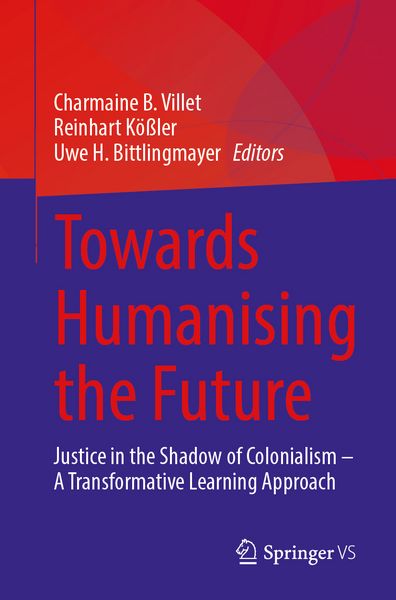
Produktbild: Towards Humanising the Future

Towards Humanising the Future Justice in the Shadow of Colonialism – A Transformative Learning Approach

128,99 €

inkl. gesetzl. MwSt., Versandkostenfrei


Beschreibung

Education is intertwined with social justice in multivarious ways, and it takes place in historically defined contexts. The proposed collective volume brings together a range of perspectives from an interdisciplinary array of social sciences with a clear focus on education. The authors include academics...

Beschreibung

Education is intertwined with social justice in multivarious ways, and it takes place in historically defined contexts. The proposed collective volume brings together a range of perspectives from an interdisciplinary array of social sciences with a clear focus on education. The authors include academics and some activists from Namibia and Germany. The contributions are centred on current issues and challenges, but in particular on account of the binational composition of the authors, the historical context of German colonial rule and the 1903-1908 genocide also form a focus of attention. However, the contributions do not rehearse history only or exclusively. Authors address an array of current issues, ranging from social justice to the issues of recognition, apology, and reparation connected with the genocide. The latter issue is connected in many ways with the questions of justice and equity as well as with the persistent high social inequality that besets Namibia. It affects the psycho-social well-being of learners and their family relations, but relates also to class room practice and the syllabus. One main concern here, motivated especially by educational considerations, is transgenerational trauma in the wake of the genocide. As has been shown in other, more intensely researched cases, most notably the Holocaust, trauma sustained from experiences of large-scale violence including mass killings, genocide or concentration camps may be transmitted to survivors’ posterity through several generations. In Namibia, various discourses among victim communities speak to this circumstance. The proposed volume addresses these issues from the various perspectives of educational science, history, philosophy, sociology, and public health. It addresses communal memory practices, which keep oral traditions alive. It also looks at curricular issues and various aspects of teaching practice, in particular approaches centred on social change.

Portrait


Uwe H. Bittlingmayer
studied Sociology, Philosophy and Political Science at the Institute of Sociology, Muenster University. He made his PhD at the same institute with a critical study about the knowledge society. Later on he worked in several third-funded projects at Bielefeld University at the Faculty of Public Health. Finally, he became full professor for general sociology at the Institute of Sociology at the University of Education Freiburg. 


Reinhart Kößler
studied sociology, history, in particular Eastern European history and ethnology at the University of Heidelberg and Chinese Studies at the University of Leeds. He took his doctorate in sociology 1978 at the University of Münster and his senior doctorate (Habilitation) in 1987 also at Münster. He pursues a long-time interest in southern Africa, for many years with a focus on Namibia, combining scholarly and activist pursuits. After retiring as Director of the Arnold-Bergstraesser-Institut Freiburg in 2015, he remains an associate there as well as at the Department of Anthropology at the University of the Free State, South Africa. 


Charmaine Villet
completed her Ph.D. studies in Curriculum and Instructional Leadership at Ohio University in the USA. She teaches in the Department of Applied Educational Sciences in the School of Education at the University of Namibia. Charmaine participated and led prominent studies on educational reform and transformation with the World Bank, UNESCO, the EU, the AU and in Namibia and the SADC region. She served as the co-chair of the International Taskforce on Teachers for Education 2030/UNESCO from 2016 – 2018 and heads the sub-cluster on Curriculum, Teaching and Learning in Higher Education under the African Union’s Continental Education Strategy for Africa/ CESA 2016-25 as articulated in the African Union’s vision of Agenda 2063: The Africa We Want.

Produktdetails

Einband

Taschenbuch

Erscheinungsdatum

29.05.2026

Abbildungen

XV, 207 p. 9 illus.

Herausgeber Charmaine B. Villet + weitere

Produktdetails

Einband

Taschenbuch

Erscheinungsdatum

29.05.2026

Abbildungen

XV, 207 p. 9 illus.

Herausgeber
Verlag Springer
Seitenzahl

207

Maße (L/B/H)

23,5/15,5/1,3 cm

Gewicht

347 g

Sprache

Englisch

ISBN

978-3-032-18256-2

Herstelleradresse

Springer-Verlag KG
Sachsenplatz 4-6
1201 Wien
AT

Email: ProductSafety@springernature.com

Ein neues Kapitel für Ihre Bücher

Ein neues Kapitel für Ihre Bücher

Schenken Sie Ihren alten Schätzen ein zweites Leben und erhalten Sie dafür eine Thalia Geschenkkarte.

Jetzt verkaufen
Jetzt verkaufen

Noch keine Bewertungen vorhanden

Verfassen Sie die erste Bewertung zu diesem Artikel

Helfen Sie anderen Kundinnen und Kunden durch Ihre Meinung.

Kundinnen und Kunden meinen

Bewertungen (0)

  • Produktbild: Towards Humanising the Future
  • Chapter 1. Introduction.- Part I: Burdens of History.- Chapter 2. Addressing the Intergenerational Trauma of the People of Namibia through Transformative Higher Education.- Chapter 3. Generational Trauma: The Impact of Genocide on Gender Relations in Namibia.- Chapter 4. German Postcolonial Entanglements – Namibia and Beyond.- Part II: Social Justice.- Chapter 5. Social Justice in Postcolonial Namibia: Whose Justice? What Justice? Which Rationality?.- Chapter 6. Justice. On the Importance to Recognize Dignity and Social Equity as Two Sides of the Same Coin.- Chapter 7. Justice and Fairness in Negotiations: On Genocide and Reparations.- Chapter 8. Bringing Justice to the Dead. The Open and Seemingly Desolated Old Location Cemetery in Kramersdorf, Swakopmund.-  Part III: Challenges of Teaching.- Chapter 9. Facing History, Teaching for change and social action.- Chapter 10. The Curriculum Coverage of Genocide Studies in Namibian Schools and Pedagogical Issues.- Chapter 11. A Comparative Analysis of Life Skills Education in Namibia and Germany – and what we can learn from each other and for the future.- Chapter 12. Life Skills in Home Economics.- Part IV: Venues of Remembrance.- Chapter 13. Learning to See History whilst Listening. Acoustic Echoes of German Colonialism in Namibia – Memory Cultures in Museums and Exhibitions.- Chapter 14. Germany and Namibia: Laying Bare Layers of Memory to Dismantle the Past for the Future. The Way Forward. Final remarks.