















































KI-Beratung Beta

Gutscheinbedingungen

Gültig bis 11.11.2026 | Gültig für Spielzeug, Filme, Musik, Software, Games, Geschenke & Trends, Schreibwaren, Hörbücher und Hörbuch-Downloads (außer Abo & Shelfies), gebrauchte Bücher, nicht preisgebundene Bücher und Kalender | Einlösbar unter thalia.de und in der Thalia App | Click & Collect nur mit Online-Zahlung (Paypal/Kreditkarte) vorab | Einzelne Artikel können ausgeschlossen sein | Nicht kombinierbar mit anderen Gutscheinen oder Preisaktionen | Nur einmal pro Einkauf einlösbar | Gutschein wird auf max. 500€ Bestellwert angerechnet | Keine Barauszahlung | Digitale Hörbücher nur für Android  | Nicht gültig für preisgebundene Artikel (aufgrund der Buchpreisbindung sind Gutscheine nicht auf Bücher, eBooks, Presse einlösbar), tolino eReader & Zubehör, Abonnements & Flatrates, Geschenkkarten, Versandkosten und Services

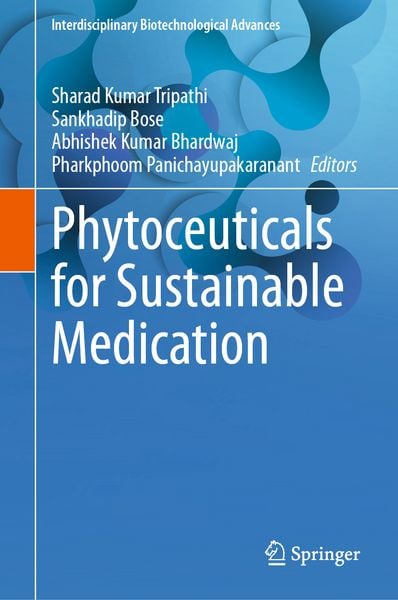
Produktbild: Phytoceuticals for Sustainable Medication
- 10%

Phytoceuticals for Sustainable Medication

10% sparen

142,99 € UVP 160,49 €

inkl. gesetzl. MwSt., Versandkostenfrei


Beschreibung

Produktdetails

Einband

Gebundene Ausgabe

Erscheinungsdatum

17.04.2026

Abbildungen

XIV, 397 p. 27 illus., 24 illus. in color.

Herausgeber

Sharad Kumar Tripathi + weitere

Verlag

Springer Singapore

Seitenzahl

397

Maße (L/B/H)

24,1/16/2,8 cm

Gewicht

730 g

Auflage

1. Auflage

Sprache

Englisch

ISBN

978-981-9575-87-9

Beschreibung

Portrait


Dr. Sharad Kumar Tripathi is an Assistant Professor in the Department of Life Sciences at the Arni School of Basic Sciences & Biotechnology, Arni University, Kangra, Himachal Pradesh, India. He earned his Ph.D. from the Central University of Allahabad (Prayagraj) and completed postdoctoral research at the ICAR–Directorate of Medicinal and Aromatic Plants Research, Anand, Gujarat, focusing on the quantification, isolation, and molecular identification of phytochemicals from Garcinia species of North-East India. His research interests include phytochemical characterization and bioprospection of medicinal and aromatic plants. He teaches plant sciences, ethnobotany, and ethnopharmacology at undergraduate and postgraduate levels, and has supervised over 20 postgraduate projects and one Ph.D. scholar. He received the Young Scientist Award in 2019 from the Botanical Society of India and GESA India.


Dr. Sankhadip Bose is Professor and Head of the School of Pharmacy at The Neotia University, West Bengal, India. He has over 19 years of academic experience, including long-term service at Maulana Abul Kalam Azad University of Technology, where he guided more than 20 M.Pharm research projects. He has successfully completed a Central Government–funded research project supported by the Department of Science and Technology (DST), Government of India. One Ph.D. has been awarded under his supervision, and seven doctoral projects are currently ongoing across The Neotia University and Maulana Abul Kalam Azad University of Technology. He is a life member of SPER and serves as a CEC member of the Association of Pharmaceutical Teachers of India (APTI).


Dr. Abhishek Kumar Bhardwaj is an Assistant Professor in the Department of Environmental Science, Amity School of Life Sciences, Amity University, Gwalior, Madhya Pradesh, India. He earned his Ph.D. from the Central University of Allahabad (Prayagraj) on drinking water disinfection using green‑synthesized metal nanoparticles and completed postdoctoral research in the Department of Environmental Science at VBS Purvanchal University, Jaunpur. He teaches postgraduate students of Environmental Science and contributes to university administration through various academic and organizing committees. His research interests include green synthesis of nanomaterials for water purification, biosensing, nanodevice fabrication, advanced water treatment, diatom and mushroom cultivation, phytoremediation, and sustainable waste management. He is a life member of several national and international scientific societies.


Dr. Pharkphoom Panichayupakaranant is a Professor in the Department of Pharmacognosy and Pharmaceutical Botany, Faculty of Pharmaceutical Sciences, Prince of Songkla University, Thailand. His research focuses on the development of herbal products using green extraction technologies, standardization strategies, active‑constituent‑enriched extracts, and medicinal plant tissue culture systems. In 2021, he received the Dushdi Mala Medal of Arts and Sciences (Pin of Scientific Arts), conferred by His Majesty the King of Thailand, in recognition of his outstanding contributions to scientific research and national innovation. He holds 17 patents and 21 petty patents related to herbal product development. His work has earned multiple international invention awards, including gold medals and special recognitions from major exhibitions in Germany, Korea, Switzerland, Taiwan, Poland, Malaysia, and Belgium.

Produktdetails

Einband

Gebundene Ausgabe

Erscheinungsdatum

17.04.2026

Abbildungen

XIV, 397 p. 27 illus., 24 illus. in color.

Herausgeber

Verlag

Springer Singapore

Seitenzahl

397

Maße (L/B/H)

24,1/16/2,8 cm

Gewicht

730 g

Auflage

1. Auflage

Sprache

Englisch

ISBN

978-981-9575-87-9

Herstelleradresse

Springer-Verlag GmbH
Europaplatz 3
69115 Heidelberg
DE

Email: ProductSafety@springernature.com

Ein neues Kapitel für Ihre Bücher

Ein neues Kapitel für Ihre Bücher

Schenken Sie Ihren alten Schätzen ein zweites Leben und erhalten Sie dafür eine Thalia Geschenkkarte.

Jetzt verkaufen
Jetzt verkaufen

Noch keine Bewertungen vorhanden

Verfassen Sie die erste Bewertung zu diesem Artikel

Helfen Sie anderen Kundinnen und Kunden durch Ihre Meinung.

Kundinnen und Kunden meinen

Bewertungen (0)

  • Produktbild: Phytoceuticals for Sustainable Medication

  • Chapter 1.  Green Technology for Phytochemicals.- Chapter 2. Approaches of Biotechnology in Phytochemicals.- Chapter 3. Novel Pharmaceutical Technologies in the Development of Phytopharmaceuticals.- Chapter 4. Epigenetic Reprogramming by Endophytes: Unlocking Silent Biosynthetic Gene Clusters for Next-Generation Phytopharmaceuticals.- Chapter 5. Endophyte-Mediated Biosynthesis of Valuable Secondary Metabolites.- Chapter 6. The Role of PGPRs in Enhancing the Quality and Production of Medicinally Important Plants.- chapter 7. Quality Approaches for Phytochemicals.- Chapter 8. Phytochemicals Potentially Applied for Non-Communicable Diseases.- Chapter 9. Phytochemicals Potentially Applied for Dermatological Diseases.- Chapter 10. Phytochemicals Potentially Applied for Infectious Diseases.- Chapter 11. Phytochemicals Potentially Applied for Emerging Diseases.- Chapter 12. Terpenoids in Healthcare Management.- Chapter 13. Medicinal Plants for Sustainable Healthcare.