















































KI-Beratung Beta

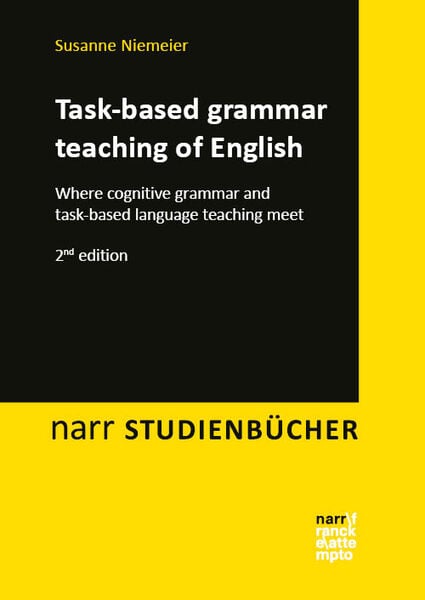
Produktbild: Task-based grammar teaching of English

Task-based grammar teaching of English Where cognitive grammar and task-based language teaching meet

Aus der Reihe Narr Studienbücher

29,99 €

inkl. gesetzl. MwSt., Versandkostenfrei


Beschreibung

Produktdetails

Einband

Taschenbuch

Erscheinungsdatum

27.04.2026

Verlag

Narr Francke Attempto

Seitenzahl

316

Maße (L/B/H)

16,8/24,7/2,1 cm

Gewicht

592 g

Auflage

2nd revised edition

Sprache

Englisch

ISBN

978-3-381-10961-6

Beschreibung

Produktdetails

Einband

Taschenbuch

Erscheinungsdatum

27.04.2026

Verlag

Narr Francke Attempto

Seitenzahl

316

Maße (L/B/H)

16,8/24,7/2,1 cm

Gewicht

592 g

Auflage

2nd revised edition

Sprache

Englisch

ISBN

978-3-381-10961-6

Herstelleradresse

Narr Dr. Gunter
Dischingerweg 5
72070 Tübingen
DE

Ein neues Kapitel für Ihre Bücher

Ein neues Kapitel für Ihre Bücher

Schenken Sie Ihren alten Schätzen ein zweites Leben und erhalten Sie dafür eine Thalia Geschenkkarte.

Jetzt verkaufen
Jetzt verkaufen

Noch keine Bewertungen vorhanden

Verfassen Sie die erste Bewertung zu diesem Artikel

Helfen Sie anderen Kundinnen und Kunden durch Ihre Meinung.

Kundinnen und Kunden meinen

Bewertungen (0)

  • Produktbild: Task-based grammar teaching of English
  • 0. IntroductionPART I: Didactic and linguistic theory1. Grammar in the foreign language classroom1.1 Current situation1.2 A brief history of grammar teaching2. Task-based language teaching2.1 The development of task-based language teaching2.2 The task cycle2.2.1 Pre-task2.2.2 Task2.2.3 Language focus2.3 The role of grammar in task-based language teaching3. Cognitive grammar3.1 The development of cognitive linguistics3.1.1 Embodiment3.1.2 Lexis-grammar continuum3.1.3 Categorization3.1.4 Usage-based perspective3.1.5 Perspective on language acquisition3.2 The cognitive grammar perspective on language3.2.1 The centrality of meaning3.2.2 Construal3.3 Pedagogical applications of cognitive grammar3.3.1 Advantages of applied cognitive grammar3.3.2 Research on applied cognitive grammar4. Cognitive grammar and task-based language teachingPART II: Case Studies5. Tense5.1 A cognitive grammar perspective on tense5.2 The present tense5.2.1 Form5.2.2 Meaning5.2.3 Communicative situation and didactic reduction5.2.4 The task cycle5.2.5 Alternatives5.3 The past tense5.3.1 Form5.3.2 Meaning5.3.3 Communicative situation and didactic reduction5.3.4 The task cycle5.3.5 Alternatives5.4 The present perfect5.4.1 Form5.4.2 Meaning5.4.3 Communicative situation and didactic reduction5.4.4 The task cycle5.4.5 Alternatives6. Aspect6.1 Form6.2 Meaning6.2.1 Lexical aspect6.2.2 Grammatical aspect6.2.3 Non-prototypical uses of aspect6.3 Communicative situation and didactic reduction6.4 The task cycle6.5 Alternatives7. Modality7.1 Form7.2 Meaning7.2.1 Root modality7.2.2 Epistemic modality7.3 Communicative situation and didactic reduction7.4 Alternatives8. Reported speech8.1 Form8.2 Meaning8.2.1 Deixis8.2.2 Temporal shifts8.3 Communicative situation and didactic reduction8.4 The task cycle8.5 Alternatives9. Conditionals9.1 Form9.2 Meaning9.2.1 Mental Space Theory9.2.2 Potentiality space9.3 Communicative situation and didactic reduction9.4 The task cycle9.5 Alternatives10. The passive voice10.1 Form10.2 Meaning10.2.1 Highlighting function10.2.2 Research results10.3 Communicative situation and didactic reduction10.3 The task cycle10.5 Alternatives11. Prepositions11.1 Form11.2 Meaning11.2.1 Metaphorization11.2.2 Proto-scenes11.3 Communicative situation and didactic reduction11.4 The task cycle11.5 Alternatives12. Phrasal verbs12.1 Form12.2 Meaning12.2.1 Semantic networks of the particles12.2.2 Analyses of the particles up, down, out and in12.3 Communicative situation and didactic reduction12.4 The task cycle12.5 Alternatives13. Verb complementation13.1 Form13.2 Meaning13.2.1 Iconicity13.2.2 The complementizers13.3 Communicative situation and didactic reduction13.4 The task cycle13.5 Alternatives14. Pronouns14.1 Form14.2 A cognitive-linguistic perspective on pronouns14.3 Personal pronouns14.3.1 Meaning14.3.2 Communicative situation and didactic reduction14.3.3 The task cycle14.3.4 Alternatives14.4 Possessive pronouns14.4.1 Meaning14.4.2 Communicative situation and didactic reduction14.4.3 The task cycle14.4.4 Alternatives15. Articles15.1 Form15.2 Meaning15.2.1 Definiteness vs. indefiniteness15.2.2 Boundedness vs. unboundedness15.3 Communicative situation and didactic reduction15.4 The task cycle15.5 Alternatives16. Conclusion