















































KI-Beratung Beta

Produktbild: Nixon's War with Students

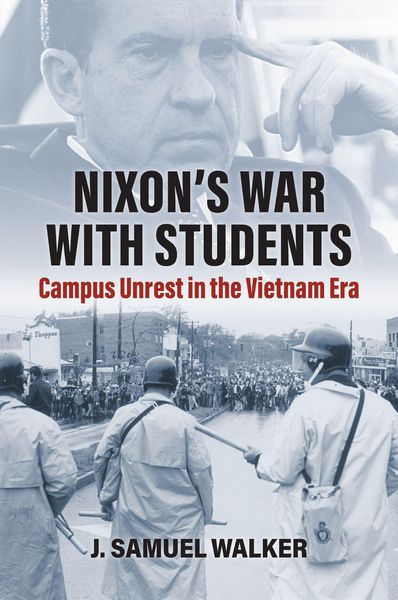
Nixon's War with Students Campus Unrest in the Vietnam Era

39,99 €

inkl. gesetzl. MwSt., Versandkostenfrei


Beschreibung

J. Samuel Walker recounts the dramatic standoff between a populist Republican president and protesting college students—and what the crisis of higher education under President Nixon can teach us today.

College students frustrated with the state of American society and foreign policy under a Republican...

Beschreibung

J. Samuel Walker recounts the dramatic standoff between a populist Republican president and protesting college students—and what the crisis of higher education under President Nixon can teach us today.

College students frustrated with the state of American society and foreign policy under a Republican president, rising up in protest across the country. Sound familiar? With new sources and fresh perspective, esteemed historian J. Samuel Walker studies the campus crisis of the late 1960s and early 1970s under President Richard Nixon, during the protracted conflict in Vietnam and roiling racial tensions in the wake of the Civil Rights Movement.

Walker tells how Nixon’s administration responded to the intense, and sometimes violent, unrest on college campuses across the United States, which became a prominent policy issue during the first four years of his presidency. A Gallup poll taken in May 1970 showed that campus unrest was rated as the “country’s leading problem,” outranking the war, other international questions, racial conflict, crime, and inflation. Nixon was so concerned that he created a presidential commission to study the problem, identify its origins, and recommend ways to restore calm to the nation’s colleges that had erupted in disorder.

But Nixon was of two minds when it came to campus turmoil. On the one hand, he saw it as a problem that needed to be fixed because it threatened the ability of institutions of higher learning to educate their students and to sponsor vital research. On the other hand, it was an irresistible opportunity to take advantage of the popular outrage with student protests. He hoped that attacking dissidents would appeal to the “silent majority” and build a new political coalition that would support his reelection campaign and the fortunes of the Republican Party going forward. Opting for political gain, Nixon dismissed and privately denounced the findings of his own presidential commission before he had even read its report.

Drawing on many unused or littleknown sources, Nixon’s War with Students is the first book to examine campus disturbances as a national political issue—one that is as relevant and important today as it was then.

Produktdetails

Einband

Gebundene Ausgabe

Erscheinungsdatum

18.09.2026

Abbildungen

8 Halftones, black and white

Verlag University Press of Kansas

Produktdetails

Einband

Gebundene Ausgabe

Erscheinungsdatum

18.09.2026

Abbildungen

8 Halftones, black and white

Verlag University Press of Kansas
Seitenzahl

248

Maße (L/B/H)

16,1/23,7/2,2 cm

Gewicht

510 g

Sprache

Englisch

ISBN

978-0-7006-4196-3

Herstelleradresse

Libri GmbH
Europaallee 1
36244 Bad Hersfeld
DE

Email: gpsr@libri.de

Ein neues Kapitel für Ihre Bücher

Ein neues Kapitel für Ihre Bücher

Schenken Sie Ihren alten Schätzen ein zweites Leben und erhalten Sie dafür eine Thalia Geschenkkarte.

Jetzt verkaufen
Jetzt verkaufen

Noch keine Bewertungen vorhanden

Verfassen Sie die erste Bewertung zu diesem Artikel

Helfen Sie anderen Kundinnen und Kunden durch Ihre Meinung.

Kundinnen und Kunden meinen

Bewertungen (0)

Die Leseprobe wird geladen.
  • Produktbild: Nixon's War with Students
  • Preface

    1. The “Indispensable Element of . . . Constructive Protest”

    The Rising Tide of Student Dissent During the 1960s

    2. “Citadels of Freedom . . . Are Under Attack”

    Nixon and Campus Protests, 1969

    3. “A Time of Extraordinary Stress”

    The Crisis of May 1970

    4. “The Country Is Not With These Clowns”

    Nixon and the Scranton Commission Report

    5. “The MD. U. Revolt They Said Could Never Happen”

    The University of Maryland as a Case Study

    Conclusion: “A Sense of Community and Common Purpose”

    Notes

    Essay on Sources

    Index