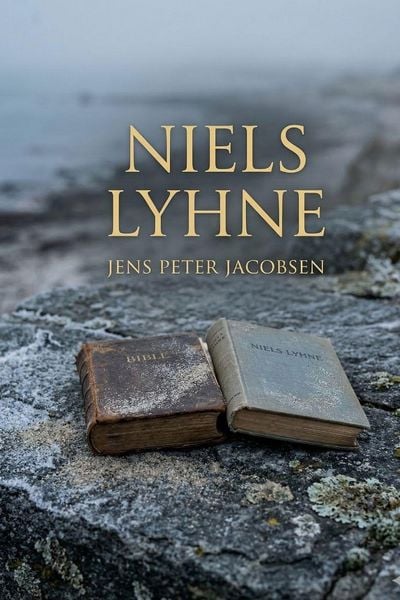
Niels Lyhne
-
- Hardcover
- Taschenbuch ausgewählt
- eBook
-
Sprache:Englisch
- Englisch 28,99 € ausgewählt
- Spanisch 29,99 €
- Türkisch 14,99 €
-
Verlag:Les prairies numériques
- Digireads.com 14,99 €
- Creative Media Partners, LLC 27,99 €
- Alpha Editions 24,99 €
- Anson Street Press 19,99 €
- Wildside Press 17,99 €
- Lushena Books 21,99 €
- Aegypan 18,99 €
- Chicago Review Press Inc DBA Indepe 9,99 €
- Sharp Ink 9,80 €
- Penguin Publishing Group 24,99 €
- Les prairies numériques 28,99 € ausgewählt
- Culturea 20,95 €
- Double 9 Books 18,99 €
28,99 €
inkl. gesetzl. MwSt.,
Beschreibung
Produktdetails
Einband
Taschenbuch
Erscheinungsdatum
01.03.2026
Verlag
Les prairies numériquesSeitenzahl
240
Maße (L/B/H)
22,9/15,2/1,4 cm
Gewicht
396 g
Sprache
Englisch
ISBN
979-10-431-3564-4
Niels Lyhne, an aspiring poet, is torn between the romanticism and faith of the old tradition, and modern notions of realism and reason. His relationship with different women, including his young aunt Edele, a free spirit of Copenhagen, and Mrs. Boye, a passionate artist, only lead him to further disillusionment as he searches for meaning in a rapidly changing world.Published in 1880, Niels Lyhne, Jacobsen's second novel, was not as well received as his first, neither by reviewers nor the public. There wasn't a second printing until after his death in 1885. Niels Lyhne is an 1880 novel written by the Danish author Jens Peter Jacobsen.General description A naturalistic work, Niels Lyhne is considered to be part of the Modern Breakthrough, a style of Realism native to Scandinavia; however, the novel does contain several romantic elements, and it relies and expands on romantic themes (examination of individual struggle and consciousness; artistic expression and inspiration), while it also ironizes them. The story chronicles the titular character's renunciation of his faith, his various bereavements and, ultimately, it depicts his disillusionment and his death. This disillusionment is part and parcel of the work's naturalism-focusing on his failures as a lover and as an artist, Niels Lyhne demonstrates the individual's helplessness and serves as a critique of atheism as well as faith. Georg Lukács cites the novel in his influential Meaning of Contemporary Realism as the "first novel to describe this state of mind of the atheistic bourgeois intelligentsia".[2] Rainer Maria Rilke, in Letters to a Young Poet, cites the Bible and Jacobsen's work as the two books most worth reading. Since a focus of Niels Lyhne is how the nonbeliever deals with death, in pairing this novel with the Bible, Rilke sets the unwary young poet upon the dialectic. Further, this work may be considered a forerunner of the existentialist novels of mid-20th century France.
Ein neues Kapitel für Ihre Bücher
Ein neues Kapitel für Ihre Bücher
Schenken Sie Ihren alten Schätzen ein zweites Leben und erhalten dafür eine Thalia Geschenkkarte.
Noch keine Bewertungen vorhanden
Verfassen Sie die erste Bewertung zu diesem Artikel
Helfen Sie anderen Kundinnen und Kunden durch Ihre Meinung.
Kurze Frage zu unserer Seite
Vielen Dank für Ihr Feedback
Wir nutzen Ihr Feedback, um unsere Produktseiten zu verbessern. Bitte haben Sie Verständnis, dass wir Ihnen keine Rückmeldung geben können. Falls Sie Kontakt mit uns aufnehmen möchten, können Sie sich aber gerne an unseren Kund*innenservice wenden.
zum Kundenservice